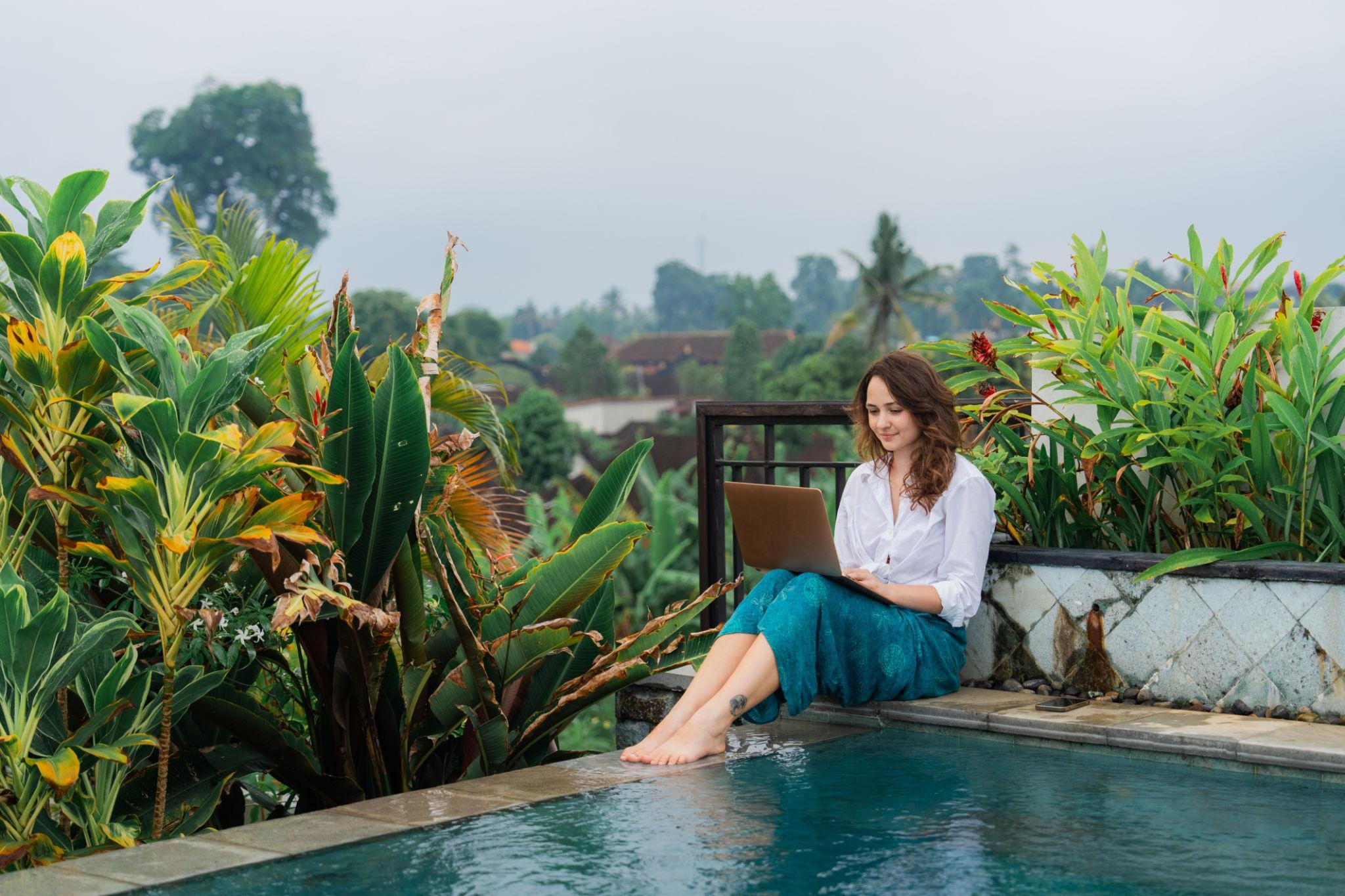
Confessions of a Digital Nomad
Didn’t We Already Debunk This in 2019?
There’s something almost tender about reading a British newspaper in 2026 explaining that working remotely from a villa in Bali might not automatically lead to enlightenment.
The piece in iNews – titled Confessions of a digital nomad – features a thirty-something London escapee who quit the commute, booked a one-way ticket, and landed in Bali only to discover that paradise comes with time zones, loneliness and too many abs.
Apparently, smoothie bowls don’t replace colleagues.
Who knew?
Let’s be clear: the reader’s experience is real. Isolation is real. Career drift is real. The emotional hangover after a big life move is very real. Executive coach Hannah Salton gives thoughtful, reasonable advice. Routines matter. Real-life connections matter. Not every co-working space equals community. Absolutely fair.
But here’s the question nobody is asking loudly enough:
Why are we still framing this as a shocking revelation?
Digital nomadism has been mythologised, demonised, glamorised, monetised and then “debunked” in cycles for over a decade. First it was the Instagram fantasy: laptop by the infinity pool, #freedom, #bosslife. Then came the backlash: loneliness, burnout, no pensions, visa confusion, existential dread at sunset.
Now we’re in phase three: newspapers gently informing us that highlight reels are not real life.
Groundbreaking.
There’s a strange amnesia at play. The same media ecosystem that amplified the fantasy is now positioning itself as the sober adult in the room. “Social media sets high expectations,” they warn. True. But who spent years packaging Bali, Lisbon, Tulum and Barcelona as lifestyle commodities with glossy travel-work hybrids and breathless “Why I quit my job to…” headlines?
Exactly.
What’s interesting is not that one remote worker feels lost. What’s interesting is that we’re still discussing digital nomadism as if it were a personality trait rather than a work configuration.
Remote work is infrastructure. It’s a tool. It’s logistics.
It’s not therapy.
It’s not identity.
It’s not salvation from London rents.
Leaving a city because it’s expensive and depressing doesn’t automatically solve the deeper questions about belonging, ambition or meaning. Changing latitude doesn’t automatically upgrade your emotional firmware.
And Bali – lovely as it is – is not a co-founder.
The real issue in the article isn’t palm trees versus office blocks. It’s structure versus drift. Community versus transience. Time zones versus career momentum. Those are operational problems, not moral failures of “the nomad dream”.
Some people thrive in motion. Others need rootedness. Some need a base plus periodic escape. Some need colleagues in three dimensions. The problem begins when flexibility is sold as universal liberation.
It isn’t.
The irony? Mature remote professionals figured this out years ago. The quiet ones. The ones who don’t post laptop-by-pool photos because they’re busy building systems, long-term client relationships and hybrid lives that include both mobility and routine.
You can work from Bali and feel empty.
You can work from Croydon and feel fulfilled.
You can also feel miserable in both places.
Geography is a multiplier, not a cure.
What the iNews column gets right is the emphasis on intentional community, rhythm, and honest conversations. What it still subtly reinforces is the idea that digital nomadism is a binary choice: paradise or failure.
In reality, it’s a spectrum of arrangements. Base + travel. Seasonal migration. Three months abroad, nine months home. Remote job with structured hours. Freelancing with anchored clients. Village life instead of mega-hubs. Slow over flashy.
And perhaps that’s the uncomfortable truth: the most sustainable remote lives are rarely the most photogenic.
So maybe the better headline in 2026 isn’t “Confessions of a Digital Nomad.”
Maybe it’s:
“Confessions of Someone Who Thought a Location Change Would Solve Structural and Emotional Questions.”
Less catchy, admittedly.
But more honest.
And if there’s one myth worth dismantling now, it’s not that digital nomadism is perfect.
It’s that it was ever meant to be.
The real work – wherever you do it – is still work.