

Desperately Seeking Digital Nomads

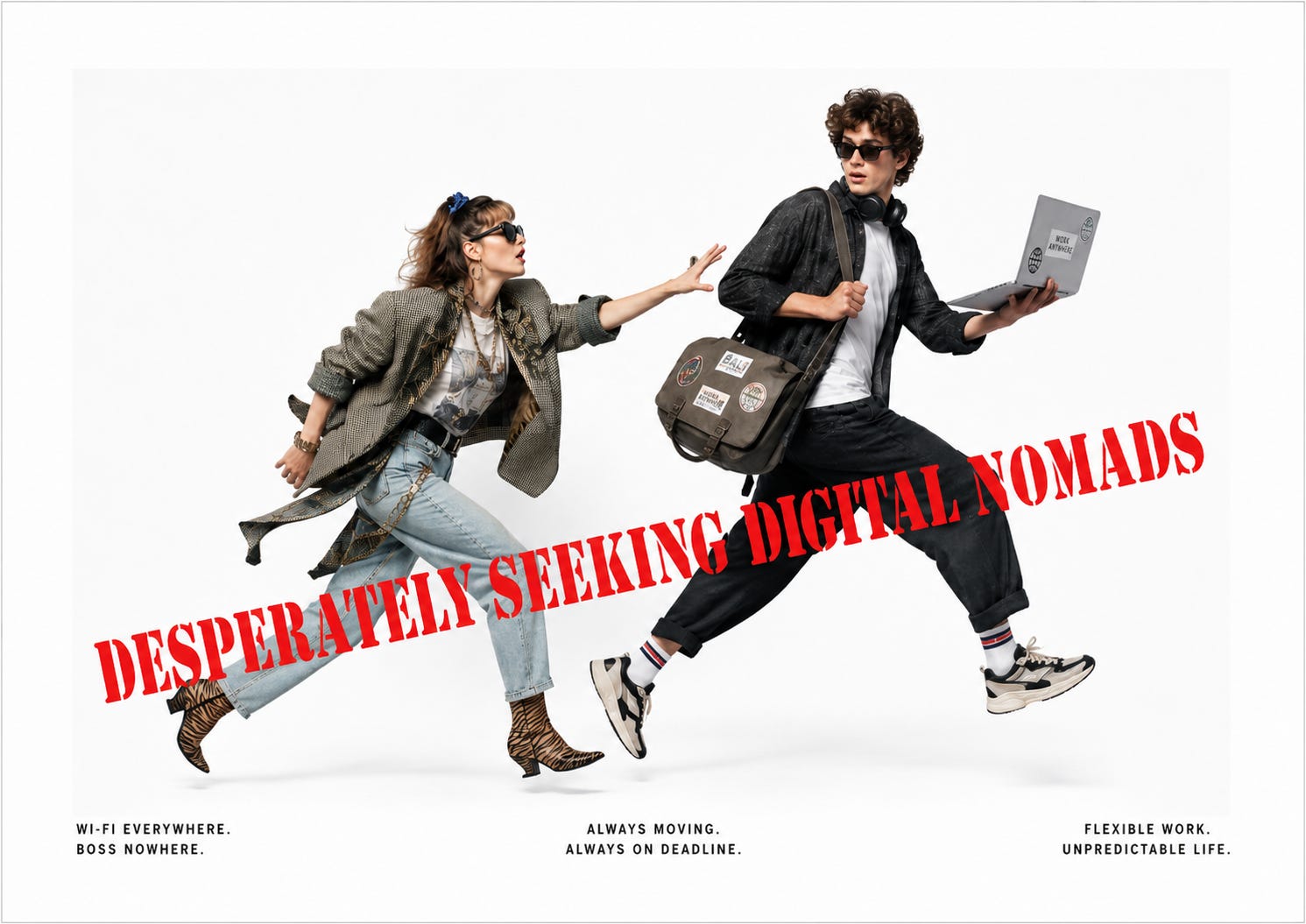
Take one report on hybrid work, add an event, a newly launched flat in a small town, a hotel with Wi-Fi and a few municipalities rebranded as “villages”. Stir vigorously. Congratulations: you have created the digital nomad economy. The only thing still missing may be the nomads.
Translation and brief from the original article published in Italian by Matteo Cerri

A few days ago, the largest newspaper on a certain well-known Italian island published an article about flexible hours, workplace autonomy and digital nomadism. I shall spare you the name of both the paper and the author. Otherwise, this would immediately be reduced to the usual little drama: not a criticism of editorial standards, but the bitter outburst of a jilted boyfriend, a professional grudge, a bruised ego, someone “having a go” at somebody else.
That would be terribly convenient, because it would allow everyone to ignore the real issue. And the issue is not limited to one article, one journalist, one island or even Italy. This particular form of editorial alchemy has become remarkably international: take a genuine shift in the way people work, sprinkle it with lifestyle imagery, destination marketing and a few conveniently unverified figures, and suddenly everyone with a laptop is a digital nomad.
The article begins with perfectly legitimate subjects. Employees want more flexibility, greater control over their working hours, a better balance between professional and private life, and fewer hours wasted travelling to an office simply to prove that they exist. It discusses hybrid work, return-to-office mandates, isolation, the right to disconnect and the redesign of corporate workplaces. All real issues, all worth examining.
And then, apparently out of nowhere, the digital nomads arrive.
The transition is made with the confidence of someone boarding a train in Milan, waking up in Vladivostok and insisting that this was always the intended destination. Workers want flexibility; therefore, they want to work from anywhere. If they want to work from anywhere, they must be digital nomads. If they are digital nomads, they can move to small towns. And if those towns install broadband and four desks, they become international destinations capable of reversing decades of depopulation.
Seriously?
Most people asking for flexibility do not want to become nomads. They want to avoid two hours of traffic, take a child to school, care for an elderly parent, concentrate without being interrupted every seven minutes or avoid crossing a city in order to join an online meeting with colleagues based elsewhere. They are asking for autonomy, not itinerancy. They want to work from home, near home or somewhere other than the corporate office when it makes practical sense. They are not necessarily dreaming of changing country every three months with a MacBook, a reusable water bottle and a carefully distressed backpack photographed against the sunset.
An employee working from their kitchen twice a week is not a digital nomad. A professional spending August in the family holiday home while answering emails is not necessarily a digital nomad. Someone extending a holiday and working from a hotel for a few days is on a workation, or has simply failed to take a proper holiday. A person who permanently moves to a smaller town while continuing to work for a distant employer is a remote worker who has relocated.
A digital nomad is something more specific: someone who uses location-independent work to move between places, usually staying temporarily and without tying their professional life to one permanent base.
These categories can overlap. They are not interchangeable. Treating them as synonyms merely inflates the phenomenon until it includes anyone who has ever opened Outlook outside an office.
The exercise becomes more impressive when research is brought in. The article cited, among other sources, the Smart Working Observatory at Politecnico di Milano. We happen to know its work rather well, partly because we publish a title called Smart Working Magazine and should, at least in theory, have some idea of what smart working means.
The Observatory examines hybrid work, remote work, organisational autonomy, workplace redesign, corporate policies and proximity working. In other words, it studies the broad transformation of work that in Italy we stubbornly continue to label “smart working”, even when it often amounts to allowing employees to work from home twice a week.
It does not primarily document a mass migration of laptop-bearing professionals preparing to colonise picturesque Italian hill towns.
Perhaps we have misunderstood the whole thing. Perhaps Smart Working Magazine should be renamed Wannabe Digital Nomad Magazine. We could stop covering management, leadership, productivity, organisational culture and the right to disconnect, and publish photographs of cheerful people typing beside infinity pools instead. It would certainly be easier. We would probably receive more press releases too.
The fault, of course, is not with the research. The problem is what happens to it afterwards.
A serious study on flexible work is reduced to two or three percentages. A paper on loneliness is added. A statistic on office redesign is dropped in. A survey on workplace autonomy is sprinkled over the top. Once the reader has been sufficiently reassured by universities, numbers and fashionable English expressions, the article heads off towards digital nomads, “villages”, rural coworking spaces, hotels and local initiatives.
The research becomes a sort of scientific passport for a story that the research itself does not support.
This is the classic editorial casserole in which every ingredient may be genuine, but the final dish bears no resemblance to any of them. One study measures autonomy, another wellbeing, another the use of office space. A country has introduced a remote-work visa. A region has organised an event. A hotel has decent Wi-Fi. A small municipality has announced a coworking room. Everything is poured into the same pot and presented as evidence that digital nomadism is transforming work and reviving rural communities.
No one appears too concerned that the sources refer to different populations, use different definitions and measure different things. As long as they contain words such as flexibility, remote, autonomy, territory or digital, they are apparently close enough. The headline will take care of the rest.
This is hardly an exclusively Italian habit. Across Europe and beyond, digital nomadism has become one of those gloriously elastic labels that can be attached to almost any mixture of tourism, property, remote work and local economic development. Hotels sell “nomad packages” that look suspiciously like ordinary long stays with a desk. Tourism boards count remote workers as nomads. Cities launch visas and then struggle to explain how many people actually use them. Coworking spaces become “ecosystems”; a group chat becomes a “community”; a two-week retreat becomes evidence of structural regeneration.
The appeal is obvious. “Remote employee spends three weeks working from an Airbnb” sounds fairly mundane. “Global talent chooses authentic village lifestyle” sounds like something that deserves a panel discussion, a research report and at least one person wearing a linen shirt on stage.
The logic of the article becomes easier to understand when read backwards. It may not begin with evidence about flexible work and naturally arrive at digital nomadism. It may begin with a few cases that someone wants to include and then search for a fashionable term broad enough to connect them to the future of work.
That term is, inevitably, “digital nomadism”.
One of the examples cited was an event for digital nomads. It may be an interesting event, well organised and useful in connecting people and places. But it remains an event. It does not measure the scale of the phenomenon. It does not prove that the host territory has created a stable ecosystem. It does not demonstrate the existence of a substantial, settled community of itinerant workers.
The London Boat Show is an event too. It does not prove that Britain has become a nation of yacht owners.
Another example was a newly launched initiative currently centred on one flat in a small municipality. I know the person behind it and have no interest in belittling the effort. It may be a good idea. It may grow, develop a sustainable model and eventually become something important. At present, however, it is an experiment: not a network, not a tested model, not a territorial infrastructure and not a project with significant evidence on occupancy, average stay, repeat visits, economic impact or long-term sustainability.
One flat becomes a local project. The local project becomes a flagship case. Two flagship cases become proof that digital nomadism is reshaping the country. Somewhere during this rapid promotion through the ranks, nobody stops to ask whether anyone has actually moved in yet.
The problem is not that people are attempting small experiments. On the contrary, these individuals, local authorities and entrepreneurs are often the only ones trying to convert years of conference rhetoric into something tangible. The problem is journalism taking fragile, early-stage efforts and using them to support claims far larger than the projects themselves.
This does not help those initiatives. It burdens them with expectations they cannot yet meet and turns them into promotional props before they have had time to become functioning models.
That, then, may explain why “digital nomadism” was needed in the article. It was not the obvious conclusion of research on hybrid work, because that research concerned flexibility, remote work, proximity working and workplace change. It was the bridge required to move from those large-scale findings to an event and a newly launched local initiative.
The structure is an inverted funnel. It begins with research concerning millions of workers, narrows suddenly to a very specific category, and ends with an event and a flat. Yet the scale and authority of the opening are allowed to rub off on the examples at the end.
Had the article simply said that a number of small Italian initiatives are beginning to test whether mobile workers might be attracted to less obvious destinations, there would have been little to object to. It would have been a more modest story, but also a more honest one. It would have required conditional verbs, proportion and the acknowledgement that the model remains largely unproven.
Far better to announce “digital nomadism”, cite an authoritative study on smart working and let the reader imagine that a movement is already under way. After all, the distance between an event, one flat and a national ecosystem is only significant to people who insist on measuring things.
The word “village” performs a similar magic trick. In Italy, virtually every small municipality, outlying settlement or town inconveniently far from a railway station can now be repackaged as a borgo. Internationally, the equivalent might be “historic village”, “rural hub” or “authentic community”. The language immediately produces stone walls, artisanal bread, unhurried living, strong social bonds and an elderly local man who has apparently been making cheese in the same way since 1847.
Not every municipality is a village. Not every small town is a destination. Not every place facing demographic decline can become a remote-work hub by installing a desk beneath an arch and connecting it to broadband.
Behind the sunset photograph there may be no public transport, limited healthcare, homes available only for three-night tourist lets, shops closed for much of the year, no social life and an internet connection that performs rather better in the funding presentation than it does on a Tuesday morning in February.
This is not an attack on the places themselves. Many are doing what they can with limited resources, often relying on one stubborn mayor, one local association or one entrepreneur willing to risk time and money. The problem is presenting them as finished products for an international audience when much of the basic infrastructure for living and working may still be missing.
Broadband matters, but broadband alone is not a strategy. Remote workers also need housing for medium-term stays, transport, healthcare, daily services, accessible information, places to meet and administrative procedures that do not require an advanced degree in Italian bureaucracy. Four desks do not create a community. A two-week residency does not reverse depopulation. An annual conference does not create an ecosystem. A hotel does not become a digital-nomad hub merely because the Wi-Fi password is printed on the room key.
The article also mentioned a well-known high-end albergo diffuso, an important heritage and hospitality project. No criticism is directed at the property, which probably did not ask to be enlisted as evidence in this argument. The question is simply what it proves about digital nomadism.
The fact that a guest can open a laptop in an expensive room does not transform a luxury hotel into infrastructure for itinerant workers. Otherwise every boutique hotel with a desk, a view and a functioning router can be added to the national digital-nomad map.
Its inclusion completes the picture nicely: genuine village, historic stone, dispersed hospitality, open laptop. Visually persuasive. Analytically less so.
Then comes the grand promise of repopulation. Digital nomads, we are told, could breathe new life into struggling towns. They might. But nomads, by definition, tend eventually to leave. They can stay for several weeks or months, spend money, use local businesses and build relationships. All useful. None of it automatically makes them new residents.
To attract longer-stay visitors is one policy. To attract families and permanent residents is another. To host mobile professionals who move every few months is something else again. Each group requires different housing, services, incentives and forms of integration.
Blurring the categories allows everyone to promise tourism, internationalisation, talent attraction and demographic renewal at the same time, without measuring any of them particularly carefully.
Measurement, indeed, is where the story becomes shy. We regularly hear of hundreds of thousands of digital nomads travelling through or living in a country, but rarely receive a convincing explanation of who counts. Freelancers who move internationally? Foreign employees who relocate permanently? Citizens working from a second home? Tourists who answer emails beside the pool? Anyone who tells a survey they would like more flexibility?
The vaguer the definition, the larger the total. Expand the category until the number looks impressive, then use the impressive number to prove the importance of the category. It is a wonderfully efficient system.
Many studies of digital nomadism therefore read less like measurements than letters to Father Christmas. They describe what the phenomenon could become, what destinations might do and what benefits could result. These can be useful scenario exercises. They are not necessarily scientific photographs of the present.
Somewhere between the paper, the press release and the newspaper article, however, the conditional tense goes missing. What might happen has happened. Potential visitors become actual residents. Announced projects become models. One flat becomes a network. Places that could prepare themselves become established international destinations.
This, again, is not merely an Italian speciality. The global digital-nomad conversation is full of projections presented as populations, marketing ambitions presented as policy results and lists of “best destinations” compiled without anyone checking whether an ordinary worker can afford to live there for more than a fortnight.
Italy simply adds its own distinctive ingredients: the borgo, the panel discussion, the enormous untapped potential and the expectation that some lone kamikaze will eventually risk actual money while everyone else attends the launch.
And then there is the small matter of editorial transparency.
One of the initiatives used as an example is also a communications client of the person who wrote the article. This does not automatically mean that the article was commissioned, paid for or dictated. There is no basis for making such claims, and none is needed.
The simpler question is enough: since when has it become acceptable for someone professionally representing a project to present that project as a significant case in an apparently independent editorial channel without disclosing the relationship to readers?
A PR professional can write. They may know an industry better than many reporters and make a valuable contribution. They can also mention a client when genuinely relevant. But readers should be told the position from which they are writing.
One sentence would do: the author handles communications for one of the initiatives mentioned.
That would not be a confession. It would be transparency.
When the person selecting an example is also paid to promote that example, the relationship is not a private detail. It is part of the information required to assess the article. Without disclosure, we enter a neat circular economy of reputation: a project is announced; the person promoting it includes it in an article; the article becomes evidence that the project exists and matters; the project then cites the article as proof of independent media recognition.
Everything circulates beautifully. Except, once again, the data.
Digital nomadism exists and may represent a real opportunity, in Italy and elsewhere. That is precisely why it deserves reporting that is less approximate, less promotional and less infatuated with its own forecasts. It needs clear definitions, verifiable numbers, properly examined examples and a basic distinction between what exists, what has just begun and what people would rather like to happen.
Perhaps the order should be reversed. Build the projects first. Measure the results second. Describe the phenomenon third.
Instead, we often create the narrative, attach a study that was discussing something else, add an event, a newly launched flat, a hotel with Wi-Fi and a tasteful photograph of old stone. Then we wait for reality to have the courtesy to catch up.
Meanwhile, employees continue to ask for flexibility. Some will use it to travel, some to relocate and many simply to live better exactly where they already are.
The digital nomads, however, remain in urgent demand.
And when we cannot find enough of them, we build them ourselves.