

Digital Nomads and Italy: What If Almost Everything We Assume Is Wrong?
The Nomag Pulse - Exclusive Research Preview

For years, Italy has looked at digital nomads through the same images: young freelancers, backpacks, cheap destinations, coworking spaces, coliving and remote villages.
But our new NOMAG research into digital nomads, international remote professionals and their relationship with Italy suggests that, at least among the 1,056 international respondents in our community, many of those assumptions simply do not hold.
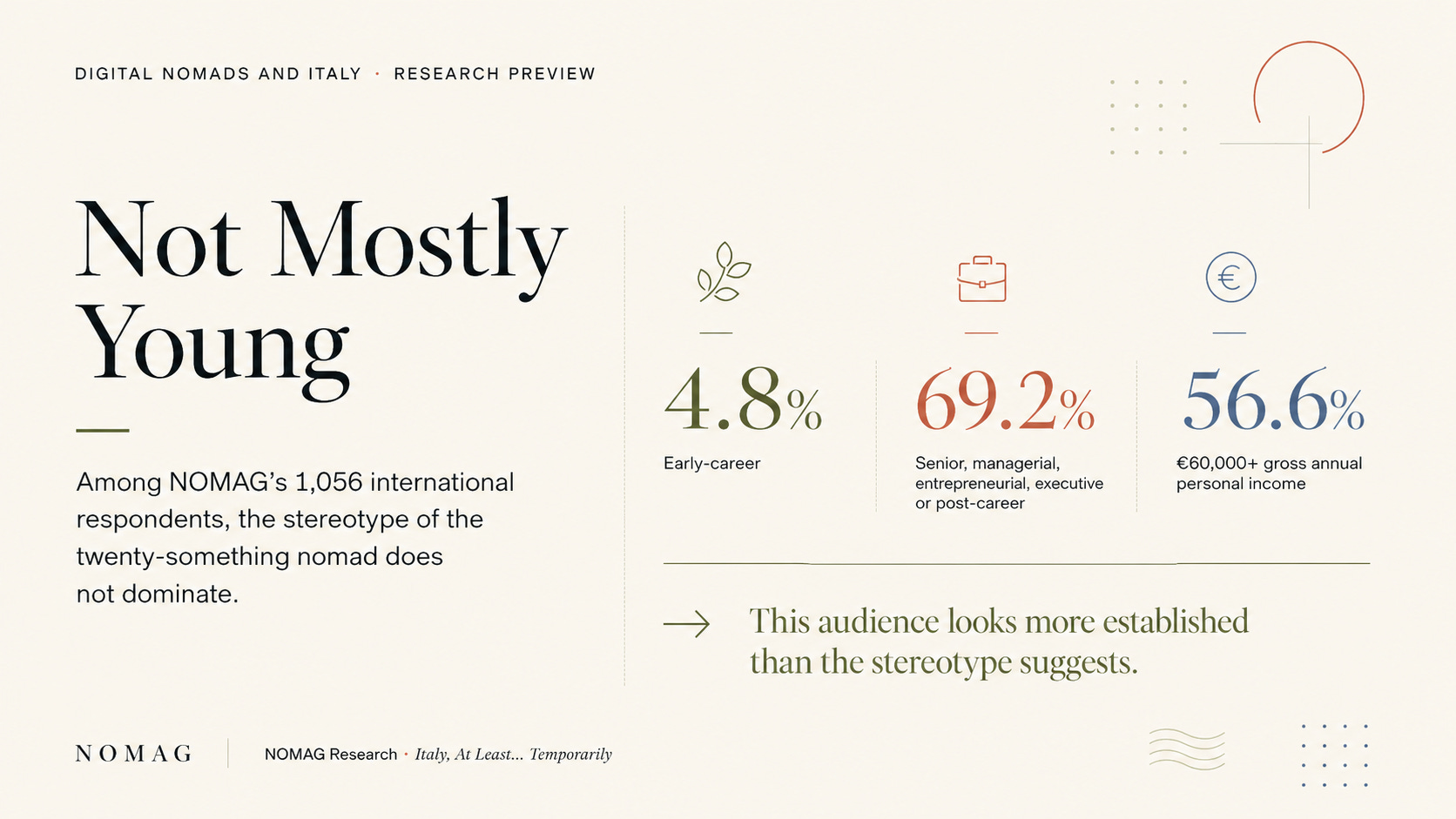
Only 4.8% are at the beginning of their careers. By contrast, 69.2% are senior professionals, managers, entrepreneurs, executives or post-career. More than half — 56.6% — report gross personal annual income of at least €60,000.
Assumption one: the digital nomads considering Italy are young.
Not really.
Assumption two: they want to keep moving.
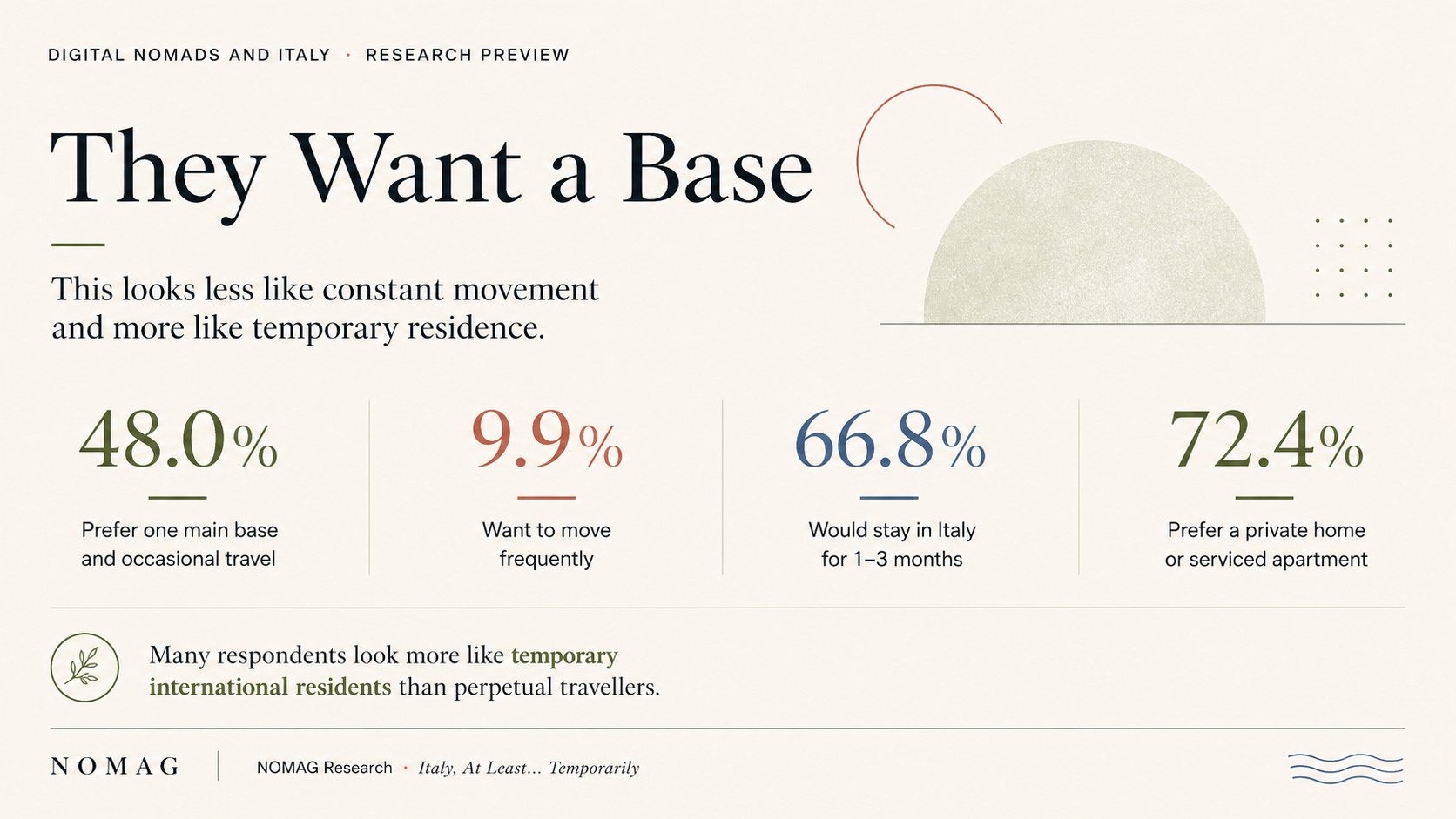
Again, not really. 48% prefer one main base from which to travel occasionally, while only 9.9% want to move frequently. And 66.8% would ideally stay in Italy for one to three months.
Assumption three: Italy should attract them through remote villages.
The most popular choice is actually a medium-sized city, considered by 49.4% of respondents. Small towns and villages attract 19.6%; rural or mountain areas 10.2%.
Assumption four: they want coliving.
Only 9.3% do. A much larger 72.4% prefer an entire private home or serviced apartment.
Assumption five: fast Wi-Fi is the key to choosing Italy.
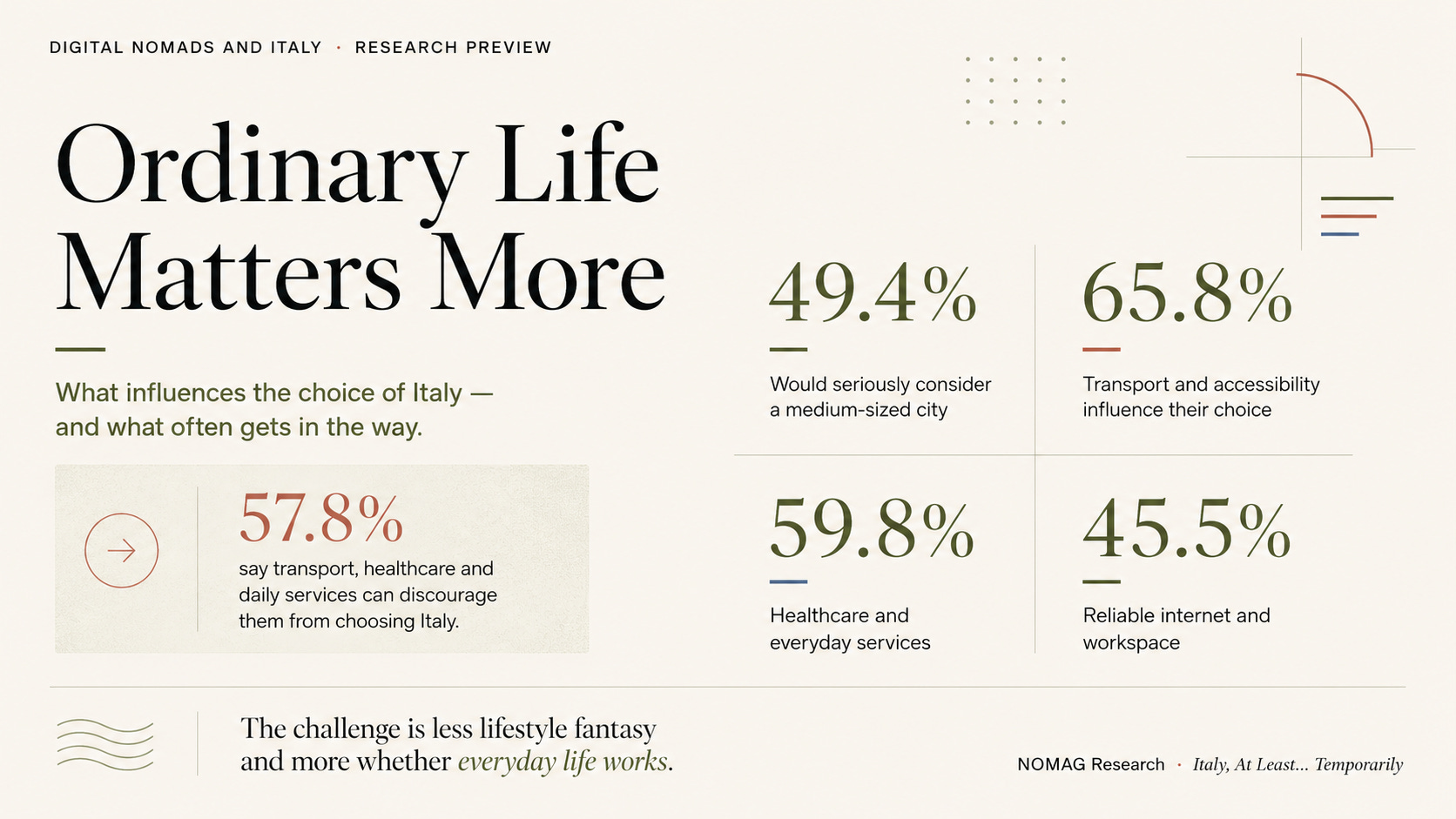
It matters, but transport and accessibility matter more: 65.8% cite them as influential, followed by healthcare and everyday services at 59.8%. Reliable internet and workspace come later, at 45.5%.
Assumption six: Italian taxes and bureaucracy are the main obstacle.
They are part of the picture, but they are not at the top. The biggest deterrent is transport, healthcare and daily services, cited by 57.8%, followed by language and local integration at 48.3%.
And perhaps the biggest assumption of all is hidden in the word “nomad”.
The people considering Italy in our survey often look less like permanent travellers and more like temporary international residents: established professionals looking for a functional base, privacy, services, transport, healthcare and a place that works beyond the tourist season.
That matters for Italy.
Because Italy may not need to invent a new lifestyle for digital nomads. It may need to stop designing policies around a stereotype.
The real question is not: how can Italy attract digital nomads?
It is: what stops people who already want Italy from actually choosing it?
Sometimes the answer is much less glamorous than a coworking space overlooking olive trees.
It is ordinary life.
And that may be the most important finding of this first preview: Italy’s opportunity is real, but the product we keep imagining for this audience may be the wrong one.
The full research will be published by the end of the month and will be available to all subscribers free of charge.