

Digital Nomads Are Growing Up. And the Law Is (Finally) Catching Them

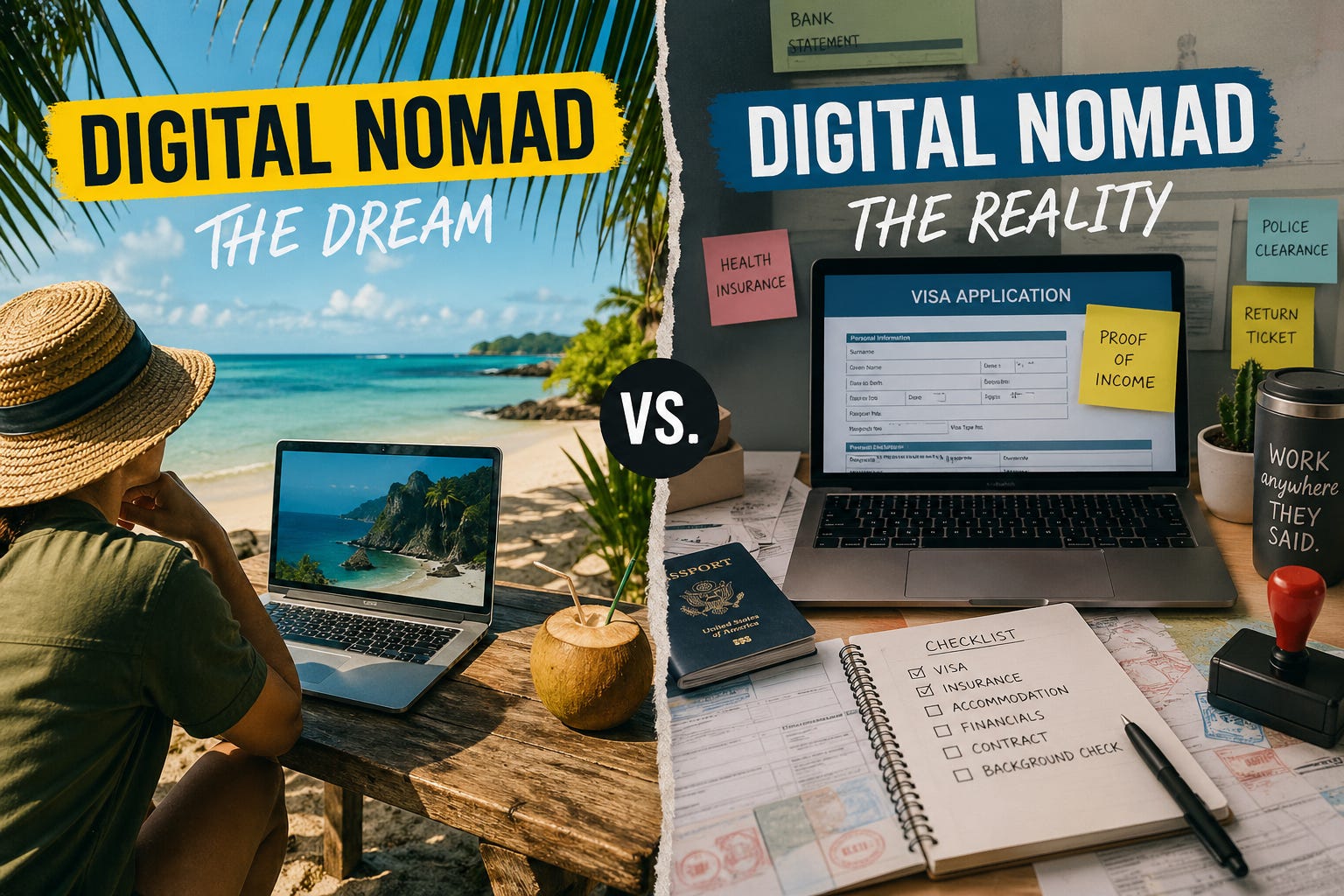
There was a time—not even that long ago—when being a digital nomad meant operating in a comfortable grey zone. You had your laptop, your Slack notifications, your Airbnb, and a quiet understanding that what you were doing might not perfectly align with the visa stamped in your passport.
Nobody really asked too many questions.
That phase is ending.
And if you want a clear signal of where things are going, it’s worth reading the “Digital Nomad Report – An Introduction” (March 2026) by the International Bar Association’s Global Employment Institute, authored by Jelle Kroes with contributions from Ann Harten and Marco Mazzeschi.
The full report is available here.
It’s not a flashy document. No bold claims, no hype. But precisely for that reason, it’s one of the most useful snapshots we have right now of what digital nomadism actually looks like once you remove the Instagram filters and start looking at the legal infrastructure underneath.
And what emerges is less a revolution… and more a system trying—slowly, imperfectly—to catch up with reality.
The first uncomfortable truth: we still don’t know exactly who a digital nomad is
You’d think this would be the easy part.
It isn’t.
The report spends a surprising amount of time just trying to define the term. And even then, it lands on something that feels more like a working compromise than a clean definition.
Is a digital nomad someone who moves constantly? Or simply someone working remotely from a different country? Does freelancing count? What about someone who relocates for a year but keeps a foreign employer?
There are academic definitions, industry definitions, even behavioral criteria—like moving at least three times per year—but none of them fully capture the reality.
And this matters.
Because when policymakers don’t have a stable definition, what they produce isn’t a system. It’s a collection of approximations.
From workaround to policy: how we got here
For years, digital nomads weren’t really regulated—they were tolerated.
People worked remotely on tourist visas because there was no alternative that made sense. Governments, for the most part, looked the other way.
But as the numbers grew, the gap between reality and regulation became too obvious to ignore.
Digital nomad visas are the result of that tension.
They’re not a visionary invention. They’re a correction.
And yet… 60+ visas don’t make a system
On paper, the expansion is impressive: more than 60 countries now offer some form of digital nomad visa.
In practice, it’s a fragmented landscape.
The report’s survey of 34 jurisdictions shows just how inconsistent things are:
A majority have a specific visa, but many still don’t
Application processes vary widely (only a minority allow in-country applications)
Durations range from short-term to multi-year permits
Requirements differ not just in detail, but in philosophy
Even something as basic as “how hard is it to get one” is measured in broad categories like “low,” “medium,” and “high”—hardly a precise metric.
So yes, digital nomad visas exist.
But no, they don’t yet form a coherent global framework.
The rule that quietly defines everything
If there’s one principle that cuts across almost all schemes, it’s this:
You can live in the country.
But your economic engine must remain somewhere else.
Most digital nomad visas require that your income comes from outside the host country.
There are minor exceptions—Spain allowing limited local work, for instance—but they don’t change the underlying logic.
This isn’t about integrating workers into local economies.
It’s about attracting spending without creating labor competition.
In other words: long-term presence, without full participation.
Freedom, but structured
Another pattern that emerges from the report is something that doesn’t get talked about enough: structure.
Yes, many visas are classified as “easy” or “medium” difficulty.
But that doesn’t mean informal.
To qualify, you’re often expected to demonstrate:
Stable and sufficient income
A formal employment or contractual relationship
Remote work authorization
Health insurance and clean legal records
In some cases, education or professional experience
This is no longer a lifestyle that lives in the margins.
It’s being formalized into a category with rules, thresholds, and expectations.
The subtle but decisive shift: from travel to residence
One of the most important insights in the report is almost hidden in plain sight.
Most digital nomad visas now last at least 12 months—and are often renewable.
That changes everything.
Because once you cross that threshold, you’re no longer just passing through.
You’re staying.
And staying comes with consequences: tax exposure, regulatory obligations, potential pathways (or barriers) to long-term residency.
At that point, the difference between a “digital nomad” and a “relocated professional” starts to blur.
An unfinished architecture
To its credit, the report doesn’t pretend to have all the answers.
It openly acknowledges the gaps:
Limited data on applications and outcomes
Incomplete information on rights (family reunification, citizenship paths)
Lack of clarity on enforcement
Significant variation across jurisdictions
What we’re looking at is not a finished system.
It’s a framework under construction.
Takeaway: the lifestyle isn’t disappearing. It’s being absorbed
If there’s one thing this report makes clear, it’s that digital nomadism isn’t fading.
It’s evolving.
What started as a loosely defined, semi-informal way of working is being gradually absorbed into formal legal, tax, and immigration systems.
That process is messy. It’s inconsistent. And in many cases, it’s still incomplete.
But it’s happening.
And that leads to a simple, slightly uncomfortable conclusion:
The future of digital nomadism won’t be less regulated. It will be better regulated.
Which, depending on how you look at it, is either the end of the fantasy…
or the beginning of something more sustainable.