

Digital Nomads in Italy: We Talk About Them More and More. Mostly in the Wrong Way.

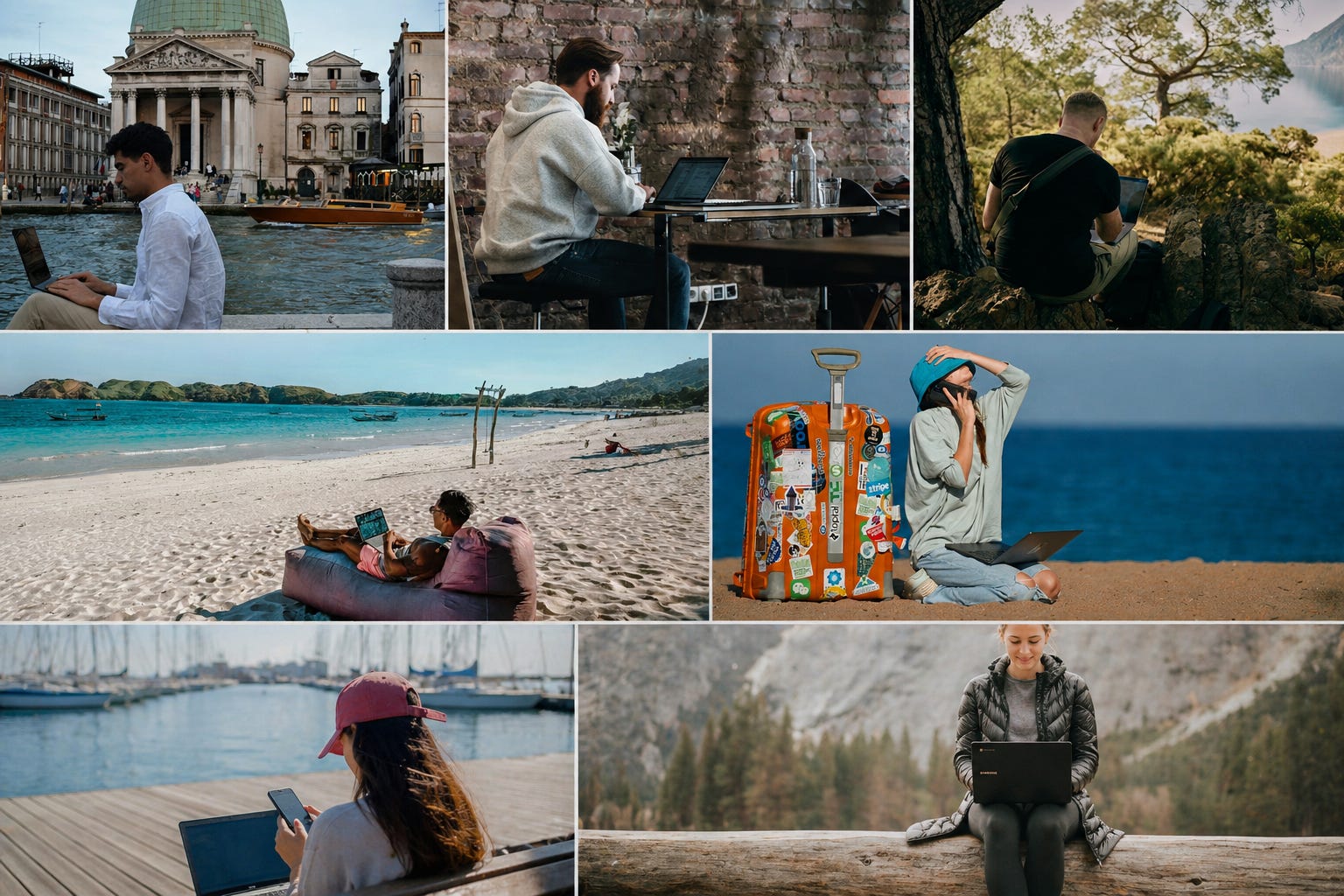
Today, our Editor-in-Chief stepped into the debate on Italy’s potential for digital nomads. As usual, not exactly quietly.

It’s good that digital nomads are finally being discussed in Italy by a newspaper like Il Sole 24 Ore. Actually, let’s say it properly: it’s a very good thing. Not because the topic has been ignored — quite the opposite, everyone talks about digital nomads these days, often throwing around global numbers with the same level of accuracy used when ordering the “house wine” in a tourist restaurant — but because when a major financial publication gives it proper space, it means something has shifted in how the topic is perceived.
It’s also fair to say that the article published today, written by Camilla Colombo and Camilla Curcio, is not the usual decorative piece with a laptop on the beach, a cappuccino with a view, and the tired “work from anywhere” narrative that should have been retired around 2017. The piece tries to address real issues: bureaucracy, visas, taxation, competition from Spain and Portugal, the need for proper services, communities, infrastructure, housing solutions, and an environment that doesn’t turn every arrival into a personal endurance test.
That’s the positive side. And it deserves to be acknowledged.
The same goes for some of the people quoted in the article. Alberto Mattei, through the Italian Digital Nomads Association, has done more than most to move this conversation beyond clichés and into something more structured. Marco Traina, with BeetCommunity and the Palermo coliving experience, represents one of the few Italian paths that has gone beyond theory and actually tested what community, hospitality, and long stays look like in practice. Federica Origo, from the University of Bergamo, rightly highlights fiscal policy, bureaucracy, and the need to simplify access to incentives and systems. All valid points. All useful. All significantly more grounded than the usual promotional soup of sunset villages and “Wi-Fi is everywhere anyway” — a sentence that is usually followed by a dropped call, a desperate hotspot, and a multilingual moment of frustration.
And yet, here’s the point.
The article is better than most. But it still sits inside the way Italy finds convenient to talk about digital nomads.
We talk about them as an extension of remote working.
As long-term tourists.
As tax-driven expats.
As tools for territorial regeneration — something to be “distributed” where we have empty homes, declining towns, fragile local economies, and a quiet hope that the outside world will come and fix what we haven’t managed to make sustainable ourselves.
That’s where the narrative, even when well intentioned, starts to drift.
Because a digital nomad is not an Italian working remotely who simply moves from Milan to Lecce. Not an expat relocating with a long-term plan, kids, pets, and a relationship with the local school system. Not a tourist staying three months and therefore suddenly becoming economically “interesting” for any territory with a calendar of “authentic experiences.” And not necessarily the ideal candidate to repopulate the village we’ve decided to promote because it has empty houses, a beautiful view, and a very motivated local council.
A real digital nomad — someone who actually works while moving, not the version observed from a distance or hosted for a couple of weeks — is, first and foremost, someone who needs things to work.
Work needs to happen.
Clients need to be served.
Deadlines met.
Teams coordinated across time zones.
Payments handled.
Connections stable.
Housing reliable.
Daily life manageable.
They are not looking — at least not initially — for a territorial mission. They are looking for a place where they can arrive and not spend three weeks figuring out how to live, how to work, what things really cost, whether housing is designed for residents or priced to extract value from visitors, whether the internet actually holds up under pressure, whether there is a professional community or just a WhatsApp group and a couple of sunset drinks.
This is the difference Italy still struggles to put at the center.
We tend to start from what we want to offer, rather than from what a mobile professional actually needs. We have villages to regenerate, properties to fill, territories to promote, tax incentives to position, funding to unlock, narratives to build. All legitimate. But digital nomads are not here to solve our demographic gaps, our housing inefficiencies, or our storytelling ambitions.
They are not a stylish patch over decades of underinvestment in services, weak mobility systems, dysfunctional housing, opaque bureaucracy, and a national tendency to label inefficiency as “authenticity.”
And here, let’s be clear: I believe in villages. I work in them. I invest in them. I try to bring others into them. I’ve spent the last ten years moving across Italy’s internal areas, working on new residents, abandoned properties, distributed hospitality, returns, and international interest.
So this is not a critique of small towns.
Some of them can absolutely become extraordinary places for remote living. For those who want to build a life. For those willing to invest time, energy, and patience. For those who are looking for something long-term.
But that is not the same as digital nomadism.
There’s a difference between someone deciding to build a remote life in a place — buying, renovating, integrating — and a professional arriving for two months who needs things to work immediately, has no intention of becoming a test case, and certainly doesn’t want to pay short-term rental rates designed for tourists while living like a temporary resident.
This is where Italy’s offer often breaks down.
Because too often, what we offer is the equivalent of a house to renovate: full of potential, attractive on paper, but requiring time, adaptation, negotiation, and tolerance for friction. Elsewhere, what is offered is a ready-to-live apartment: maybe less poetic, maybe less “authentic,” sometimes even more expensive — but immediately functional.
And professionals choose functionality.
This is not about romance. It’s about operations.
Places like Lisbon, Barcelona, Valencia, Madeira, Chiang Mai, Bali, parts of Dubai — even certain cities in Eastern Europe — don’t work because they are more beautiful than Italy. Some of them clearly are not. They work because they reduce friction. You arrive, you find housing, you understand costs, you connect with people, you access services, you work, you stay, you leave — without having to explain your existence at every step.
Italy, on the other hand, often seduces brilliantly… and then leaves you alone with the complexity.
So yes, the article is right about bureaucracy, services, housing, and competitiveness.
But it still doesn’t fully address the core issue: Italy is not yet truly attractive for digital nomads because we haven’t fully understood who they are — and we keep treating them through categories that belong elsewhere.
We see them as tourists when we sell experiences.
As expats when we think taxation.
As remote workers when we discuss labour models.
As tools when we talk about regeneration.
Rarely as what they actually are: mobile, selective, time-sensitive professionals who have options — and know it.
This doesn’t mean Italy cannot compete. It absolutely can. But it needs to stop projecting its own desires onto a market that behaves differently.
The real question is not “how do we attract digital nomads?”
It’s “which digital nomads have a real reason to choose Italy today — and where can we offer something that works immediately, clearly, and consistently?”
Because in the end, that’s all that matters.
A note from the Editor-in-Chief
I’m not writing this as an observer.
I’ve been an entrepreneur abroad for 30 years, with London as a base but, in reality, always moving — suitcase in hand, even when Covid told us to stay put. Over the past ten years, I’ve spent a significant part of my time working across Italy on investments, new residents, hospitality, and regeneration projects, often in the very villages now being positioned as solutions.
Through ITS Italy, we currently run regeneration and relocation projects across more than 20 municipalities throughout the country. I’m not observing that world — I’m inside it.
At the same time, I increasingly experience Italy as a digital nomad myself, constantly moving across the country for work, testing firsthand what works — and what doesn’t.
Through Nomag, ITS Journal, We the Italians, Smart Working Magazine, and Esco quando voglio, we speak weekly to a combined audience of nearly 500,000 people across more than 100 countries.
This is not about being an “expert.”
It’s about seeing these dynamics play out in real time, every day.
And maybe — just maybe — that’s why it’s worth trying to bring the conversation back into focus.