Europe Just Made Borders “Smart.” Travelers Made Them Slow.
If you thought post-pandemic travel had finally settled into something resembling… normal, the European Union just politely disagreed.
On April 10, the Entry/Exit System (EES) went fully mandatory across the Schengen Area. Translation: no more passport stamps, no more human discretion, no more “I think I entered in May?” conversations at border control. From now on, your face, your fingerprints, and your travel history are all logged—precisely, permanently (well, three years), and without much room for improvisation.
It’s clean. It’s efficient. It’s also… chaos.
Goodbye Stamps, Hello Database
Let’s start with the pitch. The European Commission is selling this as a long-overdue upgrade.
Every non-EU traveler entering the Schengen Zone now gets:
A facial scan
Four fingerprints
Their travel document digitally recorded
Come back again? Just your face will do.
No more ink stamps fading into oblivion. No more border officers flipping pages like they’re reading tea leaves. The system tracks your movements automatically and enforces the infamous 90/180-day rule with the enthusiasm of a tax auditor.
From a policy standpoint, it makes sense. Over 45 million crossings already logged during the rollout. Thousands of overstays detected. A few hundred security flags caught early.
From a traveler’s standpoint? Well…
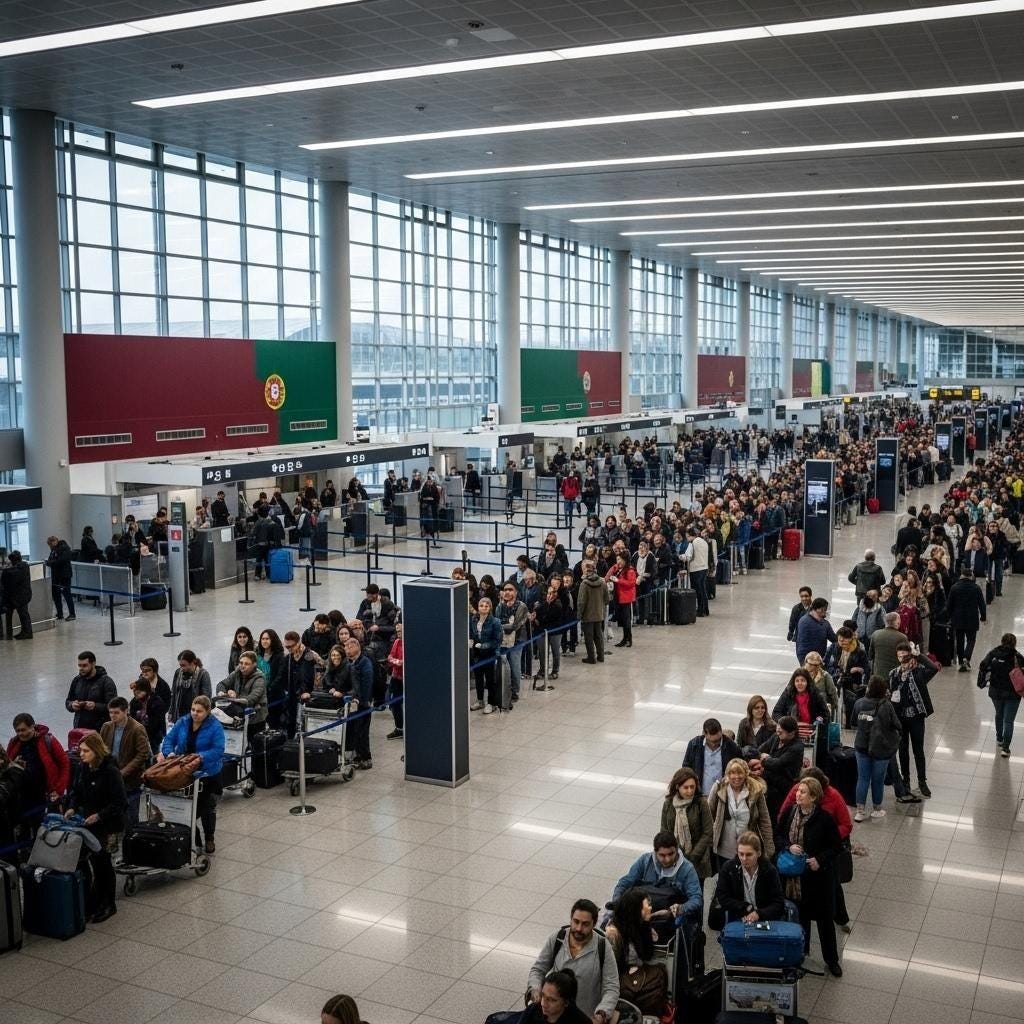
The Queue Is the Message
The theory is elegant. The reality looks more like a Ryanair boarding line in August.
Early signals weren’t subtle.
At Lisbon Airport, authorities pulled the plug on the system in December after queues stretched beyond five hours.
Geneva Airport saw three-hour waits during peak periods.
Reports (including from BBC Travel) suggest processing times have jumped by up to 70%.
And that was before the system became fully mandatory.
Now imagine July.
Industry warnings are already floating around: five to six hours at major hubs during peak season isn’t some dystopian exaggeration—it’s a planning assumption.
“But It’s Digital!” Yes. That’s the Problem.
Biometric systems are great at scale—eventually. But the first touchpoint is always the slowest.
Every first-time traveler now needs to:
Stop
Scan
Register
Wait
Multiply that by tens of millions of people, uneven infrastructure across 29 countries, and the charming unpredictability of European summer travel—and suddenly your seamless Schengen dream starts looking like a Black Friday sale.
Even airlines are now in the loop. They’re legally required to verify your visa status before boarding. Which sounds reassuring until you realise it adds another potential bottleneck before you even reach the airport bar.
Digital Nomads: Precision Cuts Both Ways
If you’re floating around Europe on vibes and vague date math, this is where things get serious.
The 90/180-day rule is no longer:
flexible
arguable
negotiable
It’s automated. Completely.
The system knows:
when you entered
when you left
how long you stayed
There’s no “but the stamp was unclear.” There’s no “the officer didn’t stamp me.” There’s just data.
For disciplined travelers, this is actually helpful. For everyone else… it’s a quiet reckoning.
If you’re on a proper digital nomad visa (Spain, Portugal, Greece, etc.), you’re fine—different category, different rules. But if you’re doing the classic Schengen shuffle, hopping between countries and hoping the math works out, the margin for error is now exactly zero.
The Bigger Trade-Off Nobody Mentions
There’s another layer here that’s getting less airtime.
Europe now holds biometric data on tens of millions of travelers in a centralized system.
That’s not inherently sinister—it’s consistent with what countries like the US have done for years. But it does shift the balance. Borders are no longer just checkpoints; they’re data collection points.
Efficient? Yes.
Neutral? Not entirely.
So… Wasn’t Travel Supposed to Be Easier by Now?
That’s the irony.
We’ve got:
biometric passports
AI-powered border systems
real-time data tracking
And yet, standing in line at 6am in a crowded terminal, none of that feels particularly futuristic.
It feels like waiting.
The EES will probably work—eventually. Systems stabilise. Processes smooth out. Queues shrink. That’s how these things go.
But right now? Europe has upgraded its borders faster than it’s upgraded the experience of crossing them.
So if you’re heading into Schengen this summer, here’s the only piece of advice that actually matters:
Arrive early.
Then arrive earlier than that.