


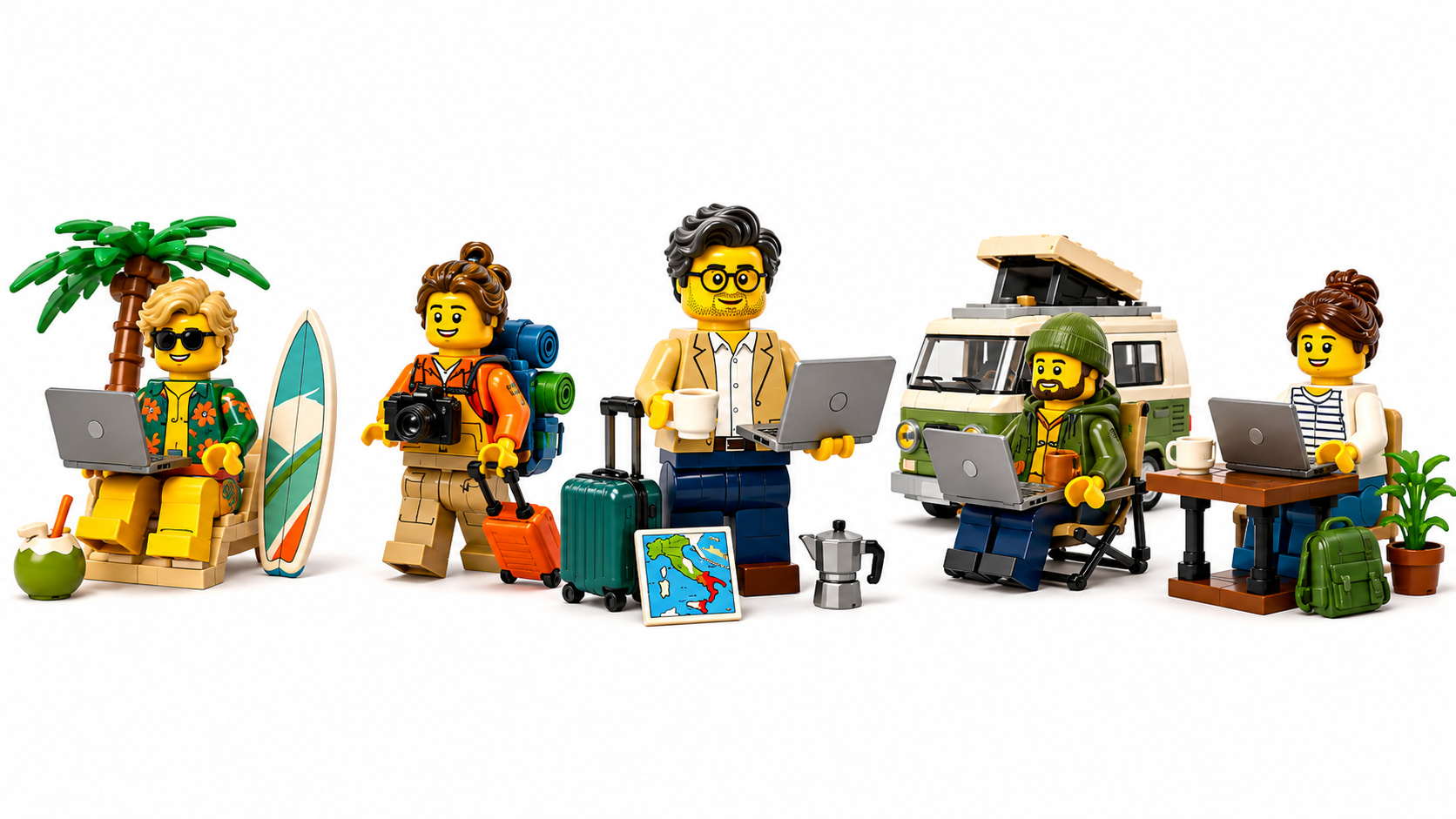
We Put the Main Digital Nomad Research on One Table. That’s When We Understood What Makes Ours Unique.
Cities want them, companies sell to them, governments create visas for them and researchers try to understand them. We compared some of the most recent studies - and discovered that “digital nomad” may now describe several rather different people.
Digital nomads have had a remarkably busy few years. First they were people with laptops who happened to move around. Then they became a tourism segment, a housing market, a visa category, a rural regeneration strategy and, occasionally, the answer to whatever problem happened to be on a municipality’s PowerPoint that morning.
Everybody seems to want them. The slightly awkward question is: which ones?
While preparing AT LAST, ITALY… AT LEAST TEMPORARILY, we went back through some of the most relevant recent research. Not to find studies that agreed with NOMAG, but to understand who everybody else was actually talking about.
MBO Partners looks at the phenomenon through the American workforce and shows how digital nomadism has moved well beyond the freelance fringe: employees are now a major part of the population, although its audience remains heavily Gen Z and Millennial and is gradually moving towards longer, slower stays. Flatio comes at the same world through accommodation: its respondents tend to stay one to four months, and finding somewhere suitable to live is one of their biggest frustrations. FlexJobs starts even further upstream, with thousands of US professionals who can work from anywhere — interestingly, only a minority say they actually want the fully nomadic, constantly moving version of the lifestyle.
Fiverr studied 2,000 “Anywhere Workers” across six countries, including Italy, and gives us one of the clearest signals that Italy is already genuinely attractive: it appears among the most popular countries to visit. The Social Hub’s European research, meanwhile, puts much more emphasis on community, loneliness and belonging — entirely logical for the audience it reaches. Its study includes Italy, although its Italy-specific figures concern Italian digital nomads rather than foreigners considering moving here.
Nomads.com — formerly Nomad List — offers something different again: a very large, live platform population already moving between destinations, useful for understanding incomes and the relative appeal of individual cities. bunq broadens the picture towards international living, financial confidence, wellbeing, healthcare and bureaucracy. InterNations looks at people who have already made the move abroad — and its Italy findings are a useful reminder that loving a country and enjoying its administration are not necessarily the same hobby. Italy performs particularly poorly on bureaucracy and administrative essentials.
Then there are the destination and policy studies. Global Citizen Solutions compares 64 jurisdictions and places Italy 25th overall, combining strong mobility and quality-of-life appeal with weaker procedural and economic dimensions. Academic research and OECD work add another useful warning: digital nomad visas, local impact and mobility patterns are more complicated than simply issuing a permit and waiting for affluent laptop owners to arrive.
And Italy has its own conversation.
The 4th Report on Digital Nomadism in Italy, produced by Associazione Italiana Nomadi Digitali with Ca’ Foscari’s Venice School of Management, is deliberately territorial. It asks how digital nomadism might contribute to rural and internal areas, temporary residency, regeneration and new forms of community. Coliving plays an important role in that model, as does the possibility of attracting younger professionals to places affected by depopulation.
It is a legitimate question. It is simply not the same question NOMAG asked.
NOMAG went in the opposite direction: instead of asking what digital nomads might do for Italy, we asked 1,056 non-Italian respondents what Italy would have to do for them. The distinction turns out to matter.
Our audience has an average age of 41 and an estimated average personal income of around USD 86,000. Only 4.8% are early-career; 69.2% are senior professionals, managers, executives, founders, business owners or post-career. Yet this relatively affluent audience is not demanding champagne-filled coliving palaces with a coworking desk beside the infinity pool.
66.8% want one to three months in Italy. Almost half want one main base. 72.4% prefer a private home or serviced apartment. Medium-sized cities attract 49.4%, against 19.6% for small towns and villages. Transport and accessibility matter to 65.8%, while internet and workspace reach 45.5%.
And then there is probably the most interesting number of all: 24.6% had already considered Italy and decided against it.
That changes the conversation. Italy may not need another campaign explaining that it has beautiful towns, good food and an enviable lifestyle. There is a reasonable chance the people we surveyed have already noticed.
The harder job is converting attraction into somewhere they can actually live for a month, two months or three.
Perhaps, then, there is no definitive answer to “what digital nomads want”. A 29-year-old freelancer recruited through a coliving environment, a 41-year-old executive considering Tuscany with a partner and an American employee using a work-from-anywhere policy can all legitimately be digital nomads.
They just do not necessarily want the same thing.
Which suggests a useful question before launching the next programme designed to attract them:
Which digital nomads do you actually mean?
This is a preview of the international comparison included in the new NOMAG Research report, AT LAST, ITALY… AT LEAST TEMPORARILY. A special preview will be distributed free to NOMAG subscribers.