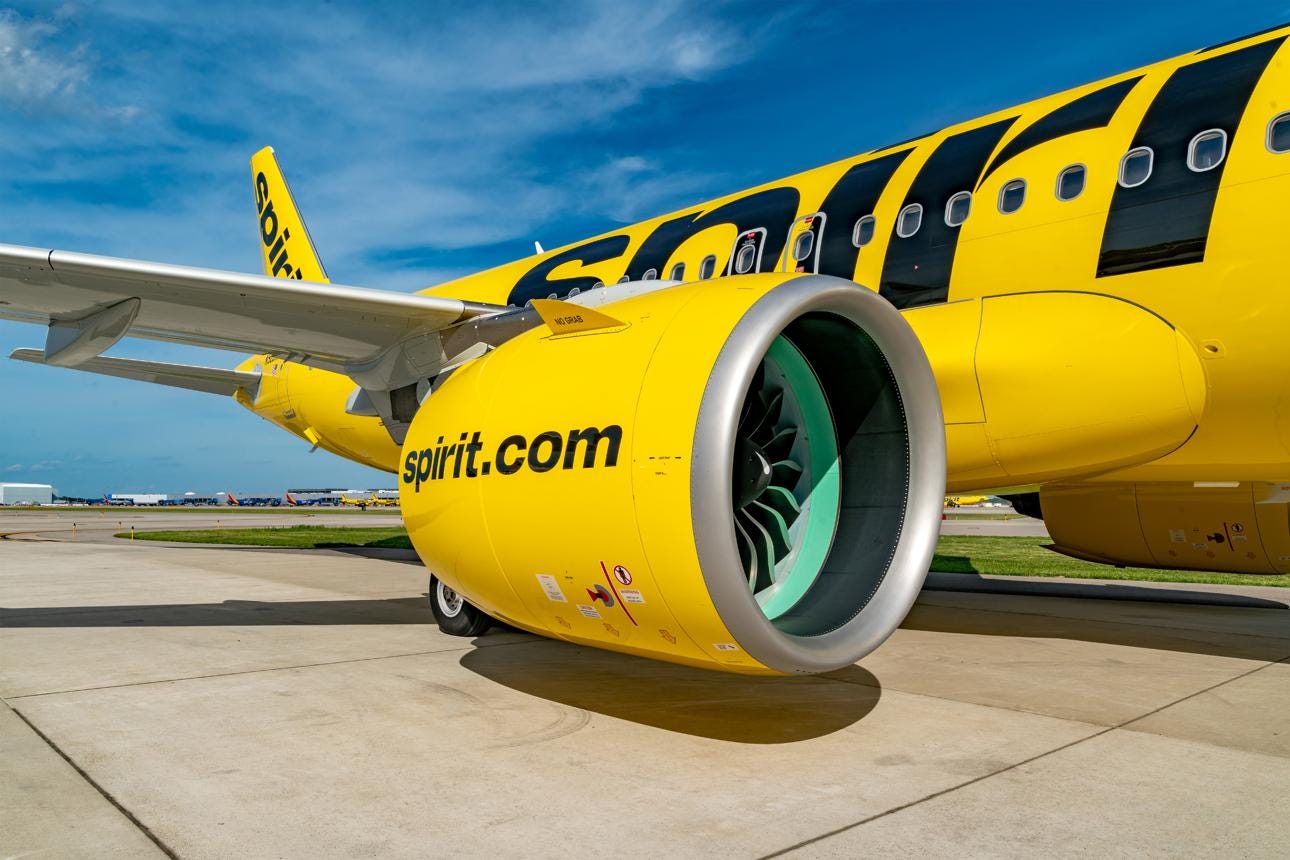
From Spirit to Ghost: when America’s cheapest wings stop flying
There was a time when booking a Spirit Airlines flight felt like a small act of rebellion against the system. You would open the app, stare at a fare that looked almost absurd, and convince yourself that even if everything went wrong, it was still worth it. That was the deal Spirit made with its passengers: we will get you there, somehow, and you will accept the rest as part of the experience.
Now there is no experience left to negotiate. Spirit has shut down, abruptly and without ceremony, after failing to secure a $500 million federal bailout. Flights cancelled, operations wound down, passengers told not to even show up at the airport. Not a slow decline, not a managed transition, but a hard stop. From Spirit to ghost, almost overnight.
America’s version of low-cost, pushed to the edge
For many travellers in the United States, Spirit played the same psychological role that Ryanair, easyJet or Wizz Air have long played in Europe. It represented access, possibility, and a slightly chaotic version of freedom, built on the idea that moving across the map should not be a luxury.
The difference, however, is structural. In Europe, low-cost airlines are not an exception but a system. They are integrated into how people think about distance, time and opportunity. In the United States, the same model has always existed in a more fragile equilibrium, stretched across longer routes, fewer alternative airports, and a market that oscillates between price sensitivity and service expectations in ways that are not always predictable.
Spirit did not just operate as a low-cost airline. It pushed the concept to its most extreme version, stripping the experience down to its bare minimum and monetising everything else with a level of aggressiveness that made even its European counterparts look relatively restrained. That model works beautifully when conditions are stable, and collapses quickly when they are not.
The official explanation is fuel
The narrative presented is straightforward. Rising fuel costs, accelerated by geopolitical tensions and the Iran war, eroded margins that were already thin. A business that survives on precision suddenly found itself exposed to volatility it could not absorb. Without fresh capital, the outcome became inevitable.
Yet this explanation, while accurate, is incomplete. Spirit had been under pressure for years, accumulating losses, restructuring, cutting routes and reducing its workforce in an attempt to stay afloat. By the time discussions around a government-backed rescue began, the airline was not looking for growth capital but for a lifeline. Even that proved too ambitious.
The proposed bailout, which would have given the U.S. government a dominant stake, failed to convince key financial players, including firms such as Citadel and Ares Management, that the underlying business could be stabilised in a meaningful way. When capital loses confidence, the timeline accelerates, and what looked like a restructuring scenario becomes a shutdown within days.
What disappears when an airline like this disappears
It is tempting to treat the collapse of a budget airline as a marginal event, something that affects only the most price-sensitive segment of the market. That interpretation misses the broader impact.
Spirit was not simply selling cheap tickets. It was lowering the threshold for movement. It allowed people to make decisions quickly, to explore options without overcommitting, to treat geography as something flexible rather than fixed. In that sense, it quietly contributed to a culture of mobility that extended far beyond tourism.
When an airline like this disappears, the immediate effect is not a dramatic halt in travel but a subtle shift in behaviour. Costs increase slightly, friction returns, spontaneity becomes less accessible. The system still functions, but it becomes marginally less fluid.
The quiet impact on digital nomads in the U.S.
For digital nomads based in the United States, this shift is more relevant than it might initially appear. The American version of location independence has always been more complex than its European counterpart, partly because the infrastructure supporting short-distance, low-cost movement is less developed.
Spirit filled a specific gap. It enabled rapid, low-risk relocation within the country, making it easier to test cities, split time between locations, or respond quickly to opportunities. Without that layer, mobility does not disappear, but it becomes more deliberate, slightly more expensive, and less impulsive.
This matters because a large part of the nomadic mindset relies on optionality. The ability to move easily is not just a logistical advantage; it is a psychological one. When movement becomes more structured, the entire experience shifts, even if only by degrees.
From ghost to something else
Airlines rarely vanish completely. Assets are redistributed, routes are absorbed, and fragments of the original operation often reappear in new forms. It is likely that parts of Spirit will survive in this way, integrated into larger carriers or repurposed under different strategies.
What is less certain is whether the specific version of ultra-low-cost that Spirit embodied will return in the same form. The model depended on a set of conditions that no longer seem as stable as they once were, and the margin for error has proven to be extremely narrow.
There is always the possibility of a phoenix moment, a reconfiguration that brings the brand or its philosophy back in a more sustainable way. At the same time, the industry has a long history of quietly moving on from models that pushed too far, too fast.
Final thought
Spirit built its identity on a simple promise: movement should be accessible, even if comfort is optional. For a while, that promise held. It expanded horizons, enabled decisions, and reshaped expectations around travel within the United States.
Its disappearance does not signal the end of low-cost flying, nor does it fundamentally alter the structure of the market. What it does is remove one of the most extreme expressions of that idea, leaving behind a slightly more cautious landscape.
For anyone building a life that depends on movement, whether occasionally or continuously, the lesson is not dramatic but it is real. Freedom of mobility is never entirely abstract. It is built on systems that can, under pressure, disappear faster than expected.