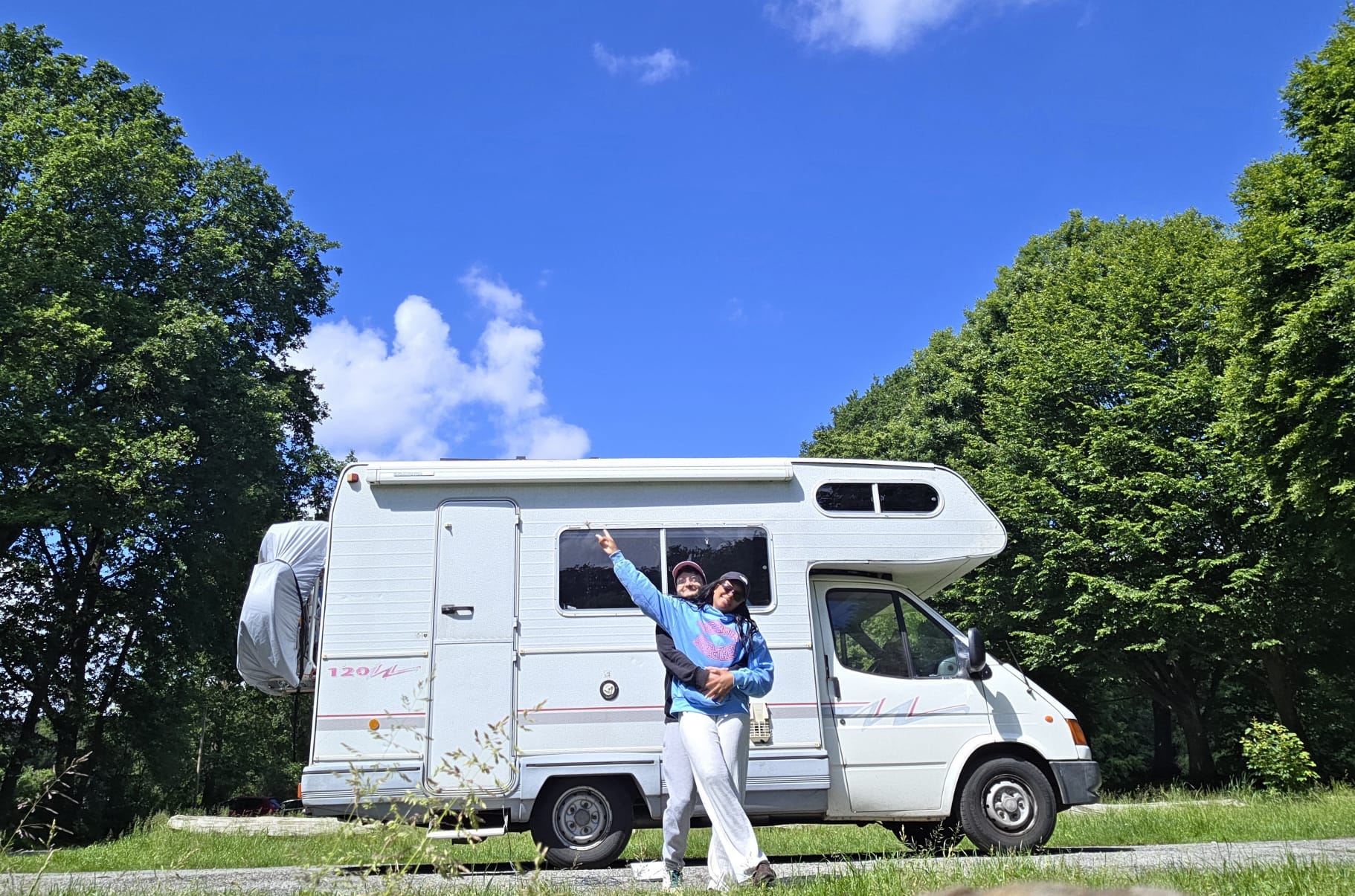
How to fight with your partner in a campervan (and survive)
Van life is often sold to us as a romantic escape: sunsets by the sea, morning coffee with mountain views, love and fresh air. And while more and more creators are trying to show the reality of life on the road, one thing I rarely see discussed is couple life. Do the same relationship dynamics still apply when you no longer have a house? After eight years together, we’ve experienced both versions: the classic life with four walls and a roof, and the one where our entire relationship fits inside a vehicle smaller than our old living room. What if van life is the ultimate relationship stress test? If you’re considering living full-time in a van with your loved one, this article is for you.
1/ Chores don’t disappear, they get worse
You might think that once you get rid of the house, you get rid of household chores. Fatal mistake! The chores stay and they can be even more exhausting: emptying the toilet cassette, filling water tanks, finding a laundromat, hunting for a place to sleep... (my nervous system is stressed just typing this!). If chores weren’t already divided fairly when you lived in a house, a campervan is a guaranteed recipe for arguments.
Rule #1 for avoiding conflict: divide the chores. Fortunately for us, this happens pretty naturally. It works because we tend to take over from each other throughout the day. For example: I cook, he does the dishes. He fills the water tank, I empty the toilet cassette. He finds a place to park for the night, I find the nearest laundromat.
2/ There is nowhere to storm off to
When you argue in a house, you can usually find a space of your own to cool down. You sleep on the couch, lock yourself in the bedroom, or go for a walk in your garden. In a campervan, if you’re angry, you remain approximately 80 centimeters away from the person who annoyed you. Which is somehow even more annoying! The upside? You don’t really have a choice but to sort things out. Staying angry for three days is a luxury reserved for people with spare bedrooms. Van life has probably forced us to communicate more, and better, than we ever did in a house. There’s nowhere to hide when something is bothering you. You have to say what’s wrong and what you need directly. The result is that we waste less energy on minor issues.
But what if you really want to sulk? Two solutions. The obvious one: go outside. Because we’re usually in unfamiliar places, stepping out of the campervan, breathing fresh air, and being surrounded by new sights immediately engages our senses. It often calms us down faster than leaving a regular home, where you might run into a chatty neighbour when all you want is to scream into the void.
And when the frustration is so intense that you don’t even want to enjoy a new place, you can create artificial personal space. In our campervan, a curtain separates our over-cab bed from the rest of the vehicle, creating a small bubble of privacy. We also designed a tucked-away desk area with headphones so we don’t have to be face-to-face all the time. We genuinely planned the layout around having moments apart, because for us that’s essential to avoiding conflict.
3/ Take vacations from each other
People tend to assume that if you live in a campervan, you’re always on vacation mode. The reality is that if you work remotely, as we do, you discover new places mostly after work and on the weekend, just like anyone else. And when you live in such a small space, sometimes you need a break from nomad life, from your partner, and from everything that comes with it.
My best vanlife relationship advice? Take solo breaks! A few days apart gives you space to breathe, recharge, and remember why you chose this life together in the first place.
Recently, my partner had to go back to Paris for work, and I decided to rent an Airbnb in the Dutch countryside for a week to enjoy being alone with myself (and my long hot showers!).
Later, I had to attend an event on an island in northern Germany, and he stayed on the mainland with the campervan. We’re not avoiding each other: we’re giving each other the space that makes the relationship work.
And if that sounds too radical, start smaller: take a walk alone, spend an afternoon working from a café without your partner, or simply stop doing everything together.
4/ The hidden challenge is not space
Most people ask us how we manage to live in such a tiny space without killing each other.
The real challenge isn’t the size, it’s what the size implies: making decisions together, constantly.
In a sedentary life, you don’t ask yourself every day where you’ll sleep, where you’ll buy groceries, where you’ll do laundry, where you’ll dump your tanks, or where you’ll go tomorrow. In a nomadic life, especially in a campervan, you face endless micro-negotiations.
You immediately notice when you’re not on the same page and these tiny daily challenges have taught us a lot about working as a team and end up becoming surprisingly valuable for the relationship.
After a year and a half on the road, I’m still not sure whether van life is good for your love life. But I do know this: if you can survive a rainy week, an engine crisis, three days without a proper shower, and an argument about whose turn it was to empty the toilet cassette, you’re probably meant for each other.
This article was written as part of an editorial collaboration with the travel app Polarsteps.