

If It’s Trending, It’s Probably Too Late: A Slightly Uncomfortable Guide for Digital Nomads
Why choosing your next base like a tourist is the fastest way to burn out—and what to actually look for if you plan to live, not just pass through.

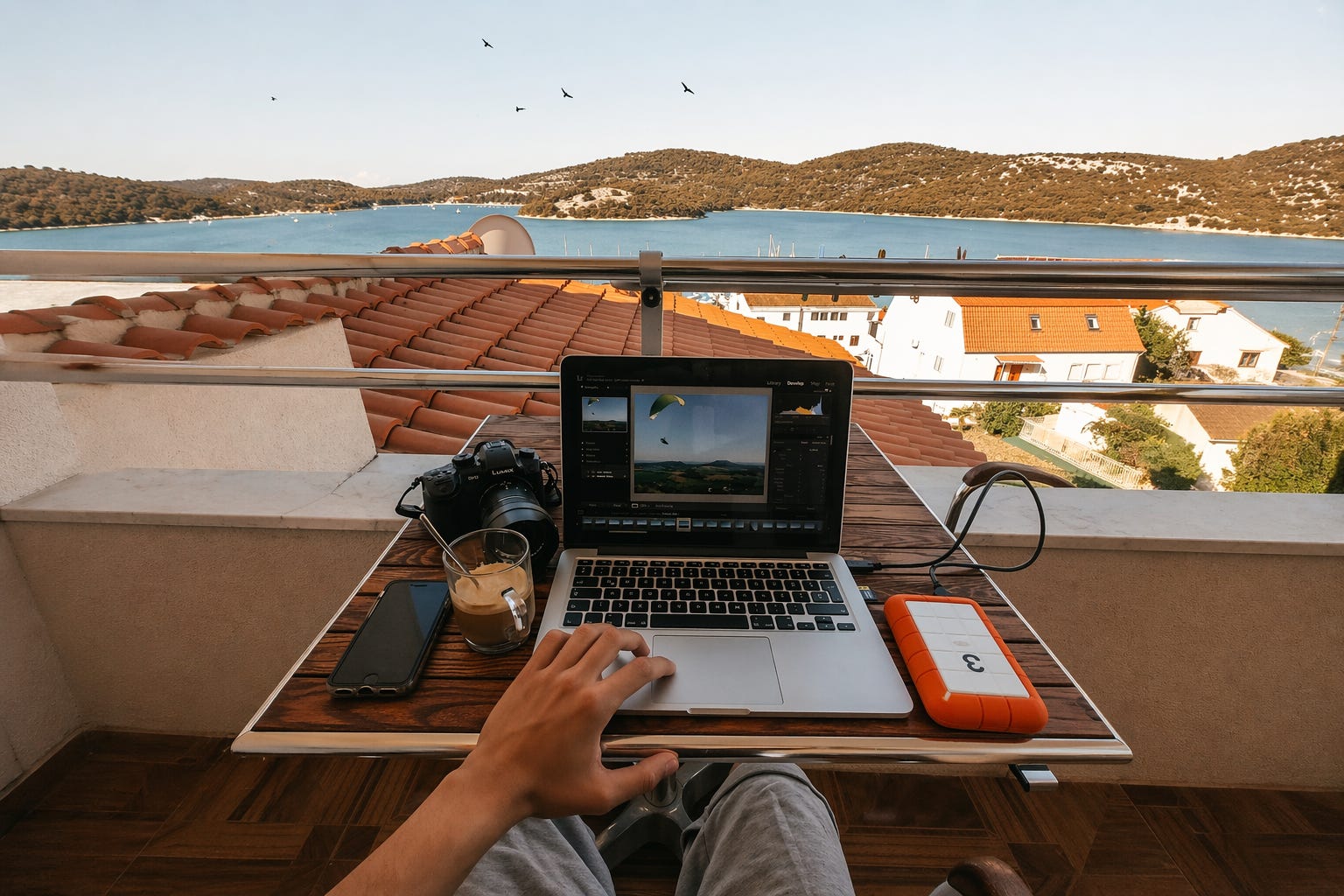
There’s something almost tragic—if you look at it from the right angle—in the way digital nomads choose where to go next.
Every summer, like clockwork, a new list pops up. “Top trending destinations.” “Hidden gems.” “Underrated cities you must visit before everyone else does.” The wording changes slightly, the logic doesn’t. A place gets picked up by a couple of outlets, amplified by a few creators, repackaged by a handful of platforms, and suddenly it becomes a destination. Not a city, not a community, not a functioning ecosystem—just a destination.
And that’s where the misunderstanding begins.
Because if you’re actually working remotely, if you’re not just on a long holiday disguised as a lifestyle, you’re not choosing a destination. You’re choosing a temporary life infrastructure. And those two things have very little overlap.
Take Alicante, or any of the usual suspects that get thrown into these rankings. The arguments are always the same: affordable, sunny, well connected, good food, decent beaches, maybe even a couple of coworking spaces thrown in to make it sound serious. All true, by the way. But also almost entirely irrelevant after your first two weeks.
The real question is not whether a place looks good on paper. It’s whether it still works when the novelty wears off and your life reduces, quite brutally, to a series of repetitive needs: stable internet, predictable routines, access to services, people you actually want to see again.
And that’s where most “trending” places quietly fall apart.
The moment a place becomes content
There is a very specific tipping point where a location stops being interesting and starts being marketed. You can usually spot it early: the same viewpoints, the same cafés, the same slightly overproduced narratives about “quality of life” that somehow always include brunch.
At that point, what you’re seeing is no longer discovery—it’s distribution.
And distribution has consequences. Prices adjust faster than infrastructure. Local businesses start optimising for short-term consumption. Housing becomes a rotating door. The very things that made the place attractive in the first place—pace, authenticity, accessibility—get diluted, not out of malice, but because demand has shifted the incentives.
This doesn’t make the place bad. It just makes it less suitable for what you actually need.
Because again, and it’s worth repeating: you’re not there to visit. You’re there to function.
The uncomfortable checklist nobody posts on Instagram
Let’s strip it down to something more practical, because this is where most people either over-romanticise or underthink.
If you’re staying longer than a couple of weeks, your decision should look less like “where do I want to go?” and more like “where can I realistically live without friction?”
A few unsexy—but decisive—filters:
Healthcare access: Not whether there’s a hospital, but whether you understand how to use it, how fast you can get seen, and whether language becomes a barrier the moment something goes wrong. You don’t need it until you really need it.
Connectivity (the boring kind): Everyone talks about Wi-Fi speed. Almost nobody checks network stability, mobile data fallback, or how often outages happen. One dropped call during a pitch is annoying. A pattern is a problem.
Transport logic: Not just airport connections, but how the city actually moves. Can you function without a car? Are trains reliable? Are you going to spend half your week negotiating logistics?
Local economy vs expat economy: If everything you use is designed for people like you, you’re in a bubble. And bubbles are comfortable, but they’re also fragile and expensive.
Administrative friction: SIM cards, contracts, rentals, basic paperwork. In some places, this is a one-hour task. In others, it’s a three-week saga that slowly erodes your will to live.
None of this is glamorous. But all of it compounds.
Coworking is not a community
This one deserves a bit of honesty, because it’s often oversold.
A coworking space is a service. Sometimes a good one. Occasionally even a great one. But it is not, by default, a community.
What you often get in highly “nomadised” destinations is a constant flow of people in similar phases of life, having very similar conversations, with very limited continuity. It’s pleasant, it’s easy, it’s also shallow by design.
If your goal is simply to not work alone, that’s enough.
If your goal is to build something—relationships, ideas, collaborations—you need a layer beyond that. You need locals, long-term residents, people with stakes in the place. And those are rarely concentrated in the same spots that get featured in “Top 10 coworking cafés with sea view.”
A slightly better way to choose
So what does a more intelligent selection process look like?
Not perfect, but at least more intentional.
Start with constraints, not desires. Define what breaks your workflow, not what enhances your Instagram. Work backwards from there.
Then, instead of looking at where everyone is going, look at where things are quietly working. Secondary cities, smaller regions, places that have infrastructure without the narrative. The kind of places that don’t need to sell themselves because they’re not trying to scale attention.
Italy, for example, is full of these contradictions. Everyone talks about the same five cities, while dozens of smaller ones—with decent connectivity, lower costs, and actual communities—remain completely ignored because they don’t fit the “nomad aesthetic.” Which, ironically, makes them far more suitable.
The same applies across Spain, France, even parts of Eastern Europe. The opportunity is rarely in the obvious choice. It’s in the slightly inconvenient one.
Or, just be honest about what you want
Because there is also a simpler possibility, and it’s worth stating without judgment.
Maybe you do want the beach, the bars, the energy, the easy conversations, the feeling of being somewhere “alive” in the most immediate sense. That’s fine. That’s not a failure of strategy. That’s a different objective.
But then call it what it is.
That’s a lifestyle break. A semi-extended holiday. A phase.
Not a base.
And the problem only starts when the two get confused—when you expect a place optimised for short-term enjoyment to support long-term stability.
It won’t. Or at least, not without friction.
The takeaway nobody will turn into a reel
If a place is trending, it means the decision has already been made—for you, by someone else, for reasons that are rarely aligned with your actual needs.
And if you follow that signal blindly, you’re not really choosing anymore. You’re just participating.
Which is slightly ironic, for a lifestyle that’s supposed to be about freedom.
So next time you’re picking your next move, resist the list. Ignore the hype. Spend a bit more time thinking like someone who has to wake up there on a Tuesday, not like someone arriving on a Friday.
And if after all that you still pick the trending destination, at least you’ll know why.
Which, already, puts you ahead of most people.