

Maybe We’re Not Always the Good Guys Either
Mexico City’s “Gringo Tax” says less about one nightclub… and more about how digital nomads are increasingly perceived around the world


A nightclub in Mexico City recently ended up in international headlines after introducing a controversial pricing policy: US citizens pay nearly $300 to enter, while locals and Latin Americans pay only a fraction of that.
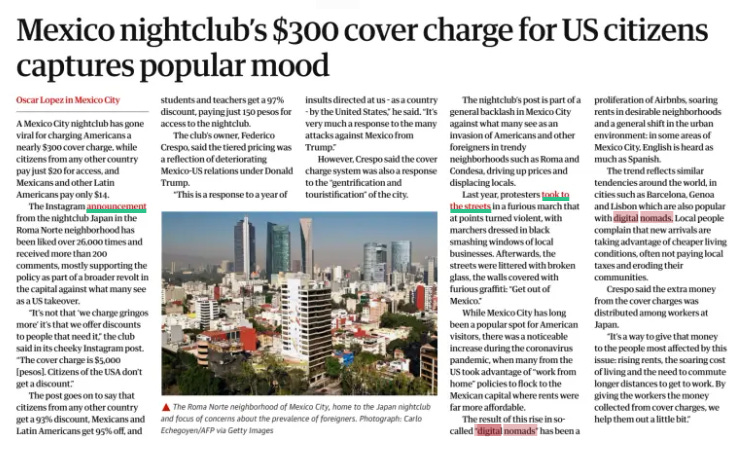
At first glance, it sounds like a joke. Or rage bait. Or one of those internet provocations designed purely to generate outrage and Instagram engagement.
But the club’s response made the story harder to dismiss so easily.
“We don’t charge gringos more,” the venue explained online. “We simply give discounts to people who need them.”
Officially, the owner linked the move partly to deteriorating US-Mexico relations and years of political hostility directed at Mexico. But he also openly referenced something else: frustration over gentrification, touristification, rising rents and the growing feeling among many locals that parts of Mexico City are slowly being redesigned around foreigners with stronger currencies and temporary lifestyles.
And that’s where the story stops being just about a nightclub.
Because if we’re being honest, this backlash against digital nomads is no longer some niche online debate happening only among angry activists on social media. It’s becoming increasingly mainstream.
The fact that even The Daily Show recently dedicated an entire ironic segment to American digital nomads in Mexico City says a lot about how far this conversation has travelled. In the piece, correspondent Grace Kuhlenschmidt interviews remote workers who proudly describe relocating south for “cheap rent, no taxes and bottomless margaritas,” while local residents speak far less enthusiastically about being priced out of their own neighborhoods and watching their communities transform around short-term foreign lifestyles.
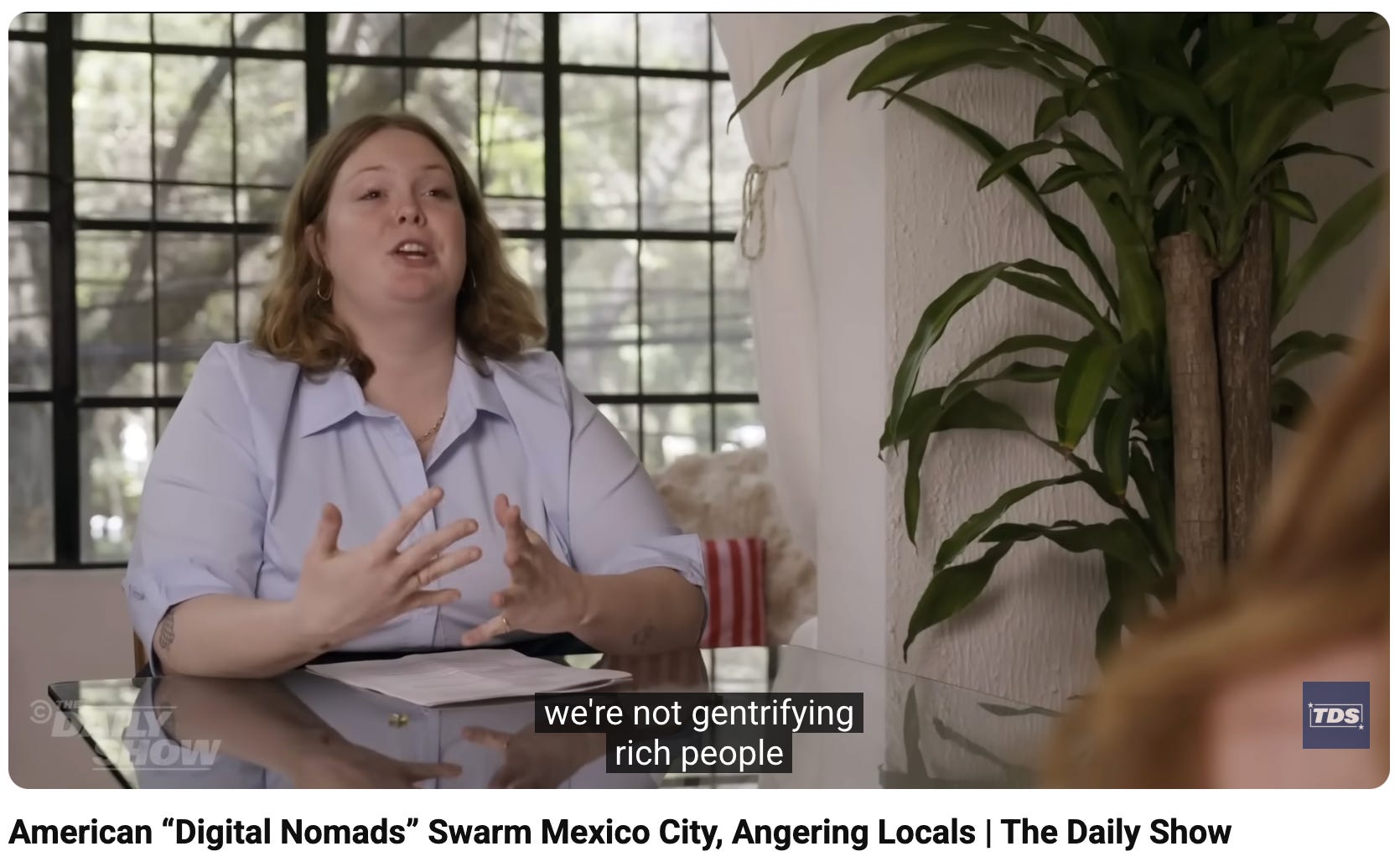
And honestly? Satire usually arrives when a cultural trend becomes impossible to ignore.
For years, digital nomadism has largely been marketed as an unquestionably positive phenomenon. Freedom. Flexibility. Borderless work. Cultural exchange. Escaping toxic office life. Reinventing yourself somewhere sunnier and cheaper with a laptop and decent Wi-Fi.
At Nomag, we’ve celebrated many of those things ourselves for years. And we still do.
Remote work has absolutely created opportunities for people to build healthier, freer and often more sustainable lives. It has allowed many professionals to leave cities that had become financially or psychologically exhausting. It has redistributed spending into places that were previously ignored. In some smaller towns and rural communities, newcomers genuinely have helped keep local economies alive.
But maybe the conversation around digital nomadism also needs to mature a little.
Because while we often talk endlessly about the benefits for nomads themselves, we’ve sometimes been far less interested in discussing the impact on the places receiving us.
And no, this doesn’t mean turning digital nomads into cartoon villains responsible for every housing crisis on earth. That would be simplistic and dishonest. Governments, speculative real estate, weak housing policies, Airbnb platforms and global inequality play vastly bigger structural roles than individual freelancers with MacBooks.
But pretending our lifestyles have zero impact is equally detached from reality.
Especially because many remote workers consciously choose destinations where their income stretches further than it would back home. That’s not immoral. Humans optimise. Expats always have. Travelers always have. Entire economies are built around cost arbitrage.
Still, there’s a difference between living somewhere and extracting value from somewhere.
And maybe that’s the tension now exploding in cities like Mexico City, Barcelona, Lisbon, Bali and beyond.
Because from the perspective of many locals, the experience can look very different from the glossy version promoted online.
You don’t see “global citizens building community.” You see apartments disappearing into Airbnb markets. Cafés suddenly operating almost entirely in English. Landlords preferring temporary foreign tenants willing to pay more. Entire neighborhoods reshaped around people who may only stay six months before moving on to the next “undiscovered” hotspot recommended by YouTube and TikTok.
Again: not entirely the fault of digital nomads themselves.
But also not entirely unrelated to them either.
And perhaps part of the problem is that the nomad world became a little too comfortable believing its own mythology.
We like seeing ourselves as adventurous, open-minded and culturally curious — and many nomads genuinely are. But mobility alone doesn’t automatically make someone a positive force in a community. Sometimes it simply makes them economically more powerful than the people already living there.
That distinction matters.
Because the best examples of remote living usually happen when people stop behaving like temporary consumers and start acting more like participants.
The nomads who tend to integrate well are rarely the loudest ones online. They’re the people who stay longer, learn at least some of the local language, build relationships beyond expat bubbles, support local businesses beyond trendy coworking cafés and understand they are guests within existing communities rather than pioneers “discovering” places where millions of people already live.
And ironically, this is also why some smaller towns often react differently from large global capitals.
In parts of rural Italy, for example, depopulation is real. Schools close. Shops disappear. Houses remain abandoned for decades. In those contexts, newcomers can genuinely create value and help sustain local life - but even there, integration matters enormously. A place cannot become merely a backdrop for cheap lifestyle arbitrage and Instagram storytelling.
Because eventually, locals notice the difference between people who want to belong somewhere and people who simply want to consume a lower cost of living for a while.
That’s why the Mexico City nightclub story resonated far beyond one provocative pricing policy.
Not because people suddenly hate foreigners.
But because more and more communities are openly questioning who global mobility is actually benefiting - and who ends up absorbing the social cost.
And if digital nomadism wants to remain socially sustainable long term, perhaps the answer isn’t becoming defensive every time criticism appears online.
Maybe the answer is accepting that freedom without responsibility eventually starts looking a lot like entitlement.
And maybe the future of remote living depends on something surprisingly simple: not just asking what a place can offer us… but also what kind of presence we become once we arrive there.