

Mendrisio and the Quiet Power of Knowledge Cities

The first mistake many cities make when speaking about talent is assuming that talent is only attracted by incentives. Lower taxes, cheaper offices, faster permits, better slogans, smarter campaigns: all of these may help, but they rarely explain why people choose to stay in a place once the first practical questions have been answered.
The more interesting question is not how a place captures attention. It is how a place becomes part of someone’s professional and intellectual life.
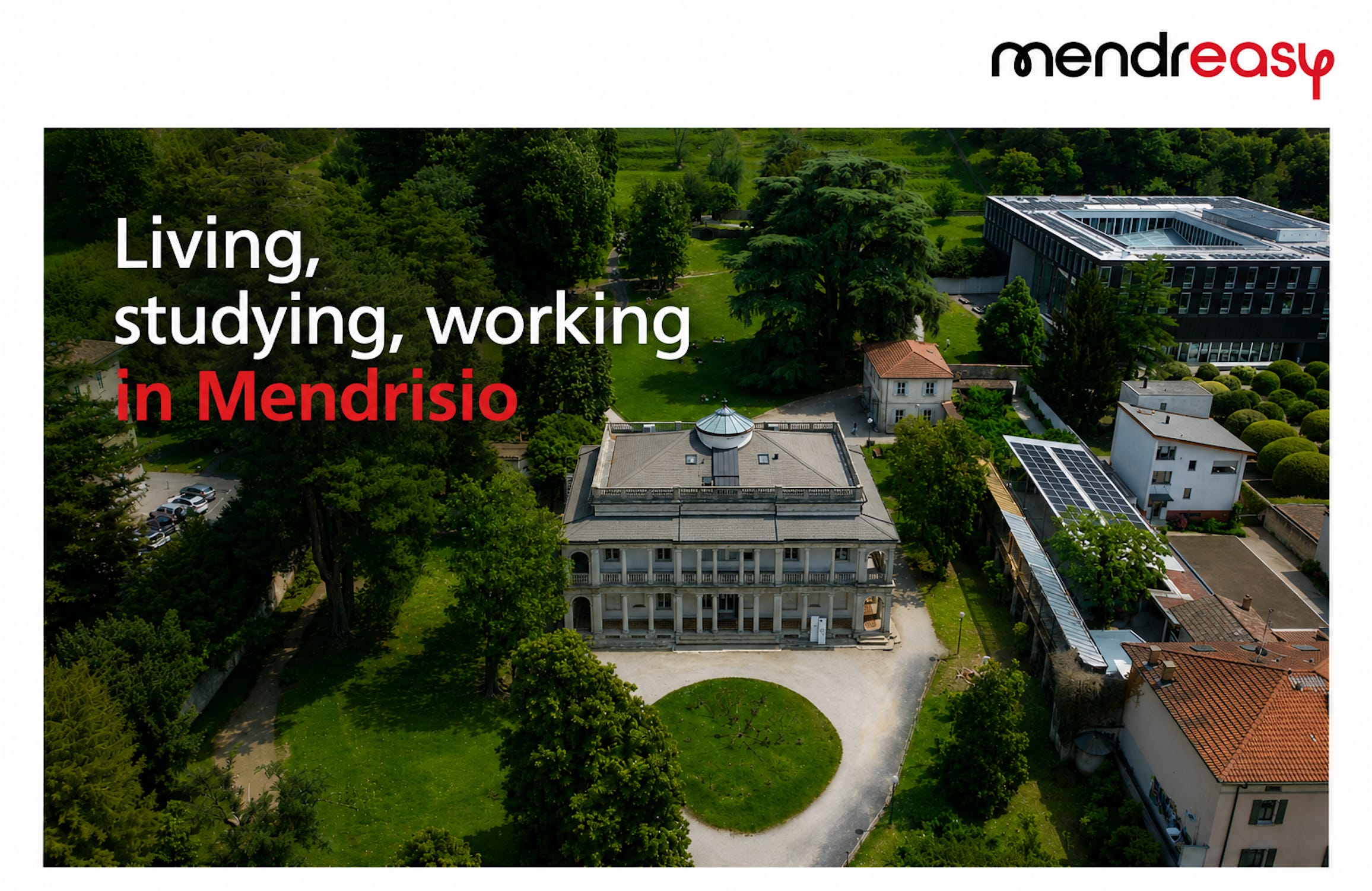
Mendrisio offers an unusually relevant answer to that question because it is not trying to present itself as a global knowledge capital. It does not need the rhetoric of disruption, nor the constant self-assurance of cities permanently announcing their own future. Its strength is quieter and, in many ways, more convincing: it brings together education, architecture, design, research, production, cross-border mobility and a human scale in a way that makes knowledge feel embedded in daily life rather than isolated inside institutions.
This matters because the geography of work has changed. For decades, ambitious people were told to move towards the largest centres of opportunity. The assumption was simple: if you wanted a meaningful career, a serious network, access to ideas and proximity to markets, you had to accept the gravitational pull of major cities. London, Milan, Paris, Zurich, New York and many other familiar destinations became shorthand for possibility.
That logic has not disappeared. Large cities still matter enormously. But their exclusive appeal has weakened. A growing number of founders, professionals, academics, consultants and internationally mobile workers are asking a more nuanced question: where can I be connected to serious opportunities without allowing my entire life to be consumed by the cost, speed and pressure of a large metropolitan centre?
Mendrisio sits precisely at the intersection of that question.
A Small City With An Unusually International Mindset
At first glance, Mendrisio’s scale might suggest a local story. Spend some time there, however, and that perception begins to change. The presence of the Academy of Architecture of the Università della Svizzera italiana gives the city a strong intellectual rhythm. Architecture is not a decorative detail here: it becomes a framework for discussions about space, cities, landscape, heritage, materials and the relationship between built environments and everyday life.

Alongside USI, the wider educational and research ecosystem, including SUPSI – Scuola universitaria professionale della Svizzera italiana – and its work across environment, construction and design, gives the area a strong applied research dimension. This is not knowledge detached from the territory. It is knowledge that directly engages with housing, infrastructure, mobility, sustainability, manufacturing, public space and the way communities actually function.
That is particularly relevant at a time when many places are trying to define what innovation means beyond software. The next chapter of territorial competitiveness will not be built only by attracting apps, venture capital and coworking spaces. It will also depend on the ability to rethink construction, energy, mobility, public services, education, health, skills and the relationship between people and their surroundings.
In that sense, Mendrisio feels more contemporary than many cities that claim to represent the future.
The Value Of Being Connected Without Being Consumed
Its position reinforces this advantage. Mendrisio is close to Lugano, Zurich, Como, Varese, Milan and Malpensa, but it is not overshadowed by any of them. It belongs to a cross-border economic region where Swiss reliability and Italian dynamism constantly meet, sometimes formally and sometimes through the everyday movement of people, ideas and work.
For professionals and companies, this geography is not abstract. It means access to markets, universities, suppliers, clients, transport connections and international talent without forcing every activity into a single metropolitan centre. A designer can think locally and work internationally. A researcher can remain close to academic networks while living in a smaller community. A business owner can reach major markets while building a daily routine that does not feel permanently stretched to its limits.
This is where smaller knowledge cities may become increasingly important. They do not replace global cities; they complement them. They offer proximity without overload, networks without anonymity, ambition without the constant sense that life must be sacrificed to sustain professional momentum.
A Different Kind Of Innovation Story
Mendrisio’s appeal is also that it does not reduce innovation to a single sector. The local economy sits within a broader ecosystem of manufacturing, high-value production, professional services, education, culture and international trade. That diversity matters because resilient territories are rarely built around a single fashionable industry. They are built through multiple layers of knowledge, skills and connections.
A city with excellent universities but no everyday quality of life struggles to retain people. A place with scenery but no professional opportunity becomes a postcard. A business hub without culture feels transactional. A community without openness becomes isolated. Mendrisio is interesting because it does not claim perfection; instead, it combines enough of the right elements to create a balanced and coherent environment.
Perhaps that is why its story is not easily captured by the usual relocation language. It is not simply cheaper, warmer, faster or trendier than somewhere else. Its proposition is more mature: it offers the conditions in which people can continue to grow professionally without losing connection with the rest of their lives.
For internationally mobile people, that may be one of the most powerful forms of competitiveness. The future of work will not be decided only by where companies open offices. It will also be shaped by the places where people feel engaged, valued, connected and able to build a future.
Mendrisio may not be shouting for attention. But for those listening carefully, it is making a quietly compelling case.
Would you like to know more? Contact welcome@mendrisio.ch or