

Nomads, Expats, or Just Escaping the Bill?
Why the “cost of living crisis abroad” story is only half the truth

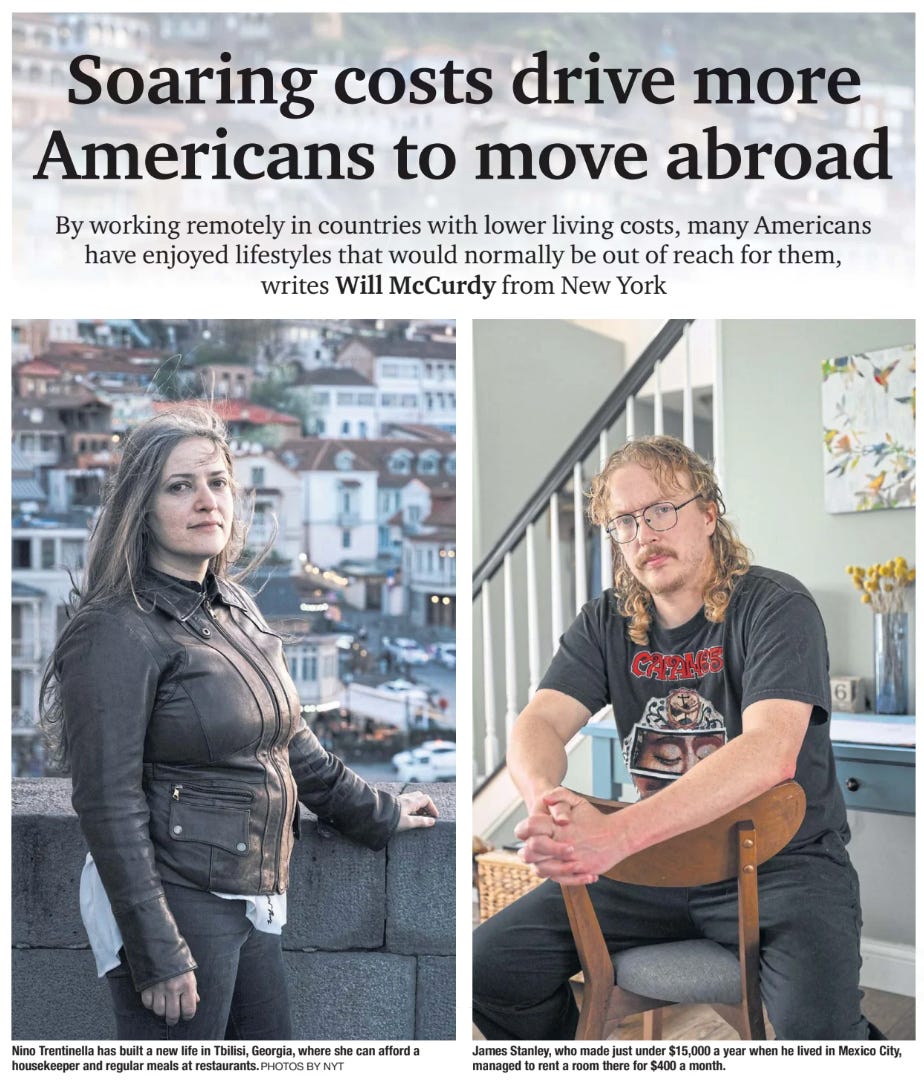
There’s a familiar narrative making the rounds again. Americans - squeezed by rising rents, healthcare costs, and the general absurdity of everyday life - are packing up and moving abroad. The pitch is simple, almost irresistible: same income, lower costs, better life.
It’s clean. It’s clickable. It’s also incomplete.
Because what we’re really talking about here isn’t just moving abroad. It’s three very different things that keep getting lumped together: relocation, expat life, and digital nomadism. And confusing them isn’t just a semantic issue—it distorts how we understand what’s actually happening on the ground.
Let’s unpack it properly.
The cost-of-living escape plan (a.k.a. relocation lite)
The article frames the trend through a very specific lens: Americans leveraging remote work to arbitrage cost of living. Earn in dollars, spend in lari, pesos, or euros. Fair enough.
But this isn’t new. It’s just newly visible.
What is new is the scale - and the fact that remote work has removed friction. You no longer need a job transfer, a local contract, or a long-term commitment. You just need Wi-Fi and a passport.
But here’s the first problem: this is not digital nomadism by default.
If someone moves to Tbilisi, Lisbon, or Mexico City and stays there indefinitely, setting up routines, building relationships, maybe even signing a lease or dealing with local bureaucracy… that’s not “nomadic.”
That’s relocation. Or, more precisely, expat life with a remote income.
Nomad vs Expat: same plane, different destination
We keep pretending these categories blur into each other. They don’t. Not really.
A digital nomad is structurally temporary. Movement is part of the model. You optimize for flexibility, not stability.
An expat is structurally settled. Even if the move was opportunistic or driven by cost, the intent shifts toward staying.
And that shift changes everything.
A nomad cares about visa runs, short-term rentals, and community churn.
An expat starts caring about healthcare systems, taxes, schools, and long-term residency.
Same starting point, completely different trajectory.
So when someone says, “I moved abroad because it’s cheaper,” the real question is:
For how long - and with what intention?
The lifestyle arbitrage myth (and where it cracks)
The article highlights a key idea: people accessing lifestyles abroad that would be out of reach in the U.S.
True. But only up to a point.
Because the arbitrage works best in a very specific window:
You earn in a strong currency
You spend in a weaker one
You don’t fully integrate into the local system
The moment you start integrating - paying local taxes properly, using private healthcare, dealing with inflation in popular expat hubs - the gap narrows. Sometimes dramatically.
Lisbon is the classic example. Once “cheap Europe,” now pricing out locals and surprising newcomers who arrived five years too late.
Mexico City? Same trajectory.
Tbilisi? Still early, but not immune.
The pattern repeats:
Nomads discover → Expats settle → Prices rise → Narrative lags behind reality
So what are we actually seeing?
Not a mass conversion into digital nomads.
What we’re seeing is a spectrum:
Short-term nomads testing locations (3–6 months, maybe a year)
Soft relocators who arrive “temporarily” and quietly stay
Full expats who commit- legally, financially, emotionally
The article mostly captures group #2 but labels it as something broader and trendier.
And that’s where the confusion creeps in.
Why this distinction actually matters
Because policies, cities, and communities respond differently depending on who’s arriving.
Nomads bring liquidity and short-term demand.
Expats reshape housing markets, services, and demographics.
If you’re a small Italian town trying to attract remote workers, this isn’t a detail—it’s strategy.
Do you want:
People passing through every few months?
Or people who might actually stay, invest, and integrate?
Same remote worker. Completely different impact.
The uncomfortable truth
Yes, cost of living is a driver. A big one.
But reducing the story to “Americans moving abroad because it’s cheaper” misses the deeper shift:
This is not just economic.
It’s structural. Cultural. Behavioral.
People are renegotiating where—and how—they live.
Some will keep moving.
Some will stop.
Most don’t know yet.
And maybe that’s the most honest version of the story.
Final thought (the Nomag way)
Call it what you want - nomad, expat, remote worker, escape artist.
Just don’t pretend they’re the same thing.
Because the moment you stop moving, you’re not just chasing a cheaper life anymore.
You’re building one.