

Oh, If the Financial Times Says So: Maybe Roaming Really Is Dying
Travel eSIMs are booming, mobile operators are worried about their roaming cash cow and digital nomads everywhere are struggling to look appropriately surprised.


There are certain things frequent travellers learn to accept.
Airport coffee will cost more than lunch. A seat described as “extra legroom” may give you approximately enough additional space to store one medium-sized knee. Hotel Wi-Fi will be excellent everywhere except inside your room.
And mobile roaming will somehow cost far more than seems reasonable.
For years, we accepted this last one with remarkable docility.
Cross a border. Receive a cheerful text message from your mobile operator. Discover that using Instagram for seventeen minutes may require refinancing your house.
Apparently, however, the party may finally be getting slightly less profitable.
And this time it isn’t NOMAG saying it.
It’s the Financial Times.
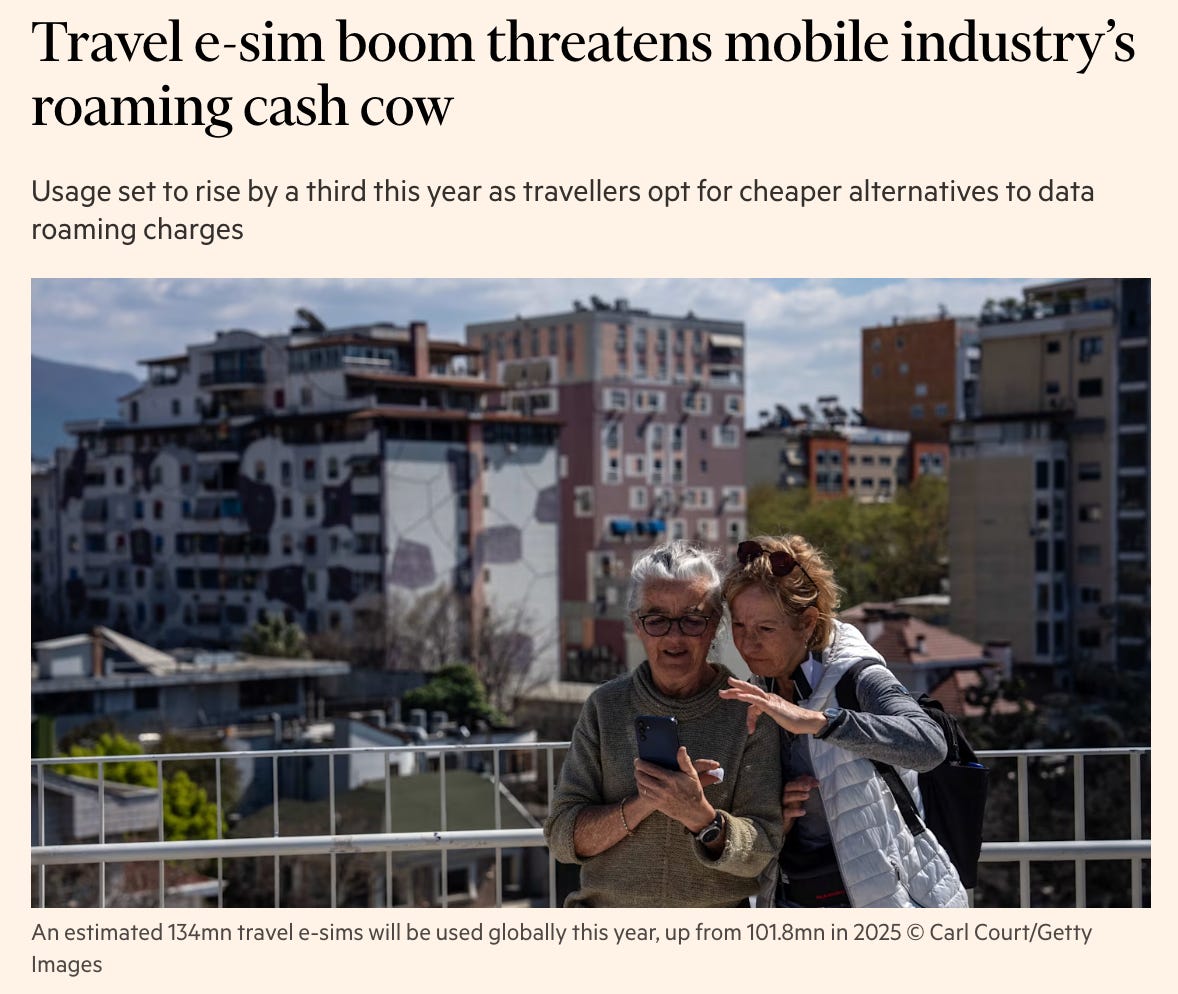
According to the FT, around 134 million travel eSIMs are expected to be used globally in 2026, up from 101.8 million last year — an increase of roughly one third. The newspaper also reports that traditional mobile operators derive around 3–5% of their revenues from roaming, typically at relatively attractive margins.
So yes: somewhere, possibly inside a very tasteful telecom headquarters, somebody has noticed that travellers have discovered the “download app” button.
The great roaming revelation
Travel eSIMs are not revolutionary because they have invented mobile data.
They are revolutionary because they have removed several of the irritating steps between I have landed and my phone works.
No shop.
No plastic SIM card.
No hunting for a paperclip.
No attempt to explain your passport number to somebody behind an airport kiosk while twelve people wait behind you.
And, increasingly, no automatic assumption that your existing operator should be allowed to decide what international connectivity costs.
The FT gives a particularly entertaining comparison: a Revolut eSIM example offering 1GB for seven days at £3.49, while EE can charge £8 for 500MB usable over 24 hours.
That does not mean every eSIM is cheaper.
It does mean consumers can now compare prices in approximately the same amount of time it takes to order an Uber.
That changes things.
Digital nomads worked this out rather early
For a traditional tourist, connectivity is convenient.
For a digital nomad, it is infrastructure.
We don’t need data because we desperately want to upload another sunset.
We need it because Slack exists.
Because Zoom exists.
Because our bank decides that the precise moment we cross into Albania is the ideal time to request biometric authentication.
Because the apartment Wi-Fi advertised as “perfect for remote work” occasionally turns out to be a router last rebooted during the Obama administration.
Being able to install another connection in a couple of minutes therefore feels considerably more important when your income depends on remaining online.
And once people become accustomed to switching connectivity providers digitally, something else happens.
Loyalty starts looking slightly old-fashioned.
Your mobile operator may have known you since 2014.
Lovely.
But if another company can connect you in Thailand, Italy or Mexico in three clicks for a fraction of the price, your fourteen-year relationship suddenly begins to feel less like loyalty and more like inertia.
Before Europe gets smug
There is an important caveat.
For EU and EEA consumers travelling within the European roaming area, this story is less dramatic because Roam Like at Home already allows people to use their domestic mobile plan abroad without an additional roaming surcharge, subject to fair-use provisions. The system has been extended until 2032.
And roaming is meant for travel, not permanent expatriation: if you spend and use your phone abroad more than at home over a four-month period, your operator can eventually intervene under fair-use rules.
For someone spending several months in Italy, meanwhile, a proper Italian SIM or eSIM may still make more sense than repeatedly buying travel packages.
So this is not one of those articles entitled:
WE TESTED 37 eSIMs AND NUMBER 14 CHANGED OUR LIVES.
We didn’t.
There is no universally cheapest solution.
There is just much more choice.
And choice is precisely the problem if your old business model relied on customers not having much of it.
The telecom industry is discovering what happened to travel
Hotels discovered Booking.
Taxis discovered Uber.
Banks discovered Revolut and Wise.
Travel agencies discovered that people could apparently operate Google themselves.
Now telecom operators are discovering that the SIM card doesn’t necessarily have to belong to them.
The FT reports that the travel eSIM market was worth an estimated £649 million in 2025 and could reach £3.2 billion by 2030. Meanwhile, the five leading eSIM apps have already recorded more than 26 million downloads this year.
And the competition isn’t only coming from telecom companies.
Banks, fintech platforms and other apps with existing customer bases can simply add connectivity to services people already use.
This is probably the part that should make traditional operators most nervous.
Because the next generation of telecom competitor may not look like a telecom company at all.
Which is very digital-nomad
There is something wonderfully appropriate about this.
Digital nomads have spent years unbundling their lives.
The office became a laptop.
The bank became an app.
The boarding pass became a QR code.
The permanent address became… complicated.
It was perhaps inevitable that the mobile contract would eventually get the same treatment.
Connectivity is becoming something you acquire when and where you need it, rather than something permanently attached to the operator whose shop happened to be closest to your parents’ house when you were eighteen.
For travellers, that’s mostly good news.
For telecom operators, apparently, it is a “challenge”.
For the rest of us, it is called competition.
An important NOMAG commercial disclosure
NOMAG received exactly €0 from Airalo, Saily, Revolut, Klarna, your mobile operator, their mobile operator or anybody else in the eSIM business to write this article.
Our enthusiasm for cheaper roaming is therefore tragically organic.
However, should somebody from the telecom or eSIM industry feel an urgent desire to sponsor NOMAG, we would like to make clear that we are a modern and commercially open-minded publication.
We sell advertising.
We sell partnerships.
Under the right circumstances, we would probably sell NOMAG-branded underwear.
What we don’t sell is the conclusion.
And the conclusion here seems fairly simple:
when travellers are given an easier and cheaper alternative, they tend to use it.
Even the Financial Times has noticed.