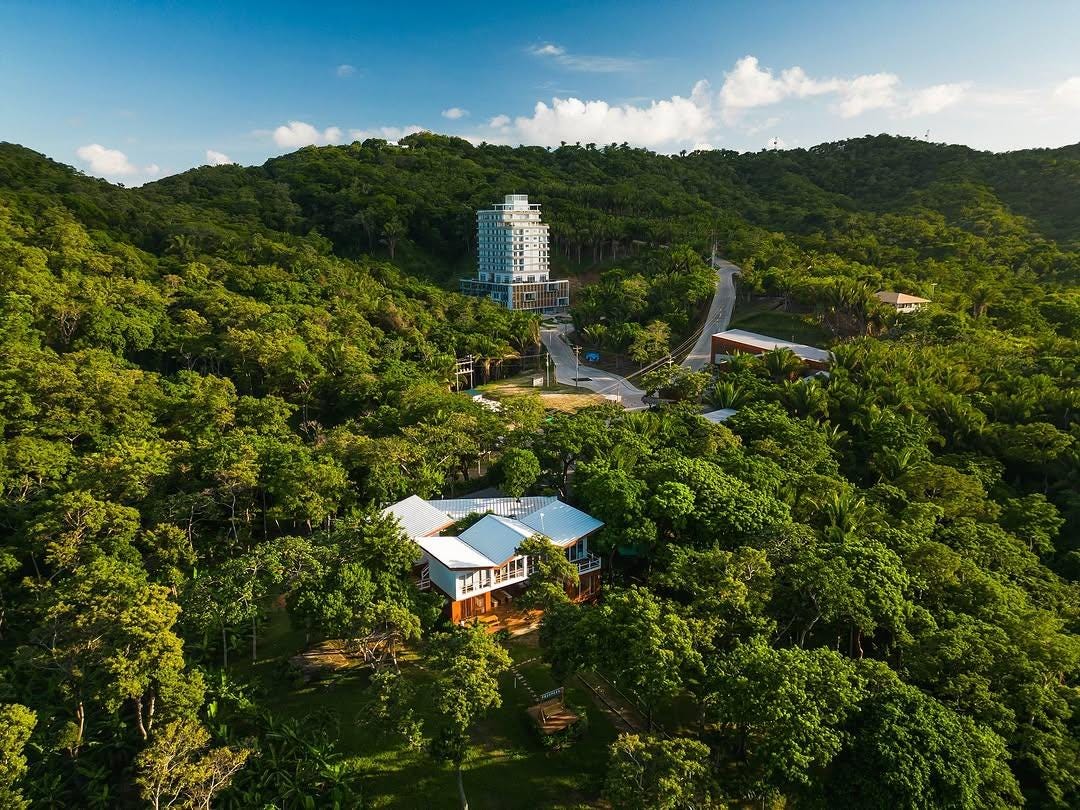
Próspera: the startup nation that forgot it’s still on Earth
There’s something undeniably seductive about the idea. A palm-lined enclave, fast permits, low taxes, no bureaucrats asking for forms in triplicate, and a Bitcoin ATM humming quietly next to your oat milk latte. A place where you can build, test, implant, inject, disrupt—without someone from a ministry showing up with a clipboard and a “no.”
Welcome to Próspera, as recently profiled by Business Insider, with reporting originally from Die Welt. A private city on the Honduran island of Roatán that aspires to be less a place and more a proposition: what if the state were optional?
At first glance, it looks like the kind of place Nomag readers should love. Remote. Exotic. Built for entrepreneurs, digital nomads, and people who use “sovereignty” both in legal and personal terms. A frontier, but with Wi-Fi. Or at least, that’s the pitch.
We’re not buying it. And not for the reasons you might expect.
The fantasy: frictionless living, on demand
The Próspera model is simple in theory and radical in implication. Step past the guarded barrier and you’re no longer really in Honduras. You’re in a privately run jurisdiction where rules are set by a corporation, taxes are minimal, and governance is, effectively, a product.
Need a building permit? Two weeks.
Want to test biotech on yourself? Sure, sign here.
Prefer Bitcoin to banks? There’s a machine for that.
It’s the logical extension of platform thinking. If Uber unbundled transport and Airbnb unbundled hospitality, Próspera tries to unbundle the state itself.
Citizenship becomes a subscription. Rights become services. Regulation becomes optional—if you can price the risk.
It’s not entirely new. Libertarian thinkers like Peter Thiel have been arguing for years that democracy and freedom are not necessarily aligned, and that the future might belong to “network states” and private jurisdictions competing for residents.
Próspera is what happens when that PowerPoint becomes concrete.
The reality: a startup, not a society
Here’s the first crack in the narrative: Próspera isn’t a city. It’s an early-stage startup with better branding.
Around 200 residents. A few hundred registered companies. A handful of buildings aligned along a single road. A coworking space with slogans like “Make Death Optional” and “Tax is Theft.” A construction site with ambition far ahead of execution.
This is not urbanism. It’s a pitch deck you can walk through.
And like many pitch decks, it quietly skips over the boring but essential layers that make places livable: infrastructure resilience, public accountability, social cohesion, long-term governance.
Electricity? Unstable.
Internet? Surprisingly fragile (hello, Starlink dish).
Legal status? Actively contested—Honduras repealed the framework that allowed Próspera to exist in the first place.
You can disrupt a market. You can’t beta-test a society in the same way.
The uncomfortable bit: freedom for whom?
Próspera sells itself as a haven for builders. And to be fair, it is—if you’re the kind of builder who is constrained elsewhere.
Biotech startups testing gene therapies on healthy humans.
Crypto firms operating in regulatory grey zones.
Biohackers implanting chips and magnets into their bodies.
This is not accidental. It’s the core value proposition: come here to do what you can’t do elsewhere.
And that’s exactly where the unease starts.
Because when you strip away regulation, you’re not just removing inefficiency. You’re also removing safeguards. The same system that allows faster innovation also enables higher risk—sometimes existential risk.
The Próspera logic is brutally consistent: if an insurer is willing to underwrite it, it’s acceptable. Ethics becomes actuarial.
That might work for a niche group of highly informed, well-capitalized individuals. It’s less convincing as a model for broader society.
The political elephant in the room
There’s another layer that the glossy narrative tends to downplay: sovereignty isn’t just a technicality.
Próspera exists because a relatively poor country allowed parts of its territory to be governed differently, in exchange for investment. That arrangement has already been challenged and partially dismantled by Honduran institutions.
Critics—like academic Sarah Moser, quoted in the reporting—go further, calling the project a form of modern colonialism: a profit-driven enclave with limited ties to the local population.
That’s not just ideological pushback. It’s a structural vulnerability.
If your “country” depends on the political tolerance of another country that has already changed its mind once, you’re not sovereign. You’re temporary.
The Nomag problem: this isn’t belonging
Here’s where it gets interesting for us.
On paper, Próspera ticks all the Nomag boxes: remote work, international community, alternative living, escape from broken systems.
But scratch the surface and it reveals something fundamentally different from what we’ve been advocating for years.
Nomadism, at its best, is about integration without assimilation. It’s about entering places, understanding them, contributing to them, and—yes—benefiting from them, but within a shared framework.
Próspera flips that logic. It’s not about engaging with a place. It’s about bypassing it.
It creates a parallel layer that floats above the local reality, selectively interacting with it when convenient. The ultimate expat bubble—just formalized, legalized, and scaled.
That’s not a village. It’s an interface.
Speed vs. depth
There’s one argument that keeps coming up in Próspera’s favor: speed.
Two weeks for permits instead of four years.
Immediate execution instead of endless negotiation.
Momentum instead of stagnation.
And yes, that matters. Anyone who has tried to build anything in parts of Europe knows exactly how suffocating bureaucracy can be.
But speed without depth is just acceleration toward an unknown outcome.
Cities—and communities—are slow by design. Not because they’re inefficient, but because they’re layered. Every rule, every friction point, every negotiation is the result of competing interests being balanced over time.
Remove that, and you don’t just remove friction. You remove memory.
So… is this the future?
Probably, in some form. The idea of modular governance, regulatory competition, and more flexible residency models isn’t going away.
But Próspera, as it stands, feels less like the future and more like an experiment conducted by a very specific demographic, for a very specific set of use cases.
It’s a lab. Not a blueprint.
And labs are useful—but only if you’re clear about what you’re testing, and who bears the cost when things go wrong.
Final thought: the illusion of exit
The most compelling promise behind projects like Próspera is the idea of exit.
If systems don’t work, you leave. If states fail, you build new ones. If rules constrain you, you opt out.
It’s an appealing narrative. Especially for people who have the means to move, invest, and choose.
But the reality is messier. You can exit bureaucracy. You can exit taxation. You can even, temporarily, exit regulation.
What you can’t fully exit is interdependence.
At some point, every “private paradise” runs into the same question: what happens when the outside world pushes back?
History suggests the answer is rarely as frictionless as the brochure.