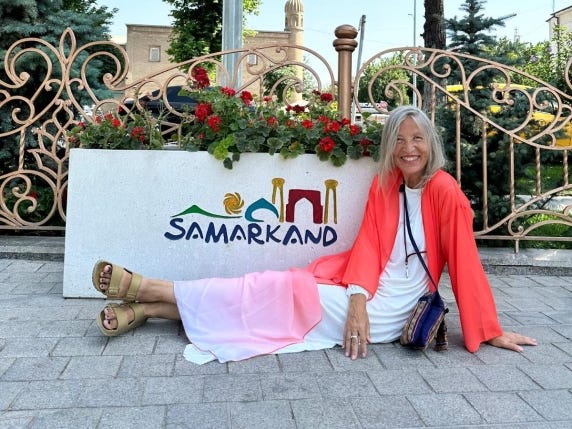
She Sold Everything at 65 to See the World
And No, Digital Nomads Are Not Just 25-Year-Olds With Backpacks
Who said nomads are supposed to be young, restless, and permanently attached to a co-working space in Lisbon?
Meet Savina Sciacqua, known in Italy as “La Nonna in Viaggio” - the travelling grandma - who at 65 decided to simplify her life, close her Milan rental contract, sell what she didn’t need, pack four suitcases and keep moving. Not for a sabbatical. Not for a gap year. For good.
She has already visited 146 countries. Her goal is simple and wildly ambitious at the same time: complete the world.
And suddenly Italy is talking about nomadism again, but from a completely different angle.
Four suitcases and radical lightness
Savina is not a trust-fund traveller, nor a glossy influencer sponsored by luggage brands. She is a long-time travel writer and journalist who has turned curiosity into a profession. Before embracing full nomadism, she made a very concrete decision: reduce fixed costs, eliminate the unnecessary, and redesign her life around mobility.
Four suitcases. That is her material perimeter.
She follows the sun, avoids winter when possible, moves across continents with a mixture of planning and instinct. There is no romantic fantasy in the way she describes it. There is discipline. Awareness. Financial balance. She openly says travelling costs money, but travelling wisely is possible.
Her income comes from her books and from children’s audiobooks under the project “La Nonna che Parla”. In other words, intellectual work funds geographical freedom.
This is not escapism. It is architecture.
Nomadism is not a generation. It is a mindset.
For years, digital nomadism has been packaged as a youth trend. Laptop on the beach. Co-living in Bali. Remote coding from Medellín. The aesthetic is always similar: 28 years old, MacBook, coconut.
Savina quietly dismantles that stereotype.
She does not sell a startup. She does not pitch a course. She does not brand herself as a “location independent entrepreneur”. She simply lives what many twenty-somethings talk about.
She travels mostly alone. She stays alert. She avoids risky situations at night. She has faced logistical chaos in Zambia, overcrowded vans in Bolivia, lost luggage in Seoul, and even a near-fatal accident in Marbella that required spinal surgery. There is nothing Instagram-filtered in that.
And yet she continues.
Not because it is glamorous, but because the unknown still excites her more than comfort.
The unfinished map
Africa is almost complete on her list. Only a handful of countries remain, postponed due to instability or epidemics. The Americas, Asia, Europe — largely done. The real frontier is Oceania, those remote island nations scattered across the Pacific: Tuvalu, Kiribati, Palau, the Marshall Islands, Samoa, Tonga.
Reaching them is expensive and logistically complex. She even considers boarding a vessel to get there, still unsure in what capacity. Tourist? Helper? Crew?
That detail matters.
Nomadism, at its core, is not about hopping between easy hubs. It is about navigating the difficult edges of the map.
But where is home?
This is where the story becomes even more interesting for us at NOMAG.
Savina does not reject the idea of home. She simply refuses to settle for a place that does not seduce her. She imagines an Italian city that is neither too big nor too small, rich in beauty, layered with history, capable of “sprinkling beauty into her eyes,” as she poetically says.
She may soon spend time in Asti for a new project. She returns often to Alba. She speaks of Italy as a country without equal.
For someone who has seen 146 nations, that statement is not naive patriotism. It is comparative knowledge.
And here is the subtle twist: mobility does not eliminate belonging. It refines it.
Family without fixed coordinates
Her daughters live internationally. They meet in Mexico. In Belgium. Wherever life aligns their trajectories. The traditional Sunday lunch has been replaced by continental intersections.
Is that fragmentation? Or evolution?
In a world where mobility is increasingly normal, perhaps this is simply the new geometry of family.
Why her story matters now
Italy often debates digital nomads through the lens of visas, tax regimes, and short-term rentals. The narrative is bureaucratic or economic. Rarely existential.
Savina’s story brings the conversation back to something more human.
Nomadism is not just about remote work. It is about agency. About redesigning your life when you are supposedly “too old” to do so. About refusing the script that says that after a certain age you shrink your world instead of expanding it.
For the global nomad community — young, mid-career, retired, hybrid — her journey is a reminder that mobility is not demographic. It is philosophical.
And perhaps this is the real headline:
The future of nomadism is not younger. It is freer.
At NOMAG we have long argued that remote life is not a trend but a structural shift. Savina simply proves that the shift is generationally fluid. The backpack is optional. The curiosity is not.
So next time someone tells you nomads are just “kids with laptops,” you might want to introduce them to a 65-year-old woman with four suitcases and 146 stamps in her passport.
And counting.