

Substack, It Was Fun. But We Should Start Seeing Other Platforms.
We brought 220,000 readers to the relationship. You treated us like needy beginners. So we are keeping the mailing list, changing the passwords and embracing digital infidelity.


A small note for those reading us on Substack: NOMAG is not going anywhere. We will continue publishing here. The database (80,000 members and counting), however, has already packed its bags and moved elsewhere.
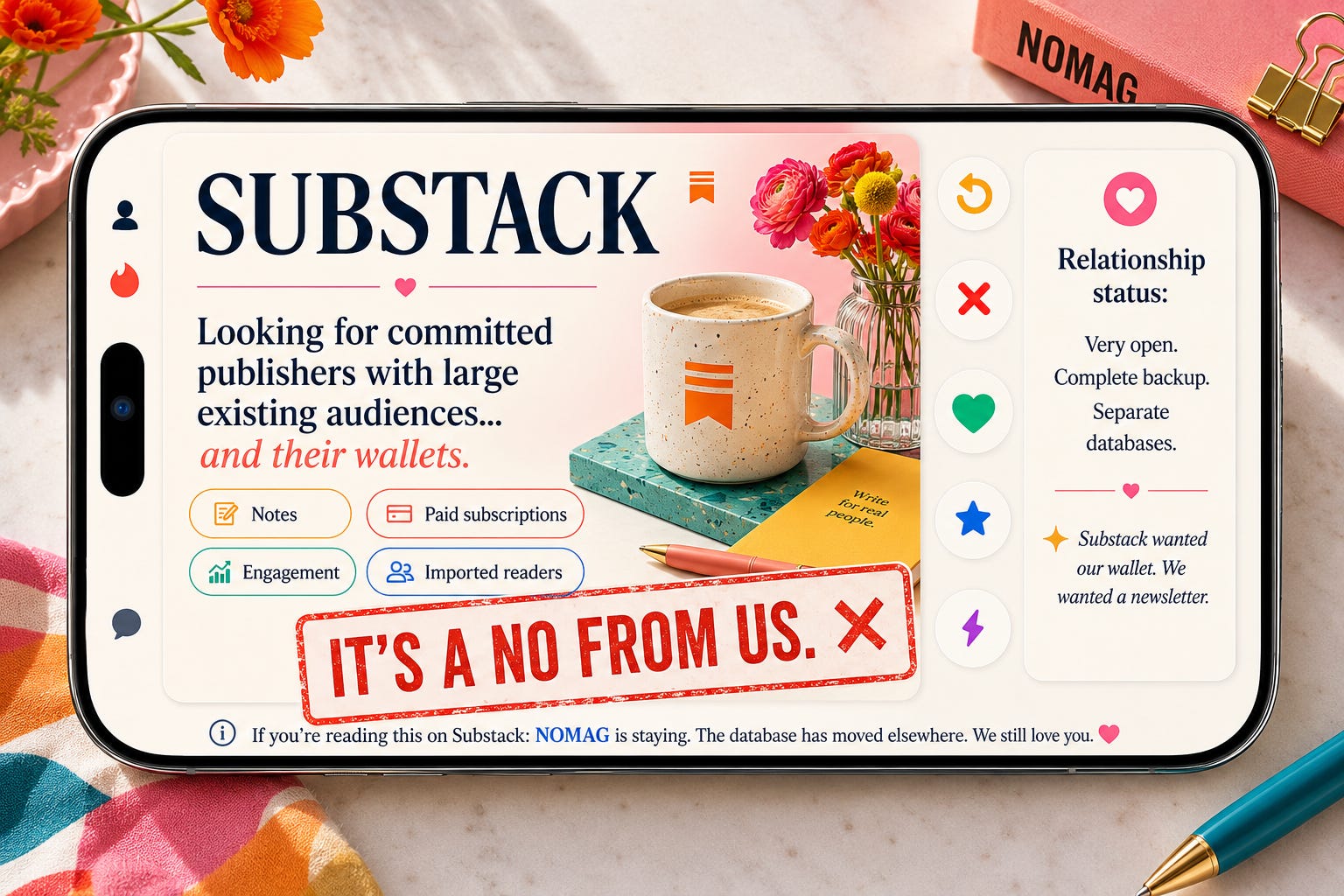
Dear Substack,
No hard feelings. We still love you. We simply no longer leave the spare keys under the mat.
We have been on Substack for roughly a year. We did not arrive with fourteen subscribers, an inspirational quote and a burning desire to become a thought leader by writing weekly essays about the importance of writing weekly essays.
We brought publications: Esco quando voglio. NOMAG. The NOMAG Pulse. ITS Journal. We also encouraged friends and editorial partners to join us, most notably We the Italians.
When we began migrating, the publications directly connected to our businesses already had a combined registered audience of roughly 180,000 to 185,000 people.
Today, that figure is approximately 220,000.
And that does not include We the Italians, which adds more than another 100,000 readers.
So, directly or indirectly, we helped bring an editorial ecosystem of more than 320,000 people towards Substack.
These were not readers discovered for us by a benevolent algorithm.
They came through our websites, events, social channels, publishing work, professional activities and years of direct audience-building. We had obtained their email addresses one by one, while managing privacy obligations across Italian, British and American businesses.
We did not arrive at Substack empty-handed.
We brought the guests, the champagne, the family silver and, apparently, enough furniture for Substack to begin assuming the house was ours only in theory.
We brought the party. Substack brought the seating plan.
The attraction was obvious.
Email distribution at this scale is expensive. Services such as Mailchimp and their many charmingly priced competitors become rather less charming once your database moves into six figures.
We were not obsessed with monetising every reader. Paid subscriptions were — and remain — a welcome token of appreciation, not a toll booth placed in front of every article.
Substack offered an elegant publishing interface, readable newsletters, a functioning archive and a relatively simple way to distribute our work.
It looked rather good.
Then the relationship began asking why we were not spending more time together.
Why were our readers not producing enough engagement?
Why were we not using Notes more aggressively?
Why were we not converting more people into paid subscribers?
Because, darling, we wanted a newsletter.
We did not realise we had joined a digital wellness retreat where every reader had to demonstrate emotional commitment to the platform.
Many of our readers opened the email and read it.
That quaint activity once known as “reading” was apparently not always enough. They did not necessarily click through, download an app, post Notes, applaud, comment, recommend strangers or spend the afternoon wandering around Substack’s internal shopping centre.
They had subscribed to us.
Not to a lifestyle.
Substack wanted a relationship with benefits. We wanted a newsletter.
The migration had already cost us readers.
Some did not want another app. Some disliked being pushed towards other publications. Others simply failed to complete the additional steps involved in moving from an existing mailing relationship into a new platform ecosystem.
To avoid abandoning them, we kept several systems running: our direct databases, Substack, LinkedIn, our websites and other paid distribution services.
In other words, we reproduced precisely the administrative clutter we had hoped to escape.
Then came the concerns about inactive readers.
Then requests or processes requiring reconfirmation.
Then communications which, from our perspective, arrived with remarkably little meaningful consultation, despite the size of the audiences involved.
We also encountered difficulties around readers to whom we had granted complimentary or lifetime status, with platform processes that appeared capable of pushing them back towards free membership or payment.
The technical detail is not the heart of the matter.
The treatment is.
We were handled as though we were hopeful beginners who should be grateful for a place at the creator table.
As though our publications had arrived on Tuesday, our mothers made up half the mailing list and our entire commercial strategy involved manifesting abundance beneath a Notes post.
No one seemed particularly interested in the fact that the publications directly connected to us had a combined audience of 220,000 people.
No one appeared to think that adding We the Italians — more than another 100,000 — might justify an actual conversation.
A proper one.
The sort involving people rather than an automated message explaining what had already been decided.
It is not you, Substack. Actually, it is.
Platforms are entitled to have rules.
Substack is entitled to favour paid subscriptions, encourage Notes, promote internal discovery and build rankings around the activity that best supports its own business.
But those rankings are not neutral measures of editorial relevance.
They reward the publishers who feed the platform’s preferred economic model.
Again, perfectly legitimate.
Just not particularly romantic.
The grand cultural language surrounding platforms often suggests that they exist to restore the sacred relationship between writers and readers.
In reality, that relationship remains sacred for precisely as long as it behaves in a commercially convenient fashion.
Do not use Notes enough?
Strange.
Do not push paid subscriptions?
Strange.
Have tens of thousands of imported readers who simply open emails rather than perform inside the platform?
Very strange indeed.
At some stage, Substack appears to have forgotten that not every publication exists to become a miniature version of Substack.
We brought 220,000 readers. We may have lost 10,000 to 12,000.
According to our internal estimates, we may have lost approximately 10,000 to 12,000 subscriptions from the audiences we originally brought into this migration.
How many genuinely new readers did Substack’s network generate for us?
Perhaps 2,000.
These are estimates rather than audited figures, and we are perfectly willing to allow a generous margin for error.
The imbalance nevertheless remains rather striking.
We brought a substantial existing audience, lost a meaningful part of it during the relationship and gained a comparatively modest number through Substack itself.
Today, our deliberately charitable estimate is that fewer than one third of our 220,000 readers will ultimately remain on Substack.
The rest will continue to receive our work through our direct databases, LinkedIn, our own websites and those expensive email distribution services we had hoped to reduce.
This means more work for us.
It also means considerably less dependency.
A painful bargain, perhaps, but a useful education.
An Italian divorce, without the murder

We are not dramatically leaving Substack.
That would be emotionally satisfying for about twelve minutes and commercially rather silly.
Instead, we are having an Italian divorce.
Not the Pietro Germi version. Nobody needs to die.
This is the modern edition: immediate separation of digital assets, shared use of selected furniture and a very clear understanding that the address book is coming home with us.
We will continue publishing on Substack for readers who discovered us here and wish to remain.
We will keep using the archive while it remains useful.
We will also create and maintain a complete independent backup because, dear Substack, trust has left the building and taken the good towels with it.
We will use the free tools available to us for as long as they remain useful.
What we will no longer do is automatically direct new readers towards Substack.
People who find us through our websites, events, social channels, professional networks or future publications will enter systems controlled directly by us.
Substack will remain a distribution channel.
It will no longer be home.
We can still be friends. But I am changing the passwords.
The relationship was fun.
There were excellent dinners. The flat was tastefully decorated. The publishing tools worked. We met interesting people.
But the exclusive phase is over.
As a serial dater, I am now embracing a very open relationship.
I will continue to visit Substack when it suits me. I may use the sofa, borrow a book and occasionally stay the night.
But my documents will remain at my place.
My contacts will not be left on the bedside table.
And yes, the passwords are being changed.
More importantly, I intend to cheat.
Shamelessly.
I will flirt with every promising publishing platform that sends a well-written message. I will test every distribution tool that offers something useful. I will use LinkedIn, direct email, independent websites and whatever new platform emerges next Thursday afternoon.
Whenever someone asks us where they should launch a new publication, Substack will no longer receive our automatic recommendation.
This is not revenge.
It is what happens when a business loses the benefit of trust.
We used to praise Substack to friends, publishers and partners. We encouraged others to join. We effectively acted as unpaid ambassadors because we believed the product and the relationship deserved it.
Our future recommendation will be rather more nuanced:
Use Substack. Enjoy it. Exploit what it does well. But back up everything, maintain your own direct audience channel and never mistake convenience for ownership.
Substack may not enjoy this arrangement as much as we will.
We shall continue using what it provides for free while bringing it fewer new users and enthusiastically testing its competitors.
That is the trouble with open relationships.
Both parties are technically free, but only one may discover that the other has many more options.
Newsletters existed before Substack. Awkward, but true.
Substack did not invent newsletters.
It did not invent writers, readers, publishing, communities or direct audience relationships.
It created a very good platform for organising them.
Perhaps, during its impressive growth, it became a little greedy. Perhaps it began confusing control of the venue with ownership of the relationships taking place inside it.
Readers do not belong to us.
They are free people who may subscribe, unsubscribe, disappear, return or read somebody else entirely.
But we built the relationship.
We did so over years, one email address at a time. We are no longer willing to place that entire relationship inside a platform that treated us as though we were interchangeable amateurs.
Does Substack suck?
No.
That would be childish and inaccurate.
It remains an excellent product and, for certain editorial models, one of the best available.
But it is not our friend. It is not a cultural charity. It is not the natural and permanent home of independent publishing.
It is a commercial platform pursuing its interests.
From now on, we shall pursue ours with equal enthusiasm.
No dramatic exit.
No slamming doors.
Just a complete backup, separate finances, several new lovers and a majestic, multilingual and wonderfully liberating:
who gives a damn?