



The comparison is deliberately paradoxical and, on paper, fairly ridiculous. My wife and I are not part of a NY Mafia family, nobody has changed our identities, there are no federal agents parked discreetly down the road and, as far as I know, nobody is trying to find us. Yet every time I watch Luc Besson’s The Family, in which Robert De Niro and Michelle Pfeiffer play an American couple relocated under witness protection to a small town in Normandy, I recognise rather more of our own life in small Italian communities than seems entirely reasonable.
The family in the film has been instructed to keep a low profile, behave like ordinary people and integrate without drawing unnecessary attention to themselves, objectives at which they are predictably unsuccessful. De Niro’s character presents himself as a writer and spends much of his time at a computer, while the practical business of settling into the new place introduces him to problems involving houses, services, tradespeople and expectations that do not always work quite as he imagined. Michelle Pfeiffer’s Maggie makes a rather more social attempt to engage with the surrounding community until a sufficiently unpleasant encounter persuades her that diplomacy has reached its natural limit.
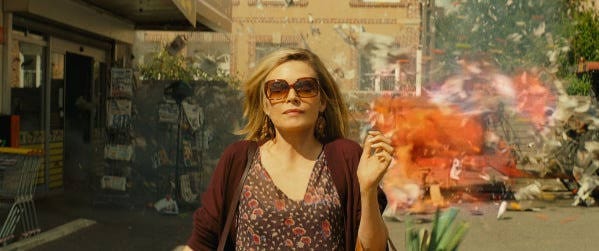
For the record, I have never beaten up a plumber, electrician, builder, window installer or anyone else after being told for the fourth time that they would definitely come “next week”, only to discover that they had subsequently vanished from every known communications network; my wife, similarly, has never blown up a local shop after being treated with spectacular condescension.
The increasingly important word in both statements is yet.
Remove those minor differences and the coincidences begin to accumulate.
We are foreigners, obviously, but that is not quite the interesting part; more accurately, we look foreign, and in a small community that can matter considerably more than whatever nationality happens to appear on a passport. We would have looked foreign in the Normandy village of The Family too, but in Italy our foreignness is communicated through dozens of tiny signals which mean almost nothing individually and become surprisingly eloquent when assembled.
There is the foreign-registered car, although that is almost too obvious to be interesting; there is an accent that occasionally suggests a life lived elsewhere, a certain discretion about where we have been and where we are going, my own tendency to be comparatively quiet and the fact that we do not naturally regard every departure or return as information requiring distribution to the surrounding population. More importantly, perhaps, there is the way we work, because very little appears quite as foreign as being visibly busy at a time when everybody around you has collectively decided that serious activity should cease until September, January, Monday or at least after lunch.
August does not necessarily stop us working, December has never proved entirely successful either, and weekends frequently fail to produce the desired effect. We may be behind computers on a Sunday, making work calls in August, leaving on Saturday morning for something that is clearly not a holiday and returning late enough to start again the following day, because our professional lives take place across different locations and schedules and the boundaries between being at home, travelling and working have become so blurred that we barely notice them any more.
For internationally mobile professionals this is hardly exotic. Work moves with us, projects and relationships exist in several places at once, and it is entirely possible to regard a small Italian community as one of your real homes while repeatedly leaving it for professional reasons. From the house opposite, however, I accept that the distinction between this lifestyle and a strangely relaxed witness protection programme may not be immediately obvious.
We are there and then suddenly we are not; the foreign car disappears and reappears, sometimes my wife is there while I am elsewhere, sometimes the reverse, sometimes neither of us is around. Bags go into the car and come out again, telephone conversations happen in different languages, visitors arrive from abroad and nobody receives an official explanation of where we are going next or when we will return.
We are not running away from anyone; we simply move because our work requires it, although I accept that, viewed from across the street, it may look remarkably as though we might be.
The resemblance becomes more uncomfortable because I spend a great deal of my time writing, exactly as De Niro does in the film. I am also the quieter member of our household, capable of passing through the village, saying hello and returning to my computer without necessarily turning every encounter into a conversation about where I have been for the previous three days.
My wife, by contrast, runs Foreign Affairs. She talks to people, particularly the older women, maintains relationships, stops for conversations and has gradually acquired a far more sophisticated understanding than I have of who is connected to whom, which apparently casual remark contains twenty years of local history and which person one should ask if one actually wants to understand what is happening.
Under normal circumstances she is therefore the diplomatic member of the household, while I remain largely responsible for Home Affairs. The difficulty is that her Foreign Office has a dangerous tendency, once a certain threshold has been crossed, to become the Ministry of War and Retaliation without requiring anything as cumbersome as a cabinet reshuffle.
Eccentricity can be tolerated, cultural differences can be discussed and a reasonable amount of inefficiency may still be absorbed in the interests of peaceful coexistence; even mild condescension can occasionally be treated as a diplomatic incident rather than a declaration of hostilities. When somebody confuses being foreign with being stupid, invents a price because they assume we will not know what something should cost, or promises for the fourth consecutive week to arrive on Tuesday without displaying the slightest intention of doing so, foreign policy can give way remarkably quickly to deterrence.
This is the point at which Michelle Pfeiffer’s character in The Family stops feeling entirely exaggerated.
No shops have been blown up — yet.
I remain at Home Affairs, where my instinct is generally to investigate before reaching the conclusion that somebody is simply taking the piss. If an electrician fails to appear, I wonder whether there is a genuine reason; if a quotation looks absurd, I compare prices and materials; if somebody changes their story, I look for the technical explanation that may have escaped me. If somebody needs help with a computer, something practical has to be organised, an extra pair of hands is useful or a dog has escaped and needs retrieving, I am generally happy to become involved.
When the problem involves a human being, however, I tend to open a file, gather evidence, compare versions, extend the benefit of the doubt and frequently arrive, after a surprisingly thorough investigation, at exactly the conclusion my wife reached approximately thirty seconds after the problem began.
“He’s taking the piss.”
It is, on the whole, a reasonably stable form of government.
The practical business of living somewhere rather than simply visiting it is also where The Family begins to feel unexpectedly relevant to the digital nomad conversation, because a place that works beautifully for four days can become a very different proposition once you need a plumber, an electrician, a reliable delivery, somebody to repair a window or simply a person who does approximately what they said they would do at approximately the time they said they would do it.
The ritual is familiar. Somebody arrives, looks carefully at the problem, declares that it is perfectly straightforward, promises a quotation for tomorrow and assures you that the work can begin next week, after which all communication ceases. Calls go unanswered, messages remain unread or, in the more sophisticated version, are read and ignored, and you gradually move from irritation to concern because perhaps something genuinely serious has happened. Three weeks later you encounter the missing person perfectly healthy and drinking coffee, whereupon he greets you warmly and announces that he really must call you.
Yes. That was, in fact, the arrangement.
On other occasions the person does not disappear at all, but a quotation arrives at a level which makes you wonder whether you are paying for the requested repair or financing a small strategic acquisition on behalf of the contractor. This is where internationally mobile people sometimes discover another dimension of looking foreign: the occasional assumption that unfamiliarity with the local system must necessarily mean unfamiliarity with money, prices or the ability to obtain a second opinion.
None of this is universal, and pretending otherwise would turn a recognisable human experience into a cheap national stereotype. Some of the finest and most dependable people we have worked with in Italy are local tradespeople whose knowledge, generosity and ability to solve problems are extraordinary, which is precisely why the contrast with the disappearing ones becomes so entertaining.
Watching The Family before some of these experiences, I thought De Niro’s response was simply insane; watching it now, I still think it is entirely unacceptable, but I understand the emotion behind it considerably better.
That distinction matters.
Yet.
There is, however, another detail which makes the whole comparison both more absurd and rather less accusatory: the pattern has followed us.
It is not confined to the small Tuscan town where we are currently spending part of our time - a location which, in keeping with the witness-protection theme, I shall continue not to identify - because we encountered remarkably similar dynamics in other Italian places where we have lived or worked, including a small town in Puglia. The landscape changed, the accent changed, the food changed dramatically and the climate certainly did, yet certain characters and situations seemed to have been recast rather than rewritten.
There was still someone who promised to come and then disappeared, someone for whom deadlines appeared to be approximate expressions of emotional intent, someone who assumed that being from elsewhere meant requiring a slightly condescending explanation of how things really work and, just as importantly, people of extraordinary generosity who helped us far beyond anything we could reasonably have expected.
Once the same thing happens in several places, it becomes difficult to blame the place.
Perhaps this is simply part of the anatomy of small communities, in Italy, in Normandy and probably almost everywhere else: relationships matter more, formal systems coexist with unwritten ones, information travels through people rather than institutions, time occasionally becomes elastic, and newcomers require a while to understand which version of reality is operating on any particular day.
There is, of course, another possibility.
Perhaps we simply ask too much.
Maybe expecting a quotation after requesting one, assuming that “Tuesday” refers to an identifiable Tuesday, believing that an agreed price should retain some relationship with the final invoice or continuing to treat August as a month in which emails may theoretically be answered are culturally aggressive expectations imported by internationally mobile people who have failed to surrender properly to local life.
I consider this explanation every time something happens.
Then we move to another town and it happens again, at which point I begin to suspect that the village may change more often than the script.
Food provides another wonderfully efficient way of discovering that foreignness is not simply a nationality but a collection of behaviours. Internationally mobile people become accustomed to crossing culinary borders without thinking very much about it: breakfast can come from one country, lunch from another and dinner may contain a combination of ingredients capable of distressing several national traditions simultaneously.
In a small Italian community, by contrast, you can discover that people who are liberal and tolerant in almost every other area of life become constitutional originalists when discussing pasta. What you eat for breakfast, the time at which you drink something, whether two ingredients are permitted to occupy the same plate and whether a particular cheese may legally approach a particular dish can cease to be private preferences and become matters of legitimate public concern.
The judgement is often magnificently confident, because local habits rarely present themselves as one possible system among several; they tend, almost everywhere, to acquire the status of the natural order.
This is precisely why the Normandy setting of The Family matters. The film is not set in Tuscany, Puglia or Sicily; the people are French, the food is different and the local history has nothing to do with ours, yet the social mechanics are recognisably similar enough to suggest that the most useful description may be the old Italian expression “tutto il mondo è paese” - the whole world is a village.
Every small place considers itself unique, and in important ways it is, but beneath the language, cuisine and local history there is often a remarkably familiar machinery. Newcomers are observed, habits become rules, somebody knows everybody’s business while somebody else merely believes they do, two people have not spoken properly since an event whose origins no outsider could hope to reconstruct, and there is almost always a brilliant tradesman whom everybody recommends and nobody can persuade to answer the telephone.
The outsider is conducting the same exercise in reverse. We study the village while the village studies us, and for a long time both sides are trying to understand what, exactly, is wrong with the other.
We look at the place and talk about its beauty; somebody born there tells us about the parking problem. We admire the landscape; they explain that a service is missing. We say we love the quiet; they ask why anybody would choose to live somewhere in which nothing happens. One of the great ironies of relocation is that the qualities attracting an outsider may be precisely those an insider has spent years trying to escape.
This becomes particularly relevant to digital nomads because the conventional image of nomadism still assumes detachment: you arrive, open the laptop, consume the destination and leave for the next one. Increasingly, however, internationally mobile professionals do something more complicated. They return to the same places, establish bases, form relationships and try to contribute while continuing to move, which creates an identity that is simultaneously local and foreign, present and absent.
You can know the neighbours, be recognised in the shop and be asked to help with something while still disappearing for two weeks and returning without having announced the trip. You can genuinely belong somewhere without being permanently there, and in a small community your absences may eventually become almost as visible as your presence.
My wife has built relationships, particularly with the older women in the village; I try to make myself useful when something falls within my limited range of practical abilities, and somewhere along the way we stopped merely occupying a house and began participating in the place around it.
I even offered to organise a small open-air cinema on our terrace.
At the time I made the suggestion, I had not connected it with The Family. Then I remembered that De Niro’s mysterious outsider, the man who spends much of his time writing, becomes involved in the local film society.
At that point the deliberately absurd comparison began to feel as though it was pursuing us personally.
Consider the evidence from the village’s perspective: a relatively quiet man with a slightly foreign accent spends a suspicious amount of time writing, works at weekends and in August, regularly disappears in a foreign car and has now suggested inviting people to his house to watch films; his considerably more sociable wife maintains diplomatic relations with the older ladies but is capable, when somebody mistakes friendliness for naivety, of moving from Foreign Affairs to Defence with impressive speed.
If we actually were in witness protection, somebody would probably tell us to behave less suspiciously.
None of this means that small Italian communities are hostile to outsiders, just as The Family is obviously not a documentary about rural Normandy. We have experienced extraordinary generosity, genuine friendship and practical help from people who also remain curious about us, occasionally misunderstand us and sometimes regard our habits with breathtaking confidence.
That contradiction is precisely what makes living somewhere so different from visiting it. A destination can be reduced to scenery, restaurants and things to do; a place in which you actually live contains favours, obligations, affection, irritation, misunderstandings, people who help when you least expect it and people who promise Tuesday until you eventually realise they have never specified which year.
For digital nomads interested in a real base rather than another temporary stop, perhaps this is one of the parts of mobility worth discussing more often. Integration is not necessarily the moment when nobody notices that you are foreign any more; it may be the moment when being foreign becomes simply one fact among many, when somebody notices you have been away, recognises that you have returned, asks you to help with a computer or a missing dog and nevertheless remains convinced that what you eat for breakfast is fundamentally wrong.
We continue to look slightly foreign, they continue occasionally to look slightly incomprehensible, and life goes on somewhere in between, with the additional suspicion that changing town does not necessarily change the script nearly as much as one might expect.
I still spend much of my time writing, my wife continues to run Foreign Affairs with occasional emergency powers, the foreign car keeps appearing and disappearing, and the little cinema on our terrace remains an entirely innocent proposal.
We are digital nomads, not fugitives; I have never beaten up the plumber and my wife has never blown up a shop.
Yet.