

The many lives of Kypseli
Athens, but make it nomad

For a lot of people, Athens is a layover wearing a laurel wreath.
You land, you climb the Acropolis, you melt slightly in Plaka, you eat something vaguely Greek near a souvenir shop — and then you escape to an island where the Wi-Fi is questionable but the sunsets are non-negotiable.
Athens, done. Or so the story goes.
But if you stay long enough to stop treating the city like a museum map, another Athens appears. One that isn’t choreographed for cruise passengers or filtered for Instagram. One that still smells like coffee, traffic, detergent, and life.
That Athens lives in Kypseli.
Not abandoned. Just passed on.
Kypseli sits just north of the historic centre. Close enough to walk, far enough to be ignored.
Between the wars, it was prime real estate: neoclassical apartment blocks, wide staircases, inner courtyards, middle-class ambition. Then came post-war sprawl, suburbs, neglect. Rents dropped. Immigrants arrived. The neighbourhood changed hands.
Not collapsed. Not erased. Changed.
That distinction matters.
Unlike other “revivals” in Europe, Kypseli didn’t get its second life through branding decks or glossy regeneration schemes. No “creative district” labels. No developer jargon. It came back because people needed somewhere to live — and could still afford it.
Students. Immigrant families. Artists. Freelancers. Remote workers quietly looking for rent that doesn’t eat their entire monthly invoice.
The boulevard that does the talking
If Kypseli has a heartbeat, it’s Fokionos Negri.
Once a river, later buried and turned into a pedestrian promenade, today it’s less a destination and more a shared living room. Dogs, prams, pensioners, laptops, gossip, long pauses. African grocery stores next to design cafés. Teenagers scrolling. Elders watching the world continue exactly as it always has.
This is what nomads usually say they want — “authentic”, “local”, “real” — but rarely stay long enough to find.
Nothing here feels staged. Because it isn’t.
Markets, books, small economies
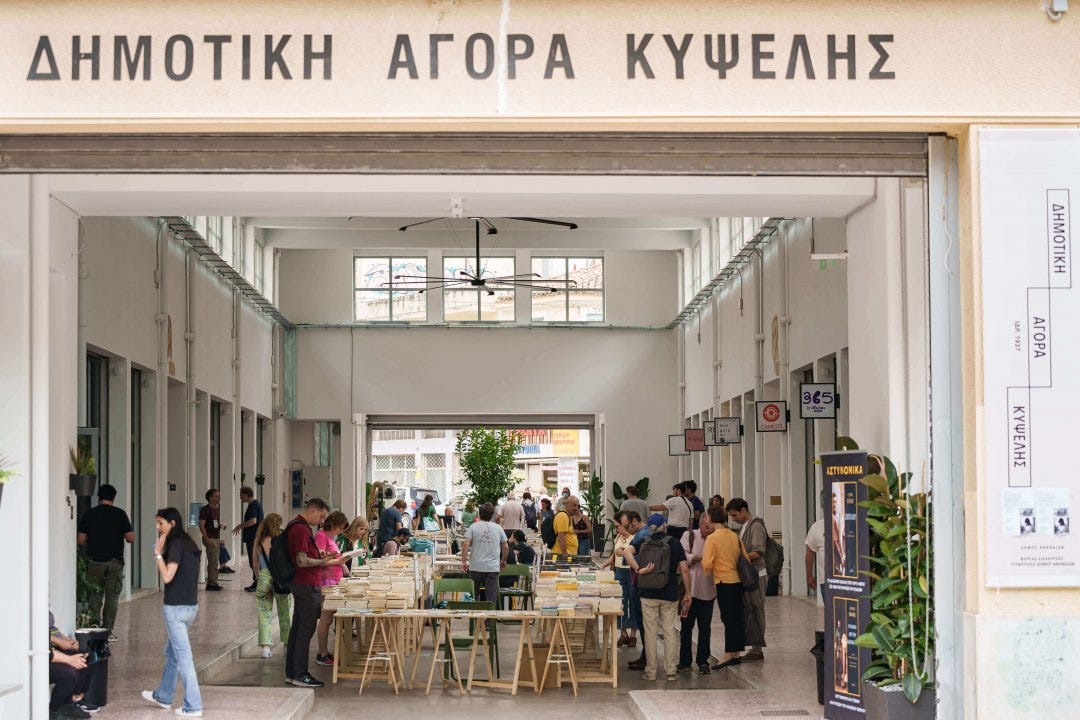
The reopening of the Kypseli Municipal Market in 2016 didn’t turn the area into a hotspot. It turned it back into itself. Food pop-ups, community events, weekend markets, cultural overlap. During one recent festival, Asian street food queues wrapped around a modernist building originally designed for neighbourhood groceries.
That mix is Kypseli’s superpower.
You see it in places like Meteoritis, an independent bookshop where browsing quickly becomes conversation. Or in small designer collectives selling ceramics, jewellery, leather goods — not as lifestyle branding, but as survival economics. Shared rent. Shared risk. Real customers.
This isn’t Etsy-ified Athens. It’s Athens figuring things out.
Eating like a resident (not a content creator)
Kypseli still eats like a neighbourhood, not a trend.
Local tavernas serve cabbage rolls, stuffed vegetables, slow food that looks unimpressive and tastes like someone’s grandmother is still in charge. €8–10 plates. No backstory required.
Coffee spots coexist across generations. Some places welcome laptops without pretending to be coworking spaces. Others don’t care what you’re doing, as long as you don’t rush.
For nomads, that’s the sweet spot: being invisible enough to belong.
Nights without spectacle
At night, Kypseli doesn’t perform.
Take Au Revoir Bar, open since 1957. Same interior. Same lighting. Same energy of quiet continuity. No menu theatre. No “concept”. Just drinks, conversation, time slowing down.
In a city constantly reinventing its past for visitors, Au Revoir survives by refusing to update itself.
It’s radical in the most boring way possible.
The fragile part
Kypseli isn’t immune to the European script. Rents are rising. Fast. Those who arrived early know they’re lucky. Those arriving now feel the pressure. The risk is obvious: the very mix that made the neighbourhood work could price itself out.
But for now, Kypseli still holds.
It hasn’t erased its past to move forward. It hasn’t frozen itself for tourists. It has absorbed change, layered it, and kept going.
For nomads tired of postcard cities and hyper-curated “vibes”, Kypseli offers something rarer: a place that doesn’t need you — but doesn’t mind you staying.
And in 2026, that might be the most honest version of Athens you’ll find.
Love how this captures urban renewal without the usual venture capital gloss. Kypseli's story reminds me that the best neighborhoods arent designed, they evolve when people can actually afford to stay. The detail about Au Revoir refusing to update is kinda brilliant.