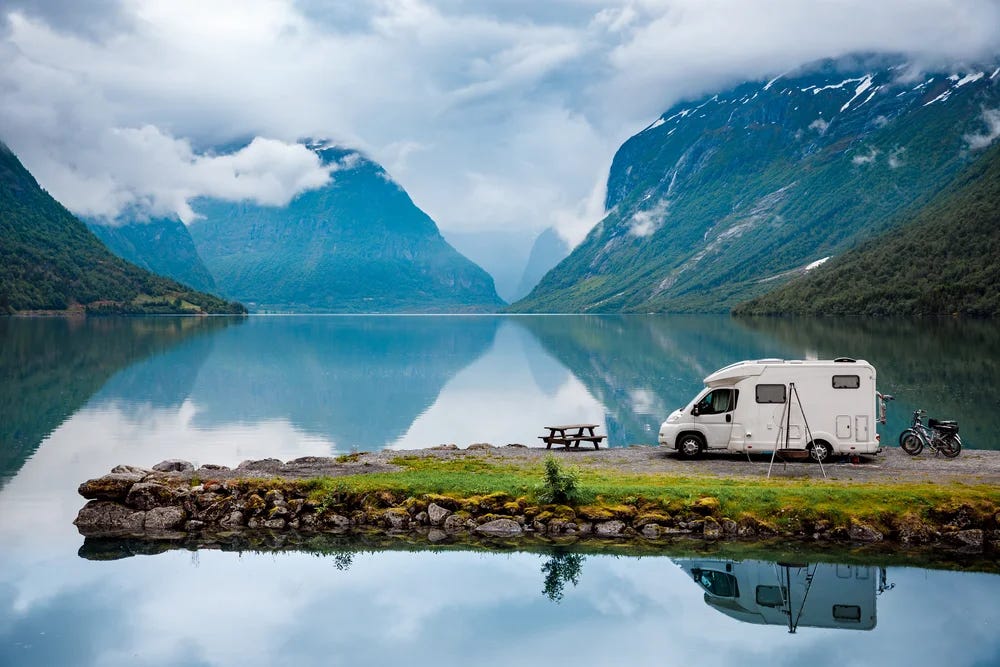
The most romantic and least forgiving species of digital nomad: those who work from a camper
The Nomag Pulse #38
There’s a particular kind of email that lands in the Nomag inbox every few weeks. It never starts with “Dear Nomag team”. It usually starts with something like “I’m replying from a lay-by outside a village you’ve probably never heard of” or “Sorry for the delay, I had to move because the wind turned”.
That’s usually how we know: camper nomads.
They are not the loudest digital nomads. They don’t dominate coworking spaces or LinkedIn feeds. They rarely talk about “optimisation”. But they are persistent, thoughtful, and quietly stubborn. And over the past year, more and more of them have been writing to us — not to sell a lifestyle, but to explain why they chose the hardest version of remote work they could realistically sustain.
So for The Nomag Pulse #38, we’re going deep into the camper nomad world. Properly deep. With names, places, contradictions, and very real trade-offs. Because if there is one nomadic tribe that deserves less mythology and more nuance, it’s this one.
🚐 Who actually chooses to work from a camper?
Let’s start by killing a myth: most camper nomads didn’t start as camper nomads.
They usually arrive here after something else stops working.
Thomas (38), product designer, Netherlands
Thomas spent five years as a classic European digital nomad: Lisbon winters, Berlin summers, the occasional month in Barcelona “for inspiration”. At some point, he realised his life had become a loop of short-term rentals, rising prices, and an inbox full of landlord negotiations.
He bought a used camper van in Utrecht, not as a rebellion, but as an experiment.
Now Thomas does long arcs rather than hops:
Portugal (Alentejo, not Lisbon) → northern Spain → southern France → the Italian Alps in summer. He works mostly with Scandinavian clients, which means late afternoons are his deep-focus hours. Mornings are for movement, surf checks, or simply not being online yet.
His rule is simple: never stay more than two nights in the same unofficial spot, and always spend money locally. According to him, that’s the difference between being tolerated and being resented.
🇪🇺 Europe: a patchwork, not a playground
Europe looks perfect for camper nomadism on a map. In reality, it’s a dense legal mosaic where behaviour matters as much as rules.
Clara (41) and Mathieu (44), content strategist & translator, France
They live half the year on the road, half the year in a small flat near Lyon. Their camper life is methodical, almost boring — and that’s exactly why it works.
France is their backbone: municipal aires, predictable services, clear signage. From there, they branch out into Italy, Switzerland, and occasionally Slovenia.
They plan routes around infrastructure, not scenery. Which is why they rarely have problems.
Their biggest lesson? “The more Instagram-famous a place is, the less suitable it is for camper work. Beauty scales badly.”
🇮🇹 Italy: difficult, generous, deeply human
Italy comes up in almost every camper conversation — usually followed by a pause.
Italy is not easy. It’s inconsistent, emotional, bureaucratic in theory and improvisational in practice. But for many camper nomads, it’s also the place they remember most vividly.
Marco (46), software architect, Milan
Marco didn’t leave Italy to escape Italy. He left Milan to rediscover it.
For two years now, he’s been doing slow loops through Abruzzo, Molise, Basilicata and inland Puglia. He avoids the coast in high season and prefers towns where nothing happens — which, incidentally, is where people still notice you.
He doesn’t call it “van life”. He calls it extended presence.
“Every time I stay more than a week near the same village, someone asks what I do. When I say I work, they relax. When I say I’m not on holiday, they relax even more.”
Italy, according to Marco, doesn’t reject camper nomads. It rejects carelessness.
🌊 Portugal and Spain: still pillars, but changing
Joana (35), UX researcher, Portugal
Joana lives between Porto and the Atlantic coast, but works almost entirely remotely for German and UK clients. Her camper is small, discreet, and deliberately unbranded.
She knows the rules tightened, especially along the coast. So she adapted: inland villages, paid camper stops, rotating locations.
Her verdict? “Portugal didn’t close. It filtered.”
Spain, especially the north, keeps appearing in stories like hers. Galicia, Asturias, Cantabria — places that aren’t chasing digital nomads, and therefore work better for them.
🇺🇸 The United States: scale changes everything
If Europe is about negotiation, the US is about logistics.
Ethan (34), full-stack developer, Colorado
Ethan works US hours, travels US distances, and thinks in weeks, not days. National parks, state parks, RV-friendly towns — the system exists, but planning is mandatory.
He uses Harvest Hosts to stay at farms and wineries, Hipcamp for longer work stretches, and mobile hotspots as his primary office infrastructure.
“The freedom is real,” he says, “but so is the responsibility. You don’t wing it here.”
🛠 The tools camper nomads actually trust (still active, still used)
Across dozens of conversations, the same platforms keep coming up — not as magic solutions, but as reliable layers:
Park4Night – still the European reference point for overnight spots and services
Campercontact – especially strong in Northern and Central Europe
iOverlander – essential outside Europe
Yescapa – peer-to-peer camper rentals in Europe
Indie Campers – structured rentals for beginners
Roadsurfer – polished, accessible, not cheap but predictable
Outdoorsy – US-focused rentals
Harvest Hosts – uniquely American solution
Hipcamp – flexible alternatives to classic campgrounds
Veterans don’t rely on one app. They cross-check, read comments carefully, and trust patterns more than ratings.
⚖️ The compromises nobody romanticises
Camper nomadism asks for a specific mindset:
You don’t control connectivity — you manage it
Comfort is earned, not assumed
Weather dictates productivity more than calendars
Privacy exists, but only if you engineer it
And yet, for many, the trade-off is worth it.
Not because it’s cheaper. Not because it’s freer in a naive sense. But because it restores something rare: a sense of proportion between work and life that doesn’t rely on escaping one to justify the other.
So who should not do this?
Anyone looking for shortcuts.
Camper nomadism is romantic in the old sense of the word: slow, inconvenient, demanding, deeply attached to place. It doesn’t scale well. It doesn’t optimise cleanly. And it doesn’t forgive arrogance.
Which is precisely why it keeps attracting people who are less interested in “how do I travel more?” and more interested in “how do I want to exist while I work?”
That question doesn’t have a universal answer.
But for a small, stubborn, quietly growing group of nomads, the answer has four wheels, a desk that moves, and just enough uncertainty to keep life honest.
— Nomag 🚐