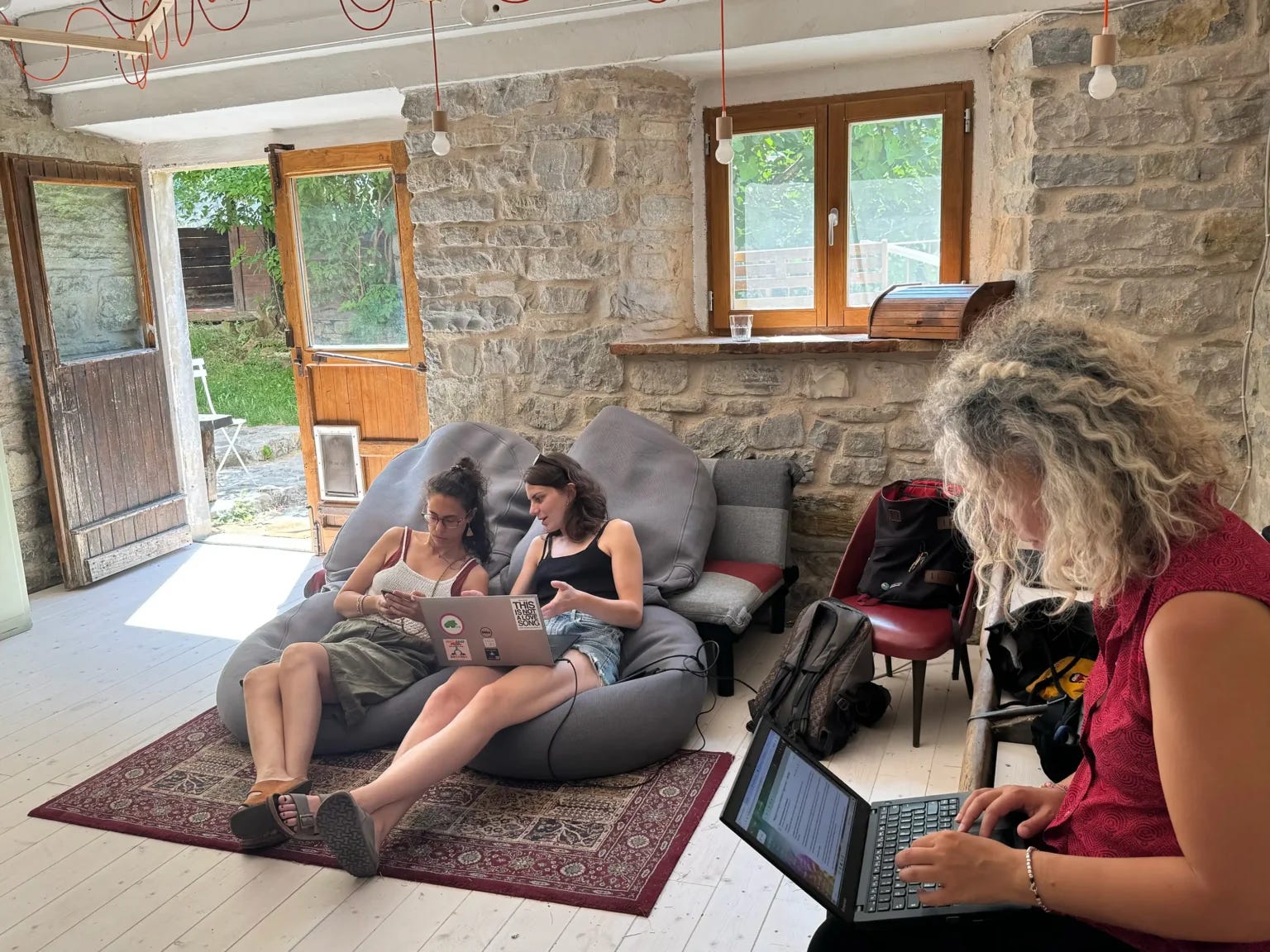
The New Rural Coliving Movement Trying to Bring Life Back to Italy’s Inner Areas
Between green coworking spaces, temporary communities and new residents, projects like Ca’Co in Italy’s Romagna Apennines reveal a different side of rural regeneration — one that sees remote work not as a trend, but as a long-term territorial opportunity.
Over the past few years, Italy’s “village regeneration” narrative has become almost impossible to escape. One-euro homes, reality shows about abandoned towns, glossy articles about digital nomads escaping big cities and rediscovering “authentic Italy.” Somewhere between tourism marketing and social experimentation, the topic has often become more performative than practical.
Yet every now and then, quieter projects emerge — and those are usually the most interesting ones.
One of them is Ca’Co, a rural coliving and coworking initiative located in Pennabilli, in Italy’s Romagna Apennines, recently featured by ANSA. The concept is relatively simple: transforming an old countryside farmhouse into a place where remote workers, creatives and mobile professionals can temporarily live and work while engaging with the local territory and community.
But the real story here is not the digital nomad cliché itself. That narrative has already been overused. What makes projects like this worth observing is their attempt to think beyond short-term tourism and into something much harder: long-term livability.
Because one of the biggest misunderstandings surrounding Italy’s internal areas is the idea that attractiveness can simply be “marketed.” In reality, attracting people requires infrastructure, social life, decent connectivity, services, opportunities and a certain everyday quality of life.
The remote workers many rural areas dream about attracting are not just looking for cheap houses or postcard landscapes. They are looking for functional ecosystems. Reliable internet. Human connections. Stability. Accessibility. Inspiration. A sense that life there is sustainable, not just picturesque.
That is why Ca’Co is interesting. It is not presented as a countryside resort or a romantic escape fantasy. The project openly talks about long stays, temporary residents, shared experiences and the possibility of building meaningful relationships with the territory.
There is also another important aspect often ignored in public debates: time.
Projects in rural and internal areas rarely produce immediate results. Building communities, changing demographic trends and creating local economic resilience takes years, not seasons. This is precisely why public funding — including European cohesion funds — remains essential for many of these initiatives.
Of course, public money alone does not guarantee success. Italy is also full of overpromised regeneration stories, inflated media narratives and projects that generated headlines but very little real impact. But perhaps this is why smaller and more grounded experiences deserve more attention.
Interestingly, the ANSA report also mentions that some internal areas around Bologna recorded a reversal in depopulation trends during 2024 — a rare phenomenon for these territories. It is still too early to draw grand conclusions, but it reflects a broader shift that has been quietly emerging across Europe: more people are reconsidering the relationship between work, geography and quality of life.
Remote work did not magically “save” rural areas. And it probably never will on its own. Italy’s internal territories still face enormous structural challenges: healthcare access, transportation, schools, aging populations, housing recovery and economic fragility.
Still, projects like Ca’Co may represent something more realistic and therefore more valuable. Not miracle solutions. Not utopian marketing campaigns. But small attempts to create contemporary, livable ecosystems in places that for decades have been treated only as spaces of decline.
And perhaps that is where the future conversation should start: less rhetoric about “saving villages,” and more focus on creating places where people can genuinely imagine building a life.