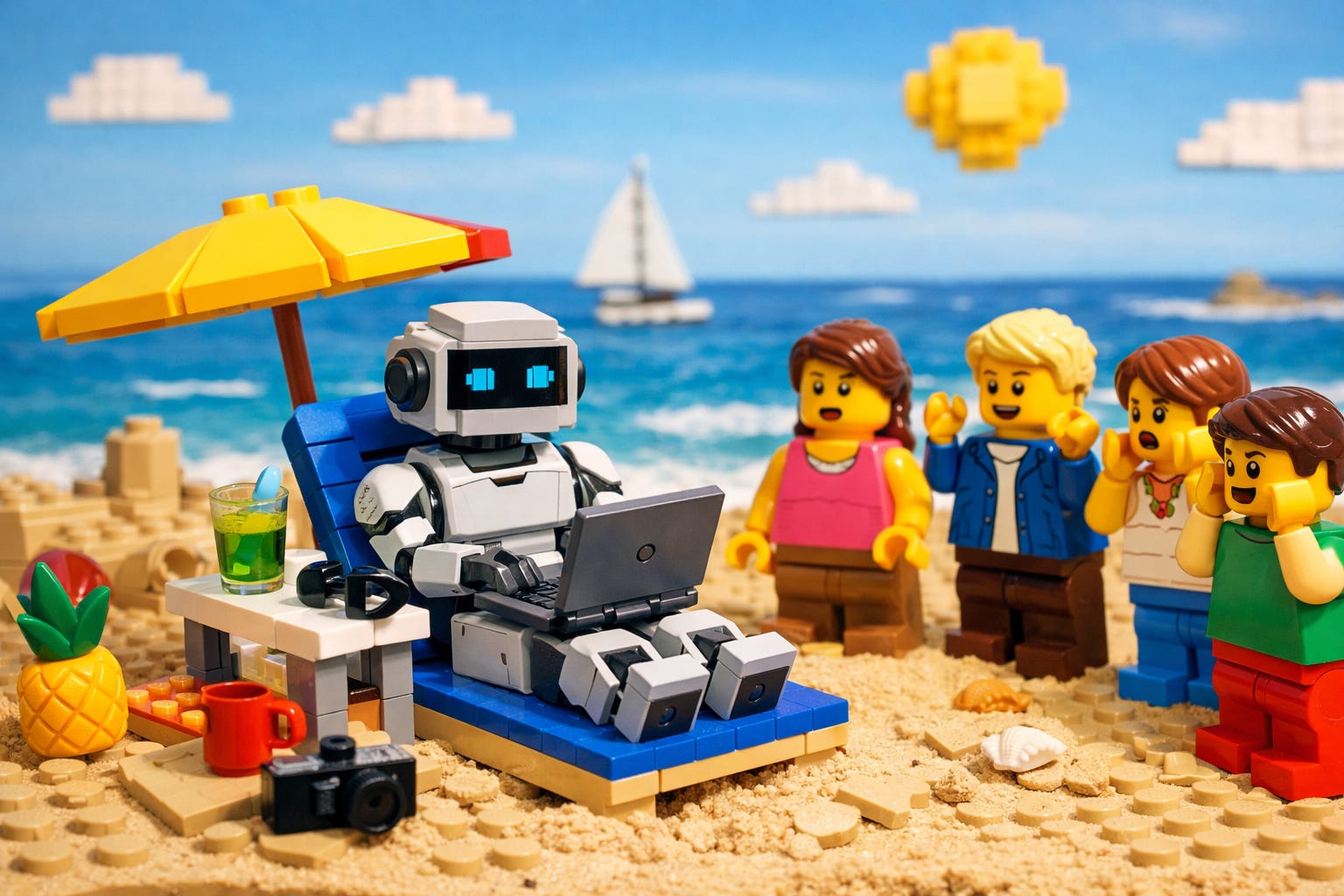
The Nomad and His (Digital) Twin: When Freedom Starts Working Without You
The Noma Pulse #41
Digital nomadism promised escape. Digital twins promise efficiency. Somewhere in between, we may have accidentally built a version of ourselves that no longer needs to travel—and might not even need us.
There is a quiet shift happening, and like most meaningful shifts, it doesn’t announce itself with a headline. It creeps in, disguised as convenience, optimization, and progress. A new tool here, a smarter workflow there, a slightly faster way of doing something you’ve already done a hundred times. Nothing dramatic. Nothing revolutionary. And yet, taken together, these small adjustments are reshaping something much larger than productivity.
They are reshaping the relationship between who we are, what we do, and where we choose to be.
Digital nomadism, at its origin, was a story about reclaiming control. Not just over work, but over space, time, and identity. It wasn’t only about working remotely; it was about refusing the idea that work should dictate where life happens. It was an inversion of a long-standing hierarchy. Life first, work second—just delivered through a laptop and a stable internet connection.
For a while, that inversion felt real.
People left cities not because they had to, but because they could. They chose places that made them feel something, even if those places were imperfect, inconvenient, or occasionally chaotic. There was friction, and that friction was part of the experience. It reminded you that you were actually somewhere. That your presence mattered.
But while this movement was unfolding in the physical world, something else was developing in parallel—quieter, more technical, and arguably more transformative. The idea of the digital twin.
Originally, the digital twin had nothing to do with identity in the human sense. It was an engineering concept. A digital twin was a precise, data-driven replica of a physical object or system, continuously updated with real-world inputs. If you had a machine in a factory, you could build its digital twin to simulate how it would behave under different conditions, anticipate failures, optimize performance. It was about prediction and control.
Over time, this concept expanded. From machines to systems, from systems to cities, and eventually—inevitably—to people. Not in the science fiction sense of a fully conscious replica, but in a more subtle, practical form. A model of how you work, how you communicate, how you make decisions. A structure built from your patterns, trained on your outputs, refined through your behavior.
At first, it doesn’t look like a “twin.” It looks like assistance.
An AI that drafts your emails in your tone.
A system that schedules your time based on your habits.
Tools that learn your preferences and anticipate your needs.
But over time, the line between assistance and representation begins to blur. Because the more predictable your work becomes, the more easily it can be modeled. And the more easily it can be modeled, the less it requires your direct, continuous presence.
This is where the intersection with digital nomadism becomes unexpectedly interesting.
Digital nomadism has always been, at least in part, about decoupling work from location. The assumption was that if you could work from anywhere, you could design a life that felt more aligned with your values. But that assumption was built on a hidden premise: that your work still required you. Your attention, your time, your input.
What happens when that premise starts to weaken?
What happens when parts of your work no longer need you in real time, or even in full?
The digital twin, in its emerging form, doesn’t eliminate your role. It fragments it. It takes the repeatable, the predictable, the structured components of what you do and gradually absorbs them. Not perfectly, not completely, but increasingly well. And as it does, it creates a strange situation in which your professional presence becomes partially independent from your physical one.
You are still working, but not always actively.
You are still present, but not always directly.
You are still producing, but not always personally.
In other words, you begin to operate through a layer.
For the digital nomad, this introduces a paradox that is rarely addressed openly. The original narrative celebrated the ability to work from anywhere, but it also relied—implicitly—on the idea that work would still occupy a significant portion of your attention. The café, the coworking space, the rented apartment with a view: these were not just backdrops for leisure, but environments in which work continued to happen, just in a more flexible form.
If that work starts to detach from you, even partially, the meaning of “anywhere” begins to change.
It is no longer just a place where you can work. It becomes a place where work can continue without fully involving you.
This might sound like the ultimate form of freedom. And in some respects, it is. But it also raises a more uncomfortable question: if your work no longer anchors you to your own activity, what anchors you to the places you choose?
Because digital nomadism, at its most authentic, was never just about mobility. It was about presence. About engaging with a place, however temporarily, in a way that goes beyond consumption. Even in its lighter, more lifestyle-oriented versions, there was still an implicit idea that being somewhere meant something. That your experience of a place was shaped by your interaction with it.
The digital twin operates in the opposite direction. It is designed to reduce the need for direct interaction. To streamline, to abstract, to make processes independent from the variability of human involvement. It is, by definition, a tool of distance.
When these two logics meet—one rooted in presence, the other in abstraction—the result is not a clean synthesis. It is tension.
You can feel it in small, everyday moments. The call you take from a place that deserves your full attention. The email you answer while sitting in a context that was supposed to be a break from exactly that. The subtle awareness that you are neither fully working nor fully experiencing, but oscillating between the two.
Add a digital twin into this dynamic, and the oscillation becomes more complex. Because now, parts of your work can continue without you, which in theory should free you to be more present. But in practice, it often leads to a different outcome: a diffusion of responsibility and attention. You are less tied to your work, but also less clearly separated from it.
The system runs, and you supervise it.
The question then becomes not whether you are working, but how much of you is actually involved.
This is where the conversation moves beyond tools and into identity.
If a significant portion of what you do can be modeled, replicated, or delegated to systems that operate in your name, your value shifts. It moves away from execution and towards something less tangible. Direction, judgment, interpretation, the ability to navigate ambiguity—these become more central, not because they are new, but because they are harder to replicate.
Interestingly, these are also the dimensions that are most sensitive to context. They require a certain quality of attention, a depth of perception that is difficult to maintain if you are constantly fragmented between layers of activity.
In this sense, the evolution of digital twins may force a redefinition of digital nomadism itself.
Not as a lifestyle of continuous movement supported by remote work, but as a more deliberate approach to presence in a world where absence is increasingly easy to simulate.
Because if your digital twin can handle the predictable aspects of your work, the real question is not how much more you can travel, but how differently you choose to experience the places you go.
The risk, otherwise, is that digital nomadism becomes a kind of aesthetic layer applied to a fundamentally unchanged structure. The same workflows, the same expectations, the same rhythms—just distributed across more visually appealing locations. Movement without transformation.
The digital twin, paradoxically, exposes this risk. By taking over what can be standardized, it reveals how much of our work—and by extension, our routines—was already structured in ways that had little to do with place.
What remains, once that structure is partially externalized, is a more essential question: what is the role of physical presence in a life that no longer depends on it?
There is no single answer to this. For some, it will mean doubling down on efficiency, using digital twins to scale output, expand reach, and reduce friction. For others, it may lead in the opposite direction: a slower, more intentional approach, where the value of being somewhere is not measured by how well you can work from there, but by how fully you can engage with it.
What is clear is that the intersection between digital nomadism and digital twins is not a niche curiosity. It is a preview of a broader shift in how we relate to work, identity, and space.
We are moving from a world where freedom was defined by the ability to take our work with us, to one where freedom might be defined by how much of our work we are willing to let go of—or at least, to let run without us.
And that is a different kind of decision entirely.
Because it forces us to confront something that the early narratives of digital nomadism only touched on superficially: that true freedom is not just about where you can go, but about what you choose to remain responsible for.
The digital twin doesn’t remove that responsibility. It redistributes it.
And in doing so, it asks a question that is both simple and difficult to answer:
If a version of you can keep things running… what, exactly, do you want to be doing instead?