The Nomad Myth, Finally Taken Seriously (and Slightly Dismantled)
A Nomag-style long read on The New Nomads by Felix Marquardt
The Nomad Myth, Finally Taken Seriously (and Slightly Dismantled)
A Nomag-style long read on The New Nomads by Felix Marquardt
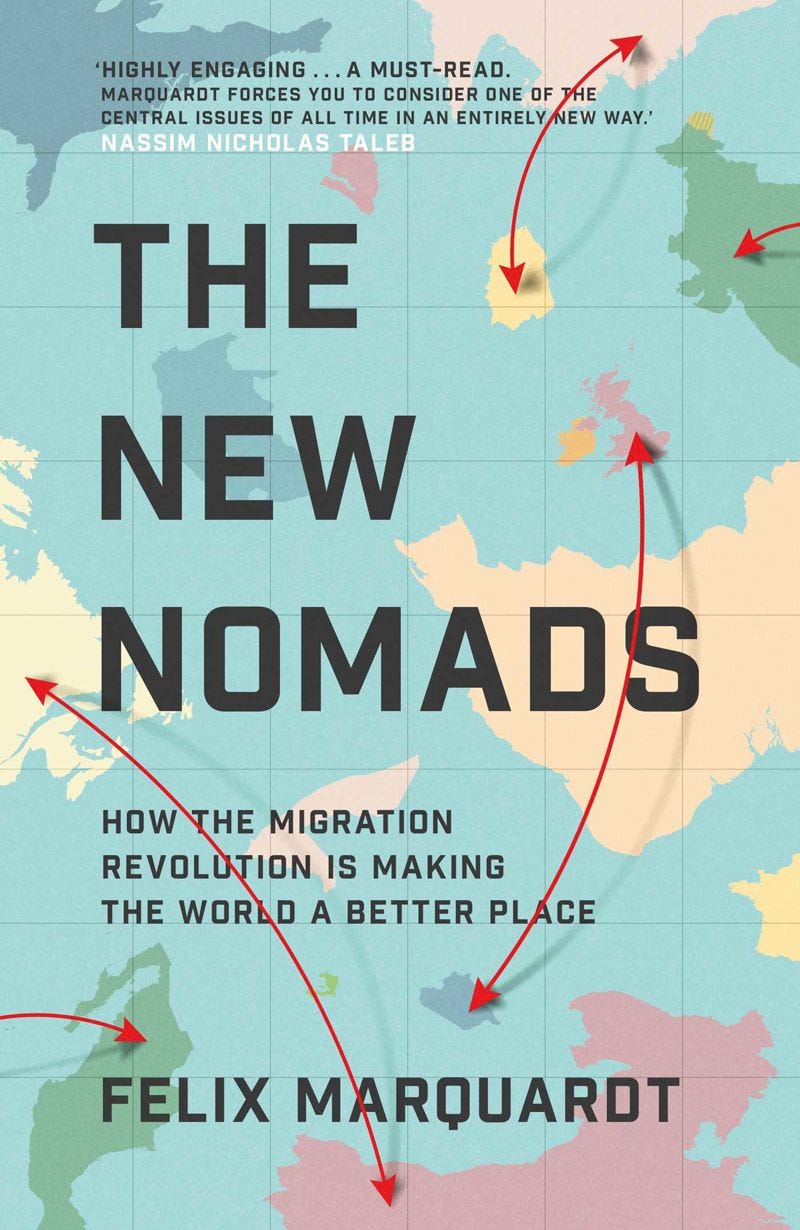
There are two types of books about migration.
The first kind reassures you. It confirms what you already think: that migration is either a problem to be managed or a virtue to be celebrated, depending on which side of the algorithm you woke up on that morning.
The second kind is rarer. It makes you slightly uncomfortable. It doesn’t quite let you sit neatly in your ideological chair. It forces you to admit that maybe—just maybe—you’ve been looking at the whole thing through the wrong lens.
The New Nomads belongs firmly to the second category.
And that, already, is a good sign.
Migration, but not as a headline
What Marquardt does—quietly, without too much performative cleverness—is strip migration of its media costume.
No more caravans. No more “crises.” No more LinkedIn posts about “global citizens” sipping flat whites in Lisbon pretending that mobility is a lifestyle choice available to everyone with a MacBook and a mild existential crisis.
Instead, he reframes migration as something both more banal and more radical: the default human condition.
Not the exception. The rule.
It’s an argument that sounds almost obvious once you read it, which is exactly why it works. Humans have always moved. Entire civilisations are built on the assumption that movement is normal, stasis is temporary, and “home” is a fluid concept rather than a fixed GPS coordinate.
And yet, modern discourse treats migration like a bug in the system.
Marquardt flips that. Migration is the system.
The uncomfortable middle ground
The book’s most interesting move is not its anthropology. It’s its refusal to flatter anyone.
He doesn’t romanticise migrants. He doesn’t demonise those who fear migration either. He goes somewhere more dangerous: the grey area where both sides have reasons, blind spots, and—crucially—contradictions.
There’s a passage (and you saw it in the intro) where he suggests that xenophobia is often less about hatred and more about fear of the unfamiliar. That’s not a fashionable argument. It doesn’t trend well. It doesn’t get applause at conferences.
But it lands.
Because it forces a shift: from moral superiority to psychological reality.
And once you start looking at migration through that lens, a lot of the usual narratives collapse. The loudest voices on both sides suddenly feel… a bit simplistic.
The Abdi effect
Then there’s Abdi.
If the book has a spine, it’s him.
A Malian migrant ending up on a ranch in Montana sounds like the beginning of a Netflix pitch. Instead, it becomes something more subtle: a study in proximity.
Put two people together long enough—different backgrounds, different politics, different everything—and something strange happens. Not harmony. Not conflict. Something in between.
Friction, yes. But also adaptation.
Abdi doesn’t arrive as a symbol. He becomes a person. And that’s precisely where the book scores points: it refuses to turn individuals into metaphors.
In a media ecosystem addicted to turning migrants into either heroes or threats, this is almost radical restraint.
Nomads vs “nomads”
Now, here’s where it gets interesting for anyone reading this on Nomag.
Marquardt quietly dismantles the modern idea of the “nomad”—the hyper-mobile, Wi-Fi-enabled, passport-stamped archetype that we (yes, we included) have probably helped romanticise.
He argues that what we call nomadism today is often just movement without grounding.
The original nomad, in his telling, wasn’t rootless. Quite the opposite. Deeply connected to place, cycles, land, community. Moving, yes—but within a system of meaning.
The modern version? Often just… moving.
It’s a slightly uncomfortable mirror for the whole digital nomad narrative. Not a rejection, but a recalibration.
Mobility without belonging, he suggests, is incomplete.
And if you’ve ever spent three months in a place without learning anything beyond the Wi-Fi password and the best brunch spot, you know exactly what he means.
The real provocation
What the book really challenges is not policy, but perception.
It asks a deceptively simple question: what if migration isn’t something to fix, control, or celebrate—but something to understand?
And more importantly: what if we are all, in some way, part of it?
Not just the obvious migrants. Everyone.
The retirees moving for tax regimes.
The founders relocating for opportunity.
The professionals bouncing between cities.
The “temporary” expats who somehow never quite go back.
Different labels. Same instinct.
Movement.
Where it slightly overreaches
To be fair, the book occasionally leans into its own philosophy a bit too confidently.
The idea that understanding migration more deeply will somehow soften political polarisation feels… optimistic. Reality tends to be messier. Economic pressures, housing markets, and local tensions don’t dissolve just because we’ve had a more nuanced conversation.
And there’s a risk—subtle but present—of underestimating how structural factors shape migration outcomes. Not all movement is equally empowering. Not all “nomads” are playing the same game.
Still, these are not fatal flaws. If anything, they highlight the ambition of the project.
So, should you read it?
If you’re looking for a book that confirms your worldview, probably not.
If you’re looking for something that complicates it—in a way that feels intelligent rather than performative—then yes.
The New Nomads doesn’t give you easy answers. It gives you better questions.
And in a space like migration—where everyone seems to have very strong opinions and very selective data—that’s arguably more valuable.
Final thought (slightly inconvenient)
We like to think of nomadism as freedom.
Marquardt suggests it might also be responsibility.
Responsibility to understand where you come from.
Responsibility to engage with where you go.
Responsibility not to confuse movement with meaning.
It’s not a moral lecture. It’s a quiet recalibration.
And frankly, the space could use more of those.
If Nomag has spent years telling you where to go, this book is a useful reminder to occasionally ask why you’re moving at all.
Not a bad trade.


