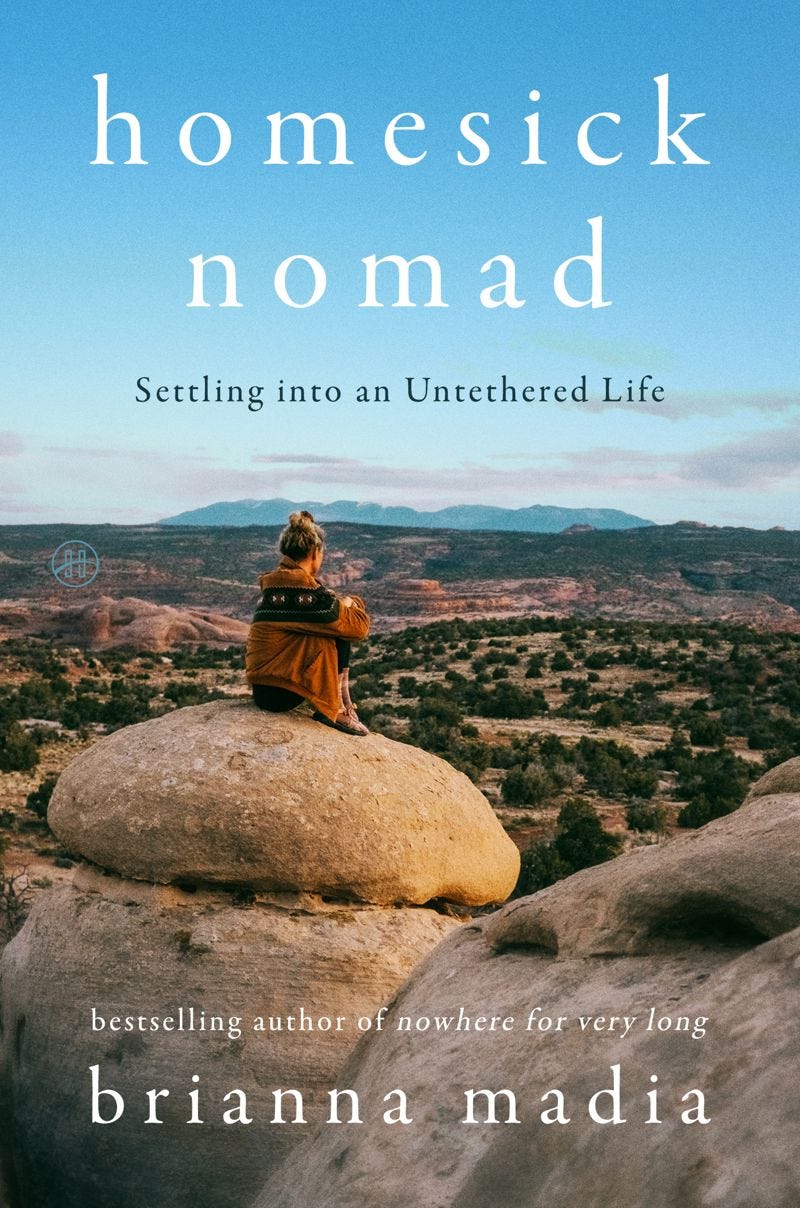
The Problem with Freedom (and the Quiet Return of Home)
A Nomag long read on Homesick Nomad by Brianna Madia
There’s a very specific kind of lie the internet has been telling for the past decade.
It looks like freedom. It sounds like freedom. It photographs beautifully at golden hour.
It’s the idea that if you remove enough structure from your life—quit the job, ditch the city, buy the van, disappear into the desert—you’ll eventually arrive at something pure. Something essential. Something that feels like you.
And to be fair, for a while, that’s exactly what happens.
Homesick Nomad starts from that premise, but it refuses to stay there.
That’s what makes it interesting.
When the dream actually works
Brianna Madia is not writing from aspiration. She’s writing from completion.
She did the thing. She lived the version of life that most people only flirt with between two browser tabs and a mild identity crisis. The desert, the van, the dogs, the radical rejection of expectations—this is not aesthetic for her, it’s biography.
Which means the book doesn’t waste time convincing you that “another life is possible.” That conversation is over before it starts.
The real question begins after:
What happens when you get what you thought you wanted?
It’s a deceptively simple shift, but it changes everything. Because once the fantasy becomes reality, it stops being a fantasy. It becomes a system you have to live inside.
And systems, even the self-built ones, come with trade-offs.
The inconvenient return of attachment
The tension at the centre of the book is not wilderness versus society. That would be too easy.
It’s independence versus attachment.
Madia doesn’t drift back into “normal life” out of failure or exhaustion. She falls in love. She finds herself splitting time between the open desert and a more structured, domestic space. Not quite suburban surrender, but not pure escape either.
And suddenly, the narrative cracks.
Because the mythology of the untethered life has very little to say about what happens when you choose to tether yourself to someone else.
Love introduces friction into freedom. Not dramatic, cinematic friction—something quieter and more destabilising. Compromise. Presence. The need to be somewhere, not just anywhere.
The book doesn’t resolve that tension neatly. It sits in it.
Which is exactly why it works.
The myth of the pure life
There’s a subtle but important critique running underneath the memoir, and it’s aimed directly at the culture that elevated this kind of life in the first place.
The idea that there exists a “purer” way of living—closer to nature, further from society, stripped of unnecessary complexity—is deeply seductive. It also collapses under scrutiny.
Madia herself resists certain “upgrades” to her life, like adding running water to her trailer, not out of necessity but out of principle. The simplicity is intentional. Almost ideological.
And yet, the moment another person enters the equation, that purity becomes harder to maintain.
Because purity, as it turns out, is a solitary concept.
Life, on the other hand, isn’t.
The book doesn’t mock the desire for simplicity. It exposes its limits. It shows that even the most carefully constructed alternative life is still entangled with the same questions everyone else is dealing with: how to build something lasting without losing yourself in the process.
Nomadism, but grown up
If a lot of contemporary “nomad” narratives are about escape, Homesick Nomad is about integration.
Not in a corporate, “work-life balance” kind of way. Something more uncomfortable.
It suggests that the binary we’ve been sold—freedom versus stability, movement versus roots, independence versus commitment—is largely artificial.
Or at the very least, unsustainable over time.
You can live in the wild and still crave softness.
You can build a life around movement and still want to arrive somewhere.
You can reject expectations and still find yourself facing the same fundamental choices about partnership, purpose, and family.
Madia doesn’t position herself as a guide. There’s no framework, no method, no “five lessons from the desert.” The honesty of the book comes from its refusal to package itself as anything other than a lived contradiction.
And in a space that is saturated with performative authenticity, that restraint is almost radical.
Where it risks losing the plot
If there’s a limitation, it’s precisely in that same honesty.
The book is deeply personal, which is its strength, but it occasionally assumes that the reader will find universal meaning in experiences that are, in reality, quite specific. The desert is not a neutral setting. The ability to step in and out of that life is not universally accessible.
There’s also an underlying privilege—subtle, not flaunted—that allows this kind of existential exploration to happen in the first place. The book doesn’t ignore it entirely, but it doesn’t interrogate it as much as it could.
Still, pushing too hard in that direction would have turned it into a different book. A more analytical one, perhaps, but also a less honest one.
And Homesick Nomad is, above all, committed to its own perspective.
The real shift: from escape to choice
What the book ultimately captures is a transition that a lot of people experience but rarely articulate well.
The move from leaving something behind… to choosing something deliberately.
Escape is easy to narrate. It has a clear antagonist: the office, the city, the expectations, the noise.
Choice is messier. It doesn’t come with a villain. It comes with responsibility.
Madia’s story is less about abandoning one life for another, and more about learning to hold two truths at the same time: that freedom matters, and that connection matters just as much.
Not as a compromise, but as a condition.
So, is it worth your time?
If you’re expecting a manifesto for van life, this isn’t it.
If you’re expecting a clean arc—from rebellion to resolution—you won’t get that either.
What you get instead is something more useful: a portrait of what happens after the aesthetic fades and the real questions begin.
Homesick Nomad doesn’t try to sell you a life. It shows you the cost of one.
And more importantly, the cost of refusing to evolve it.
Final thought (slightly annoying, but accurate)
We like to think that the goal is to become free.
This book suggests the harder task is learning what to do with that freedom once you have it—and who you’re willing to share it with.
Which, inconveniently, brings you right back to the question most people were trying to avoid in the first place.
Home.