The spontaneous weekend trip isn’t dying (yet).
It’s just being forced to grow up
For a while, the narrative has been almost dramatic: the end of the spontaneous mini-break, the death of last-minute travel, the idea that something essential is being taken away from us.
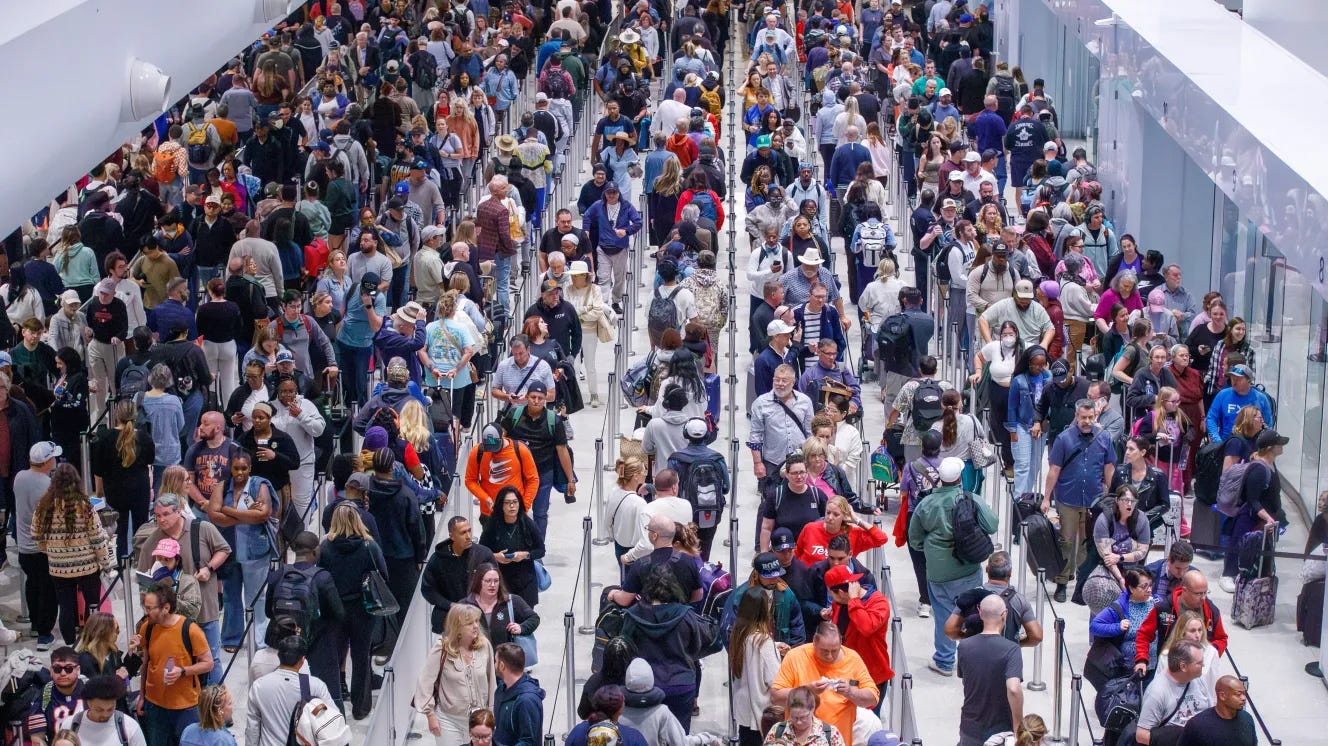
It sounds a bit exaggerated, but it’s not entirely wrong either. What’s happening is real. Flights have become less predictable, often more expensive, and in some cases simply not worth the effort. The US is just the most visible example right now, with airport congestion and operational issues pushing people to rethink even the shortest trips . But reducing this to an “American problem” would be a mistake.
Across Europe, prices have crept up in a way that quietly changes behaviour. The era of ultra-cheap, ultra-flexible flights has not disappeared, but it has become less reliable. In Asia, demand has surged again post-pandemic, creating pressure on routes and infrastructure. In many parts of the world, what used to feel simple now requires a bit more calculation.
And that’s where the real shift begins.
Because the spontaneous weekend trip was never just about travel. It was about convenience. It worked when the system around it worked effortlessly. When you could leave on a Friday evening without overthinking it, land somewhere within two hours, and still feel like the trip justified the movement.
Now that same movement comes with more friction. More waiting, more variability, more cost — not always dramatically higher, but enough to break the illusion of simplicity.
That doesn’t mean the idea itself was wrong. In fact, there was something genuinely valuable about it. Being able to change scenery quickly, even briefly, had a psychological function that went beyond tourism. It created space, interruption, a reset. The problem is not that we did it. The problem is that we built it on a model that assumed infinite efficiency.
For people who travel occasionally, this creates frustration. For people who are always on the move — digital nomads, remote workers, anyone living across geographies — it forces a different kind of adaptation.
Not less travel, but more deliberate travel.
The typical pattern starts to stretch. Instead of compressing everything into 48 hours, you begin to question whether the effort of flying for such a short time still makes sense. Not morally, not ideologically — just practically.
And often, the answer is no.
But that doesn’t automatically translate into staying still. It translates into rethinking distance.
There’s a quiet but very clear shift toward what could be called “reachable travel”. Trips that sit within a different radius, where movement doesn’t dominate the experience. Places you can reach by train, by car, or with a single, low-friction connection. Not necessarily closer in kilometres, but closer in terms of effort.
In Europe, this is almost an obvious recalibration. The infrastructure has always been there, but it was overshadowed by the speed and pricing of flights. Now trains are becoming competitive again, not just environmentally but logistically. You leave city centre to city centre, you avoid the ritual of early airport arrival, and you arrive with your time still intact.
It’s not a romantic return to slow travel. It’s a practical correction.
For nomads, this is even more pronounced, because the goal is not to “fit in a trip”, but to maintain a rhythm. Constant short-haul flights start to feel inefficient very quickly, not only financially but cognitively. You spend more time transitioning than actually living.
So the model shifts almost naturally. Fewer moves, slightly longer stays, more attention to how and where you relocate. The weekend break doesn’t disappear, it just changes scale and logic. It becomes something you integrate into a broader geography rather than something you extract from your routine.
You don’t stop going somewhere for a couple of days. You just choose places that don’t require a full logistical operation to get there.
This is where the conversation around “the end of spontaneity” becomes a bit misleading. Spontaneity is not gone. It’s being redefined within new constraints.
You can still decide on a Thursday to leave on Friday. But instead of scanning flight deals across the continent, you might look at train routes within a few hours’ reach. Instead of chasing distance, you optimise for ease. The decision remains impulsive, but the execution becomes more grounded.
And perhaps that’s the uncomfortable part for some people. The realisation that what we called spontaneity was often just subsidised convenience. Remove part of that convenience, and you are forced to make more conscious choices.
That doesn’t necessarily make travel worse. In many cases, it makes it more coherent.
The weekend trip, especially when done by plane, was always slightly paradoxical. Efficient in theory, but often disproportionate in effort compared to the time actually spent in the destination. Add rising costs and unpredictability, and that imbalance becomes harder to ignore.
So yes, maybe flying somewhere for 36 hours was never the most rational habit. Maybe it was, as some would say, a small indulgence we collectively accepted. But dismissing it entirely would be too simplistic. It served a purpose.
What is changing now is not the desire to move, but the threshold at which movement feels justified.
And that threshold is pushing people toward something more local, more reachable, more integrated with their actual lives.
Not less travel.
Just travel that makes a bit more sense.