

Want Digital Nomads in Your Village? First Help the People Already Living There Move Around



The provocation begins with visitors who arrive without a car. But the answer is not to invent services for people who are not there yet. It is to build useful services for residents — making the village naturally more accessible to everyone else.
The provocation from our Editor-in-Chief, Matteo Cerri (first published on ITS Journal), is very simple: Want digital nomads in your village? Fine. First, help them get there.
And, ideally, allow them to leave again.
Many remote workers arrive in Italy by plane or train. They do not own a car, they have no intention of buying one for a two- or three-month stay, and they quickly discover that renting one can cost almost as much as the apartment.
There is also a minor cultural detail.
Have you ever considered what driving and parking in an Italian hill town looks like to somebody who has just landed?
A road wide enough for one Fiat Panda is officially classified as two-way. Parking requires a steep reverse manoeuvre between a medieval wall and the plumber’s van. The ZTL sign is viewed with respectful uncertainty even by Italians.
Authentic, certainly.
Not necessarily inviting.
But turning this observation into yet another special programme “for digital nomads” would miss the point completely.
The point is the opposite.
Do not invent artificial services for people who are not there yet. Use their perspective to see more clearly what is already missing for the people who live there.
When a service works for older residents, young people, one-car households, disabled people and those on lower incomes, it will automatically make the village more accessible to remote workers, new residents and visitors.
For a visitor it is inconvenient. For a resident it can be a prison
For a digital nomad, poor transport may mean choosing another destination.
For somebody who already lives there, it may mean being unable to buy food, reach a doctor, accept a job, attend education or maintain an independent life.
There are older residents who no longer drive, people who never obtained a licence, young adults who cannot afford a vehicle and households where the only car is used every day by the family member who works.
Even an unimpressive old car now costs several thousand euros. Then come insurance, tax, maintenance, tyres and fuel — which now costs more than wine. Almost twice as much, depending on which Eurospin shelf we use as our economic benchmark.
The European Commission now explicitly recognises transport poverty: the inability to access affordable, adequate mobility for employment, education, healthcare and essential services. Rural, remote and poorly connected areas are among those most exposed.
Across many small communities, this lack of mobility is currently hidden by an informal network of relatives, friends and neighbours.
When the neighbour is available, the system works.
When they are working, ill, away, tired or simply unwilling to become the village’s unpaid taxi service, it stops working.
Neighbourly generosity is valuable.
It should not be a municipality’s transport policy.
Permanent dependence on favours also removes privacy and autonomy. People have to explain where they are going, why, at what time and when they intend to return.
Buying groceries or attending a medical appointment becomes a personal negotiation.
A village can be beautiful and still be a prison.
Do not build a showroom village for people who have not arrived
In recent years, many territories have treated digital-nomad attraction mainly as a communications exercise.
A website in English. Sunset photography. Four desks in an unused municipal room, a coffee machine and the word coworking.
The village is then declared ready to welcome the world.
But the world still has to reach it.
A railway station twenty-five kilometres away is not genuinely accessible when no service connects with the trains.
An airport ninety minutes away is not especially useful when the only option is a taxi costing more than the flight.
A supermarket twelve kilometres away is not “nearby” when somebody must carry water, detergent and food along a provincial road.
Accessibility is not measured in kilometres on a map. It is measured by the time, cost and complexity involved in covering them without owning a car.
The European Commission recognises a significant rural mobility deficit and recommends combining public, social and private finance while integrating shared solutions with the main public-transport network.
That is the change in perspective:
do not create a service for digital nomads. Allow their presence to contribute to the viability of a service designed primarily for the community.
Sometimes the entire mobility strategy is one car
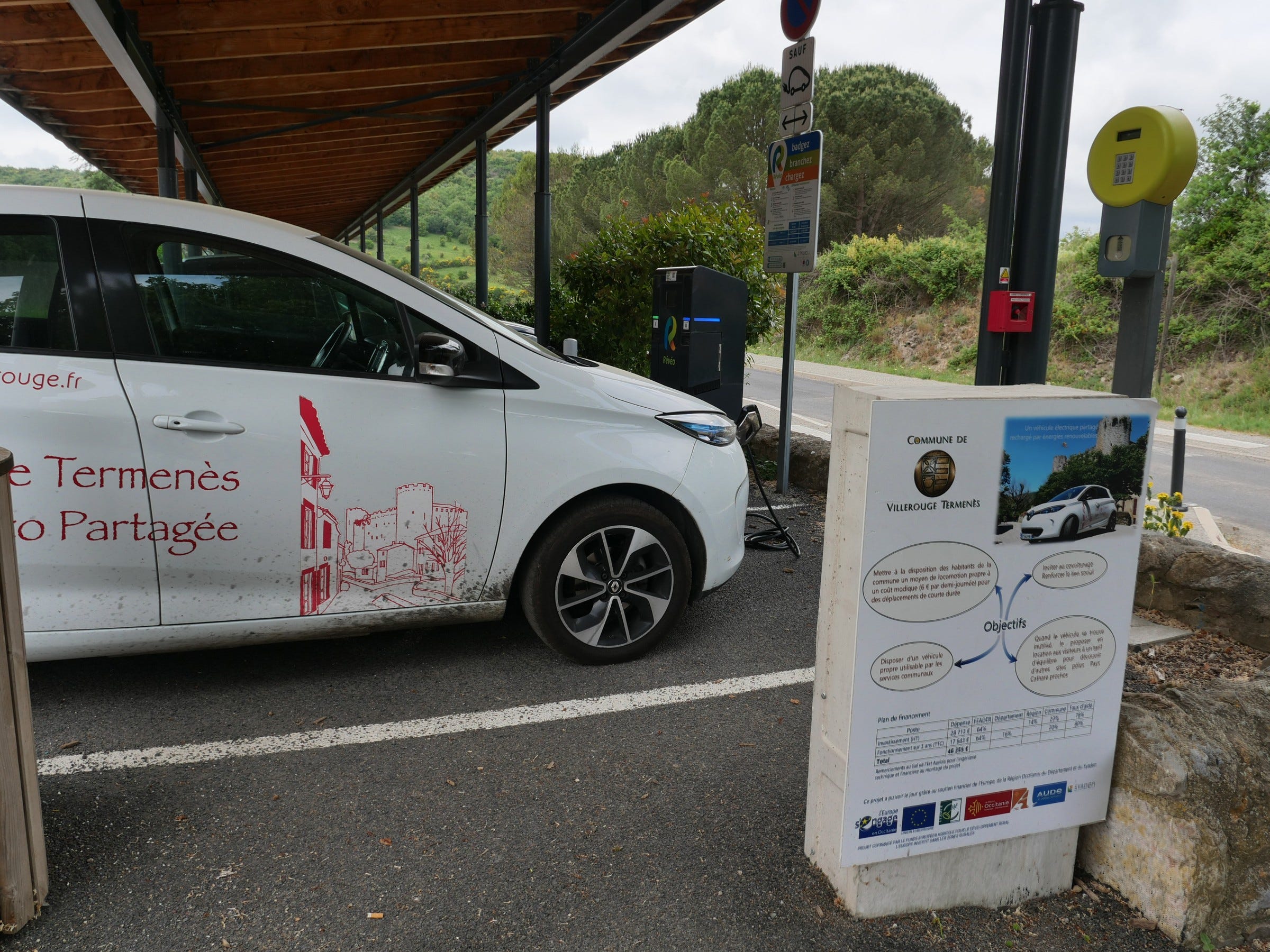
Villerouge-Termenès is a French municipality of around 140 residents, located far from major shops and specialised healthcare.
Its solution was remarkably simple: a shared municipal electric car, charged beneath a photovoltaic canopy and bookable by residents for journeys generally ranging from 40 to 80 kilometres.
It is used for markets, grocery shopping, medical care and errands that would otherwise be difficult or impossible.
The project cost €46,355 and received substantial European and territorial public support. The vehicle reached approximately 30,000 kilometres per year, and demand eventually revealed the limitations of a single small car: insufficient passenger and luggage capacity and periods when the service became saturated.
This does not prove that every rural shared car can pay for itself.
It proves that, in the right territory, one car can be genuinely useful.
Official Villerouge-Termenès project
Extended description and financing
Allons: a car managed through municipal social services
Allons is a small municipality at the end of a sparsely populated valley, far from major shops and public services.
In 2025, the municipality acquired a shared electric vehicle and placed it under the management of its local social-assistance centre. Residents can hire it at a modest cost for short journeys.
The project was financed through France’s Green Fund, support from the Verdon Regional Natural Park and municipal resources. As the service is recent, there is not yet enough evidence to judge whether its ongoing operation can become independent of public contributions.
The principle is important: the car is not treated as a tourism gadget. It sits within the local social-support system.
Official Allons case on France Mobilités
Pays de Lumbres: not only cars, but rural mobility stations
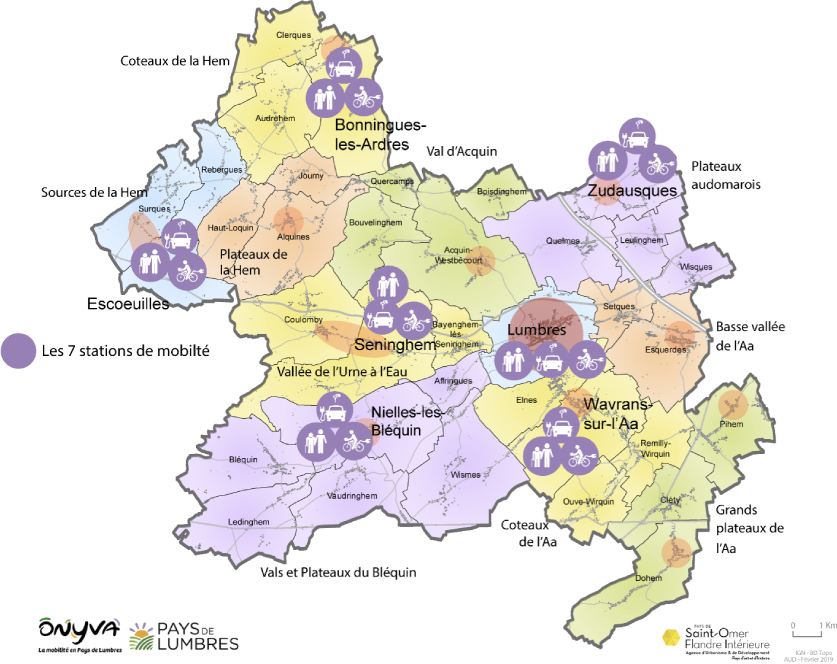
The Pays de Lumbres is a rural French territory covering 36 municipalities and approximately 24,000 residents.
Its experiment expanded into seven mobility stations, seven electric vehicles and eighteen e-bikes. The system is complemented by a solidarity-transport service involving volunteer drivers, including support for people on low incomes or unable to drive.
The mobility-station project had a declared total budget of approximately €420,000 excluding solidarity transport, with at least €247,383 coming from national, departmental, agricultural-social-insurance and municipal funding.
The original experiment used an extremely low tariff. When a charge of €1 per hour was introduced in 2019, usage declined — a useful reminder that some users choose the service precisely because they cannot afford the costs of owning a car.
Official mobility-stations page
Original rural car-sharing experiment
Italy: demand-responsive transport in Val Degano
Italy also has services designed for genuinely mountainous, sparsely populated territories.
UDonDemand, operated by TPL FVG, connects municipalities in Val Degano during periods and in locations that receive limited or no conventional scheduled service. It allows residents of isolated hamlets to reach interchange stops for the regular connections between Sappada and Tolmezzo.
Journeys can be booked through an app or by telephone — essential if digitisation is not to become another barrier for people with limited technical confidence.
Official UDonDemand information
Demand-responsive transport does not necessarily remove the need for subsidy. It can, however, avoid sending large, nearly empty buses around rigid routes, concentrating resources on journeys people actually request.
One shared car for ten apartments may be worth more than ten slogans
The municipality does not necessarily have to own the vehicle.
A company, cooperative or property operator managing several homes could provide a small shared car for tenants and guests.
Imagine ten or fifteen apartments in the same village. Their listings probably include one polite but decisive sentence:
A car is essential.
That sentence immediately excludes a substantial group of potential tenants.
Instead, the operator could offer access to a small bookable vehicle. A limited number of hours might be included in the rental, with additional use paid per journey or through a weekly mobility package.
There is no need to assign one car to every home.
Many users would require it only for grocery shopping, the railway station, an appointment or an evening in the next town.
A single vehicle shared between several properties could make homes genuinely rentable that are not truly usable without mobility.
The product would no longer be simply:
Apartment with Wi-Fi.
It would become:
Apartment with access to mobility.
The same vehicle could be opened to residents when guests are not using it.
The municipality could purchase blocks of hours for people facing hardship. Accommodation providers could buy station-transfer journeys. A supermarket, pharmacy or medical centre could contribute because the car enables customers and patients to reach them.
People arriving from outside would therefore help support a service for those already there.
That is territorial attractiveness.
Not building scenery for foreigners, but using new demand to make the village stronger.
Car sharing does not help somebody who cannot drive
A shared vehicle solves only part of the problem.
It helps people who hold a licence, are physically able to drive and feel confident on local roads.
It does not automatically help a very old person, somebody whose disability prevents driving or anyone who never obtained a licence.
They also need a driver.
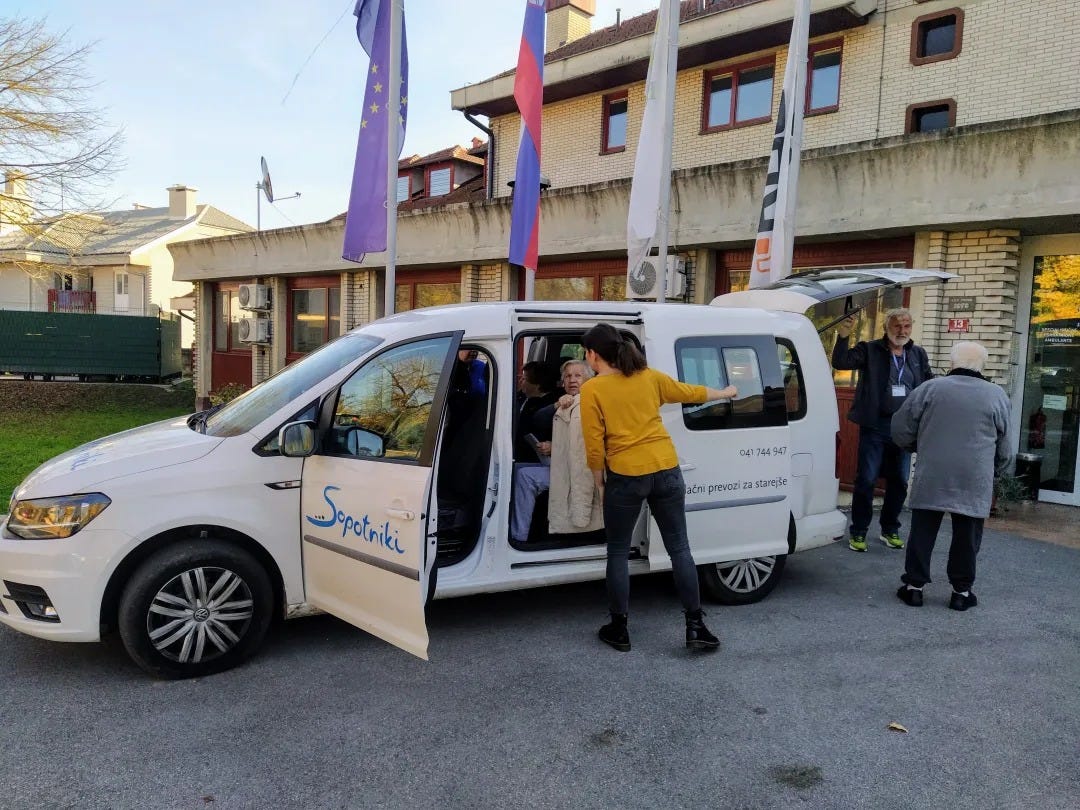
Sopotniki is a Slovenian organisation providing free transport for older rural residents through dedicated vehicles and professionally coordinated volunteers.
The service operates across 17 municipalities, supports more than 6,370 active older users, involves approximately 310 volunteer drivers and delivers around 13,000 journeys per year. Funding comes from national and European public programmes, municipalities and private partnerships.
Its success does not rely on goodwill alone. It depends on coordination, training, management, technology, insurance and clearly allocated responsibility.
That is the difference between a service and hoping a neighbour has time.
Official Sopotniki case – European Rural Pact
Can these services survive without public funding?
The honest answer is: rarely, at least not entirely.
Villerouge-Termenès required substantial public support for its initial investment.
Allons was launched with national, territorial and municipal funding.
The Pays de Lumbres used public finance to create its network.
Sopotniki provides free journeys through volunteers, municipalities, European programmes and private partners.
Guidance published by the UK Department for Transport in 2025 is explicit: particularly in rural areas, demand-responsive services are unlikely to be commercially profitable and normally require sustained local-authority or external support.
But not being commercially profitable is not the same as being unsustainable or pointless.
A rural road is not required to generate a profit.
Street lighting is not switched off because each lamp fails to produce revenue.
A nearly empty conventional bus route does not become rational merely because it has existed for thirty years.
The correct question is not:
How much profit does the car make?
It is:
How many people can reach healthcare?
How many essential journeys are completed?
How many residents regain independence?
How many homes become genuinely liveable or rentable?
How many customers can reach local businesses?
What is the cost per journey compared with the alternatives?
How much is saved by avoiding oversized services and empty routes?
Considering the amount of public money sometimes spent on oversized infrastructure, consultancy, unused platforms and routes designed for a world that no longer exists, funding one or two small shared cars does not seem extravagant.
It looks like the minimum.
Who should pay?
No single organisation needs to cover the entire cost.
The municipality can fund the launch, buy hours for vulnerable users or cover socially necessary journeys.
Property owners and operators can contribute because the service increases the accessibility and practical value of their homes.
Agriturismi, distributed hotels and holiday rentals can buy packages for guests and station transfers.
Pharmacies, supermarkets, local businesses and employers can participate because they gain customers, patients or workers.
Users can pay an affordable charge, possibly differentiated between visitor, ordinary and social use.
Public programmes can support the initial vehicle, technology or journeys for people with fewer resources.
The most credible model is not one with no public funding whatsoever.
It is a mixed model with transparent costs and measurable results.
Start with one vehicle, not a platform
A pilot for a small village could begin with:
one car;
one collection point;
a simple booking system;
a block of hours purchased by the municipality;
several property owners contributing to the monthly cost;
a tariff for visitors and ordinary users;
a small organised driver network for people unable to drive;
and a telephone number alongside any app.
After twelve months, measure usage, costs, unmet requests, medical journeys, shopping trips, station connections and the number of people who would otherwise have had no option.
When demand justifies a second vehicle, add it.
Not before.
An empty fleet, an unused bicycle rack and an app downloaded by twelve people are not innovation.
They are digital street furniture.
Digital nomads are the test. Residents are the reason
People arriving from outside immediately see what residents have learned to consider normal.
A resident knows which neighbour to call. They know that the 7:20 bus actually passes at 7:12. They know the unofficial taxi driver who may be available, unless it is market day, a wedding or a football match.
The visitor searches online.
They discover that the bus does not connect with the train, the taxi costs €140 and the supermarket cannot safely be reached on foot.
Then they choose another place.
They do not write to the mayor.
They do not begin a public debate.
They simply do not arrive.
Digital nomads are therefore an excellent stress test.
But the response should not be a fake service created to seduce them.
It should be a real service, designed for people already living in the territory and made more viable by those who may arrive.
Fast internet matters.
Affordable housing matters.
A coworking space may occasionally matter too.
But quality of life begins with the ability to buy food, reach a doctor, catch a train and see other people without requesting a favour every time.
So yes: want digital nomads?
First, help them get there.
More importantly, allow the people already living in your village to leave their homes.
From provocation to pilot
NOMAG does not want this discussion to end with an article.
Building on our direct experience in a small Italian community, we want to speak with people and organisations possessing practical expertise in rural car sharing, fleet management, insurance, regulation, vehicle-booking and access technology, community transport, public-private partnerships and rural funding.
We are not looking for another presentation about smart mobility.
We are looking for people willing to help determine whether a small, mixed and replicable model can work in the real world.
Links and sources
 | A guest post by
|
 | A guest post by
|