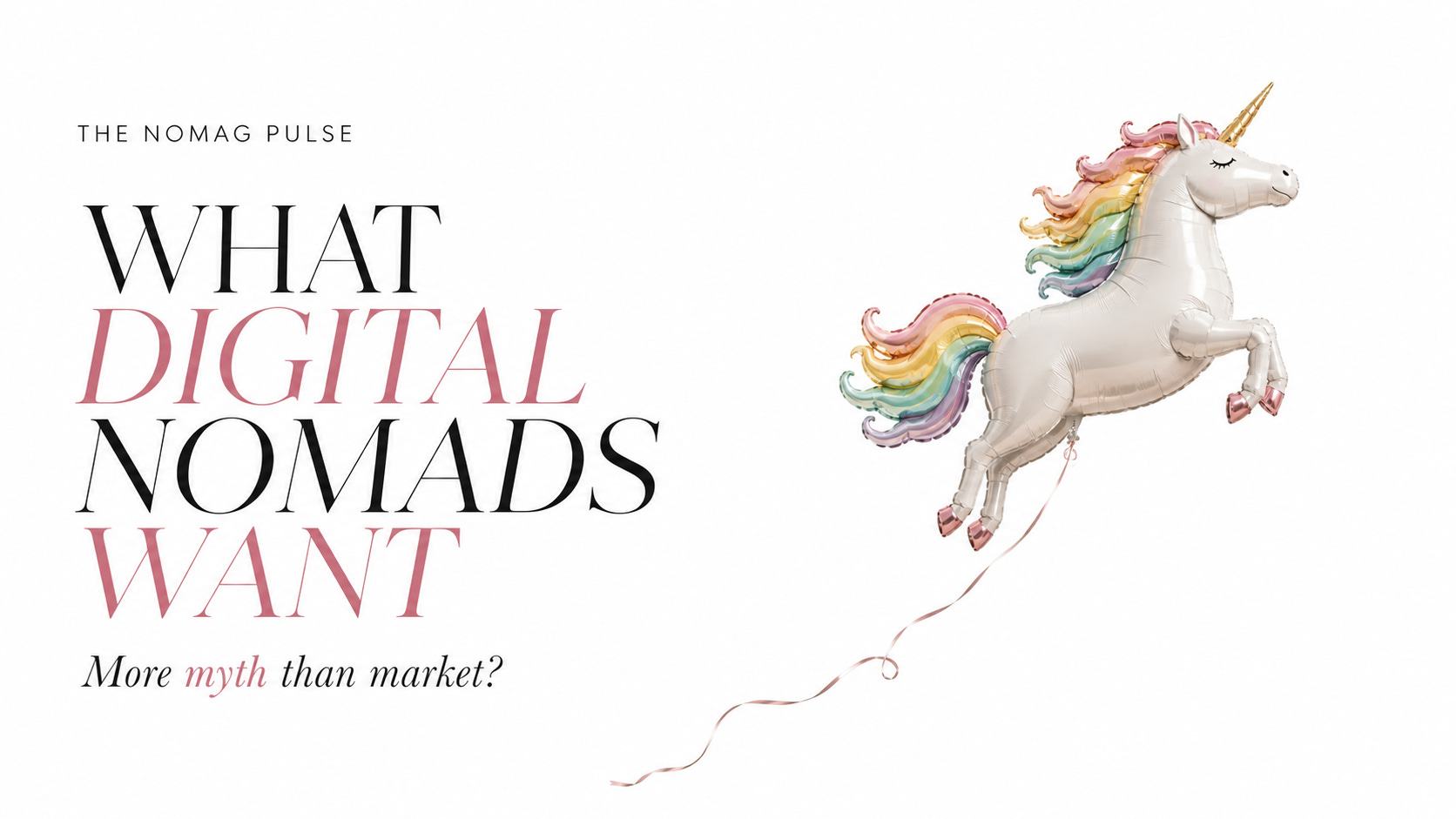
Countries invent visas for them, cities build coworking spaces for them and villages promise them an authentic life among olive trees. There is only one minor problem: almost nobody has bothered to ask who they are, what they need or whether the local population genuinely wants them around.
In What Women Want, Mel Gibson needs lightning, a hairdryer and a near-death experience before he can finally hear women’s thoughts. Governments, tourism boards and local councils have developed a less hazardous method for understanding digital nomads: they simply make things up.
Every few weeks, another country introduces or adjusts a digital nomad visa, another city declares itself a remote-working hub and another half-empty village discovers that it possesses stone houses, grandmothers, olive trees and something the local councillor confidently describes as “excellent Wi-Fi”. The OECD confirms that governments are continuing to introduce these schemes — Italy and Türkiye did so in 2024, Bulgaria followed in 2025, while Croatia extended its programme — although it also notes that they remain relatively small-volume migration channels.
Then comes the inevitable announcement: we want to attract digital nomads.
Wonderful. Which ones? Why would they come? What exactly would they do there once the ceremonial photograph with the mayor had been taken? More importantly, has anyone spoken to an actual digital nomad, rather than to a consultant whose direct experience of nomadism consists of opening a MacBook during a weekend in Barcelona?

The world’s favourite imaginary population
Digital nomads have become the urban and rural development equivalent of truffle oil. Sprinkle the expression over an ordinary project and it immediately sounds modern, international and vaguely expensive. An abandoned school becomes a “nomad hub”; a room containing three IKEA desks becomes a coworking centre; an unreliable internet connection becomes “an opportunity to reconnect with yourself”; and a village with no evening bus, no pharmacy and one bar that closes whenever the owner feels tired becomes “an oasis for conscious professionals”.
The digital nomad in this fantasy is young, single, permanently cheerful and able to manage an international software company from a deckchair. He — because the cliché is usually male — owns one backpack, wears shorts during investor calls and requires only four things: a laptop, a cappuccino, a panoramic view and a wall bearing the neon instruction DO WHAT YOU LOVE. He never needs a doctor, a printer, childcare, privacy, a second monitor, decent heating or somewhere to buy food on a Sunday.
Reality is considerably less decorative. MBO Partners’ 2025 research estimates that the United States alone has 18.5 million digital nomads, representing roughly 12 per cent of the American workforce. More importantly, 11.2 million of them have conventional salaried jobs, rather than fitting the freelance-backpacker stereotype; 54 per cent are married or living with a partner, and around one in nine is aged 55 or over. They work across technology, finance, consulting, sales, marketing, research and creative industries.
The MBO research is American rather than global, and it should not be treated as a perfect portrait of every nomad on Earth. That limitation, however, reinforces the central point: even within one country, this is not a single tribe. It includes graduates on modest incomes, highly paid executives, founders, freelancers, couples, parents, older professionals, domestic travellers, international travellers and people taking a temporary workation before returning home. Calling all of them “digital nomads” tells us approximately as much as calling everyone who owns a suitcase “a traveller”.
The question nobody asks
Territories usually begin with the wrong question: how can we attract digital nomads? It sounds strategic, looks excellent on a conference slide and is almost entirely meaningless. The useful question is much less flattering: which specific kinds of digital nomad could genuinely want the life we are capable of offering, and what would make that life function once the promotional video ends?
That extra sentence destroys approximately 80 per cent of municipal PowerPoint presentations. A large city with international flights, nightlife, universities and several professional communities may appeal to a newly remote employee who wants energy, opportunity and connections. A coastal town could attract a couple seeking three quieter months without disappearing completely from civilisation. A mountain village might appeal to an experienced slow traveller, a writer completing a book, a founder preparing a launch, a family wanting nature or someone who actively enjoys solitude.
The same village may be completely unsuitable for a corporate executive who must return to London twice a month, a parent who needs an international school, a single 25-year-old hoping to meet other people or anyone who interprets the phrase “the last bus leaves at 5.20” as a threat rather than a charming expression of local identity. “Digital nomads” cannot be a target market until someone decides which digital nomads they are talking about. Until then, it is not a strategy. It is a hashtag with a municipal budget.
No, they do not simply want Wi-Fi
Reliable internet is essential, obviously. Inviting a remote worker to live with unstable connectivity is like inviting a chef to use a kitchen without electricity and compensating them with a beautiful sunset. Yet broadband alone is no longer an attraction; it is the entrance ticket. Advertising a destination because it has Wi-Fi is increasingly like advertising a hotel because it has doors.
A 2025 study based on a survey of 101 digital nomads from 26 countries found that their five leading destination criteria were digital connectivity, quality of life, cost of living, safety and visa or entry conditions. The sample is relatively small and was recruited online, so its percentages should not be mistaken for eternal universal truths. Nevertheless, its findings align with broader research showing that destination choice is shaped by a mixture of infrastructure, affordability, legal simplicity and the quality of ordinary life, rather than by scenery alone.
A separate 2024 academic study analysed digital nomads’ online discussions and found that cultural immersion, gastronomy, coworking and employment opportunities contributed positively to destination perceptions, while poor connectivity, visa problems, awkward working hours and loneliness operated as significant barriers. The study’s most useful conclusion is not that nomads possess a secret checklist, but that emotional well-being and social connection matter alongside technological infrastructure.
In practical terms, digital nomads need a life that does not require a daily administrative expedition. They need accommodation in which “workspace” does not mean a decorative shelf beneath the television, a chair designed for a human spine, enough electrical sockets to power something more advanced than a bedside lamp, heating in winter, cooling in summer and photographs that bear some relationship to the property they eventually enter.
They need medium-term housing without hotel prices, twelve-month contracts or a landlord demanding three payslips, two guarantors, a letter from an employer, a blood sample and evidence that their grandfather paid rent punctually in 1963. They need food shops, healthcare, public transport, exercise, somewhere to work and somewhere to stop working. In other words, they need many of the same things permanent residents need, which continues to arrive as astonishing news to tourism departments.
They want community, but not compulsory fun
One of the most persistent myths in digital nomad policy is that opening a coworking space automatically creates a community. It does not. It creates a room, and quite often a room containing uncomfortable chairs, motivational quotations and nobody else.
A functioning community requires introductions, repeated encounters, activities, local connectors and some plausible reason for people to see one another again. It also requires residents who are interested in meeting newcomers and newcomers who are treated as potential participants in local life rather than temporary cash machines. None of this is achieved by organising one “nomad aperitivo” beneath a banner carrying seventeen sponsor logos and requiring everyone to introduce themselves with their name, nationality and personal brand.
Digital nomads are not exchange students trapped in a permanent orientation week. Some want professional networking, some want friendships, some want collaborators and some simply want to recognise a few faces in the café and know whom to call when the boiler begins making demonic noises. What many of them do not want is complete isolation rebranded as peace and tranquillity.
A study published online in late 2024, based on 30 in-depth interviews with digital nomads, described loneliness not as an inevitable condition but as a continuum influenced by social support, the ability to stay somewhere long enough to develop relationships and the individual’s capacity to connect with others. In other words, installing fast broadband may allow someone to attend a Zoom meeting, but it will not automatically give them a reason to remain in the town after closing the laptop.
MBO’s wider 2025 research reaches a similar conclusion from a different direction. Among the challenges most frequently reported by American nomads were separation from friends and family, financial pressure, concerns about personal safety, travel burnout, inconvenient time zones and loneliness. The glamorous lifestyle apparently consists of freedom, adventure and occasionally trying to conduct a board meeting from an apartment where the router has decided to enter a period of spiritual reflection.
The great village delusion
Small towns and villages are particularly attracted to the digital nomad story because the arithmetic appears irresistible. The village is losing population, houses are empty and remote workers can supposedly live anywhere; therefore, remote workers will move into the empty houses. Unfortunately, “anywhere” has never meant “everywhere”.
Peer-reviewed European research published in 2025 concluded that the expansion of teleworking was unlikely, by itself, to produce a major rebalancing between urban and rural areas. People’s location choices remain connected to employment ecosystems, services, amenities, family networks and other advantages concentrated around cities. Remote work can loosen the rope tying people to a particular office, but it does not erase the rest of their lives.
A 2026 working paper using data from more than 7,400 European remote workers makes the point even more brutally. It reports that 67 per cent of remote-work-related relocations occurred from one urban area to another, while moves from urban to rural areas accounted for only 2 per cent. Quality of life was cited by 78 per cent of movers and economic or housing considerations by 70 per cent. Because this is a recent working paper rather than a final peer-reviewed publication, those precise figures deserve some caution, but they provide little support for the fantasy of millions of laptop workers stampeding towards every picturesque hamlet with an empty primary school.
This does not mean rural destinations cannot attract nomads. It means that a stone alley, three vacant houses and a population problem do not automatically constitute a product. A successful rural destination has to identify the people who might actively value what it offers and then remove the practical reasons preventing those people from staying.
Can the village be reached without buying a car? Can someone find a comfortable furnished home for six weeks rather than two nights or twelve months? Is there a supermarket, a doctor and somewhere to eat on a Tuesday evening in February? Can a partner build a life there too? Can children attend school or childcare? Will residents still speak to newcomers after the official welcome event, and when everyone proudly says, “In our village, everybody knows everybody”, does that sound like community — or surveillance with geraniums?
Cheap is attractive. Depressed is not.
Cost matters, particularly to freelancers, younger workers and people using differences in living costs to sustain a more flexible lifestyle. Nevertheless, there is a substantial difference between affordable and lifeless. A destination cannot remove every service, opportunity and form of entertainment and then market the resulting absence as “slow living”.
Low prices may attract initial attention, but nomads evaluate the complete package: housing quality, mobility, safety, weather, healthcare, bureaucracy, social opportunities, legal conditions and access to other destinations. A £400 flat is not a bargain when it comes with mould, no desk, no heating and a three-hour journey to the nearest airport. A cheap village is not attractive to an executive who must spend hundreds of pounds and an entire day reaching a monthly meeting, nor to a parent who has to drive 50 kilometres for childcare.
“Authenticity” is equally unreliable as a substitute for functioning services. Nomads may genuinely want to experience local culture, learn the language, eat regional food and participate in community life. What they probably do not want is to discover that “authenticity” means every shop closes between 1pm and 5pm, the only available rental contains furniture from a deceased aunt and the internet technician is expected “sometime next month”.
Authenticity is wonderful. So is a pharmacy.
They increasingly want to stop moving
The word nomad encourages destinations to imagine people in constant motion, collecting countries, airport stamps and photographs of laptops beside swimming pools. Many real nomads eventually discover that moving every few days is not liberation but unpaid logistics.
MBO’s 2025 report identifies a continued shift towards “slomading”: visiting fewer destinations and remaining in each for longer. Its respondents visited an average of 6.2 locations in 2025, down from 7.2 in 2023, while the average stay increased from 5.4 to 6.4 weeks. The report links longer stays with better productivity, stronger social lives, more meaningful contact with local culture and lower travel stress.
This change should transform how destinations think about the market. Someone staying for six or eight weeks is not merely a tourist who happens to own a laptop. They need to live, which means predictable monthly pricing, laundry, cooking facilities, privacy, workspace, exercise, social relationships and the possibility of becoming temporarily familiar with a place.
They may buy local food, use local services, attend events, learn some of the language, invite family members to visit and return the following year. They may contribute more to the ordinary economy than a weekend tourist. But they can only become temporary citizens when the destination allows them to participate in local life, rather than treating them as unusually productive hotel guests who should remain grateful for every cappuccino.
Your citizens also get a vote
Destinations frequently discuss digital nomads as though only the visitors’ preferences matter. They do not. The people who already live there have homes, expectations, frustrations and votes, and their reaction can determine whether a nomad strategy becomes genuine integration or simply another local conflict with better branding.
A study involving 307 digital nomads across four established destinations found that conflict with residents could weaken nomads’ identification with a place and their desire to return. It also found that cooperative contact and practical support from residents could reduce some of those negative effects. The conclusion is not that locals must smile obediently while rents rise, nor that newcomers should be welcomed regardless of their behaviour. It is that relationships between nomads and residents must be deliberately designed into the project rather than treated as an automatic by-product of proximity.
Before advertising a town as a nomad destination, local leaders should therefore ask residents some uncomfortable questions. Do they want medium-term newcomers? Are landlords likely to remove homes from the long-term rental market? Will local businesses adapt their opening hours or simply increase their prices? Are nomads expected to integrate, spend money and participate, or merely to sit silently in the new coworking centre as evidence that the funding application was successful?
There is also the delicate matter of personality. Digital nomads are often independent, impatient with bureaucracy and accustomed to comparing cities, services and countries. They ask why the bus does not run, why broadband disappears during working hours, why the municipal website was last updated in 2017 and why obtaining a document requires four appointments with three offices that disagree with one another. This may be useful pressure for improvement, or it may irritate everybody within a five-kilometre radius. Usually, it does both.
So, what do digital nomads really want?
They want freedom, but not chaos; adventure, but also a chair that does not damage their lower back; affordable living, but not a house furnished entirely with objects rejected by three previous generations. They want community, but not organised happiness; local culture, but not to be displayed beside it; nature, but perhaps also a gym, a train station, decent coffee and somewhere to eat after 9pm.
They want legal clarity without having to read a 94-page government PDF whose English translation appears to have been completed by a distracted toaster. They want to feel welcome, but not to be blamed six months later for every rent increase, crowded café and unfamiliar face. They want choice, flexibility and a destination that understands they are working, not enjoying a 365-day holiday financed by mysterious internet money.
Most importantly, they probably do not want what you imagine they want when you have never tried the lifestyle, never worked for a month from an unfamiliar place and never asked anyone who has. They are young workers, middle-aged executives, freelancers, founders, couples, single people, families, people travelling internationally and people remaining relatively close to home. Some want a tropical social hub; others want a silent room in the mountains. Some are trying to build companies; others are trying to recover from them.
The one-size-fits-all strategy and the purely American image of a young man coding beside a swimming pool are therefore your worst enemies. They prevent you from seeing both the variety of the market and the limits of your own destination.
Before launching another visa, village, hub, residency programme, platform or promotional film featuring a woman inexplicably typing on a beach, ask yourself three final questions.
Do you truly know which digital nomads you are talking about?
Are you quite sure that your town can give them what they need?
And, most importantly, are you and your residents absolutely certain that you want creatures like us hanging around, questioning your transport, occupying the best table in the café for four hours, requesting invoices, demanding functioning Wi-Fi and asking why nothing can be done online?
Because attracting digital nomads is the easy part. Living with us may be the real adventure.
Research note and sources
This article draws on a combination of peer-reviewed academic research, institutional reporting, industry surveys and one recent European working paper. None of these sources, taken individually, can define a single universal digital-nomad profile — which is precisely one of the article’s arguments. MBO Partners’ research is limited to the United States; the Trihas and Papadaki study uses a relatively small convenience sample; qualitative studies provide depth rather than statistical representativeness; and the 2026 European relocation analysis remains a working paper rather than a peer-reviewed publication. What matters is the convergence across different sources: digital nomads are more diverse than the familiar stereotype, while connectivity, housing, quality of life, affordability, safety, social relationships, legal clarity and relations with local residents repeatedly influence where they go and whether they stay.
Sources
OECD, International Migration Outlook 2025 — Recent Developments in Migration Policy. Used for recent developments in digital-nomad visa programmes, including those introduced or modified by Italy, Türkiye, Bulgaria and Croatia, and for the OECD’s observation that these remain relatively small-volume migration channels.
MBO Partners, 2025 Digital Nomads Trends Report: A Niche Workforce Becomes Mainstream. Used for estimates of the American digital-nomad population, employment status, age and relationship profiles, reported lifestyle challenges and the shift towards longer stays in fewer destinations. The report estimates 18.5 million American digital nomads in 2025, of whom 11.2 million held conventional jobs; 54 per cent were married or living with a partner. It also reports an average of 6.2 destinations and 6.4 weeks per stop in 2025.
Nikolaos Trihas and Eirini Papadaki, “Digital Nomads: Lifestyle, Travel Behavior, and the Work/Leisure Balance”, in Strategic Innovative Marketing and Tourism, Springer, 2025. Based on an online survey of 101 digital nomads from 26 countries, the study identifies connectivity, quality of life, cost of living, safety and visa policy as the five leading destination-selection criteria. The authors explicitly acknowledge the limitations created by the sample’s size and recruitment through social media.
Francisco Javier S. Lacárcel, Raquel Huete and Konstantina Zerva, “Decoding Digital Nomad Destination Decisions Through User-Generated Content”, Technological Forecasting and Social Change, Volume 200, 2024. The study analyses online discussions and identifies cultural immersion, gastronomy, coworking and employment-related themes as positive influences, while connectivity problems, visa management, difficult working hours and loneliness emerge as barriers.
Cristina Miguel, Christoph Lutz, Rodrigo Perez-Vega and Filip Majetić, “‘Alone on the Road’: Loneliness Among Digital Nomads and the Use of Social Media to Foster Personal Relationships”, Media, Culture & Society, first published online in 2024. Based on 30 in-depth interviews, the study presents digital-nomad loneliness as a continuum affected by social support, length of stay and the ability to establish meaningful connections.
Pui-Hang Wong, Karima Kourtit and Peter Nijkamp, “The Teleworking Paradox: The Geography of Residential Mobility of Workers in Pandemic Times”, The Annals of Regional Science, 2025. Using large-scale European survey data, the authors find little evidence that teleworking alone will substantially narrow urban–rural disparities, because residential decisions continue to be shaped by place-specific economic and quality-of-life factors.
Sławomir Kuźmar, From Core to Periphery? Assessing Remote Work’s Potential to Rebalance EU Regional Development, working paper, 2026. Based on survey data from more than 7,400 European remote workers collected in 2024, the paper reports that 67 per cent of relocations remained urban-to-urban, while urban-to-rural moves represented 2 per cent. As a recent working paper, its findings should be treated as provisional rather than definitive.
Dario Miocevic, “Baby Come Back: Resident–Digital Nomad Conflicts, Destination Identification, and Revisit Intention”, Journal of Travel Research, first published online in 2024. Drawing on a multinational sample of 307 digital nomads across four destinations, the study finds that conflict with residents can weaken identification with a destination, while cooperative contact and practical support can reduce some of those effects.
Sources and figures last checked on 29 July 2026.