

Work Anywhere, Even in a Box: WeWork’s Latest Bet on the Nomad Reality


There’s a moment every digital nomad knows too well. You’re at an airport, boarding delayed, laptop at 23%, AirPods barely holding on, and you’ve got a call in ten minutes that absolutely cannot happen with gate announcements screaming behind you. You start scanning the space like a survivalist. A quiet corner? Taken. A lounge? Full. A café? Loud, overpriced, and somehow full of people doing exactly what you’re trying to do.
This is precisely the moment that WeWork has decided to monetise.
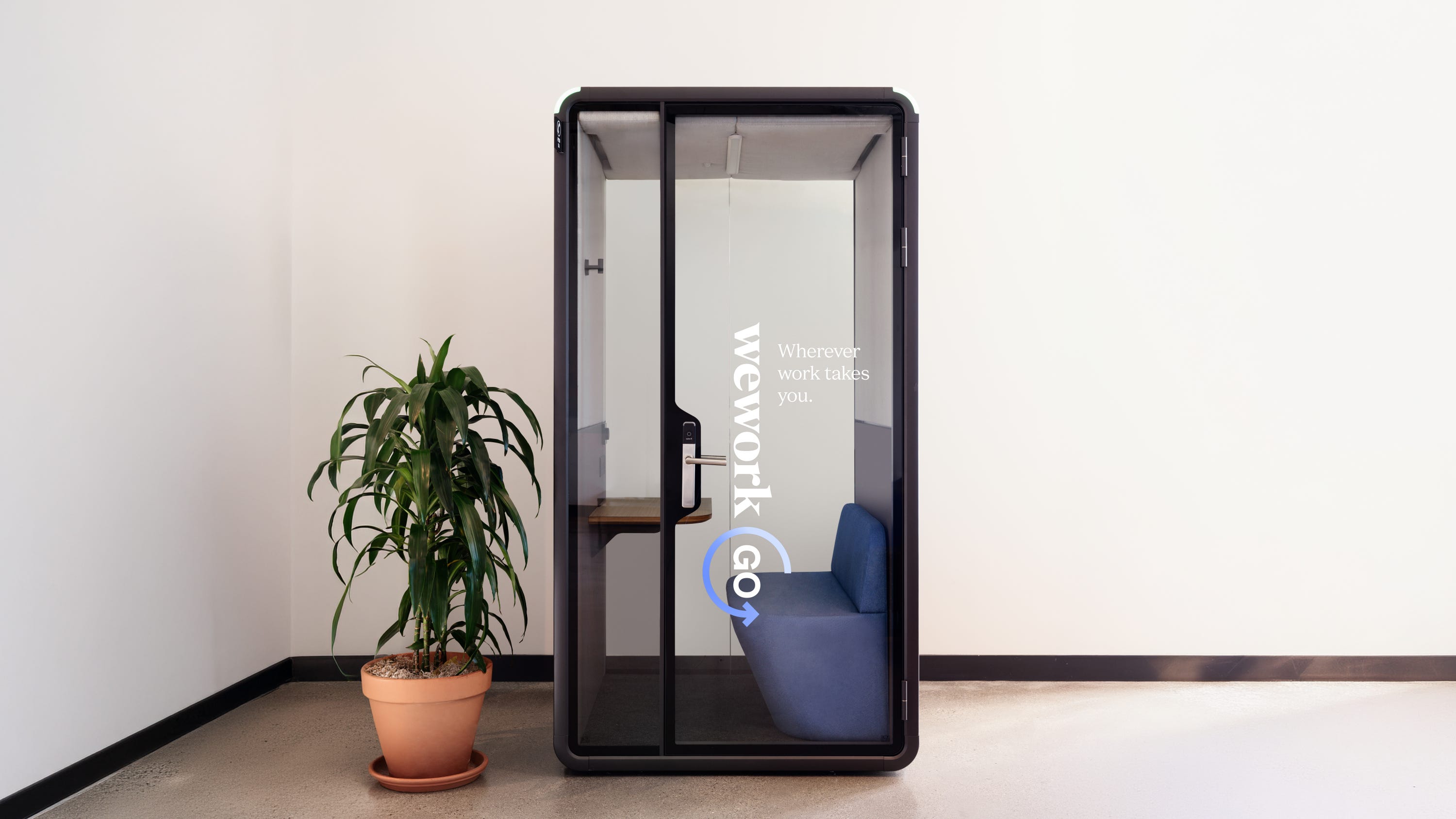
Their new product, WeWork Go, is essentially a network of compact, private office pods designed for places where concentration goes to die: airports, convention centres, large-scale events. The concept is simple enough to feel obvious in hindsight. You step in, close the door, and for a limited amount of time you reclaim something that has become surprisingly rare in modern work: control.
Inside, the promise is a curated version of the office experience shrunk down to its essentials. There’s sound insulation designed to keep the outside chaos out, lighting that won’t ruin your appearance on camera, a proper seat that doesn’t punish your spine, and reliable connectivity. In other words, it’s not trying to be inspiring. It’s trying to be functional in environments that are structurally hostile to focus.
The launch itself tells you a lot about the intended audience. The first public appearance is at the Semafor World Economy conference in Washington, D.C., a setting where everyone pretends to be present while simultaneously managing three parallel conversations across devices. From there, the plan is to expand into airports and other high-traffic nodes, the places where time is fragmented and work inevitably leaks into transit.
Now, to be clear, the idea of a private pod in a public space isn’t new. If you’ve travelled enough, you’ve probably seen (and ignored) similar solutions. Companies connected to IWG have already invested in pod-based systems like Jabbrrbox, placing them in major airports in the United States. The difference is not so much the object itself, but the positioning. WeWork isn’t just selling a booth. It is inserting itself into the micro-moments of your day, those small windows of time that used to be dead, unproductive, or simply yours.
And this is where things get more interesting.
For years, WeWork’s story was about space at scale: big, beautifully designed offices, community, flexibility, and a certain lifestyle aesthetic. After its very public reset and exit from bankruptcy in 2024, the company has been forced to rethink not just its finances, but its philosophy. WeWork Go is a signal that the new strategy is less about square footage and more about frequency of use. Instead of convincing you to rent a desk for a month, they’re inviting you to rent fifteen minutes of silence.
From a business perspective, it’s a sharp move. Smaller units, higher turnover, strategic placement in locations where demand is almost guaranteed. From a user perspective, especially if you live a semi-nomadic or hybrid life, it’s difficult not to see the appeal. You don’t need a full office when you’re travelling. You need a place to take one important call, to send one focused email, to regain composure between two chaotic environments.
But there’s also a subtle shift happening here, and it’s worth paying attention to it.
The traditional boundaries between work and movement have been eroding for years. Laptops got lighter, connectivity got faster, and suddenly work could follow you anywhere. What these pods represent is the next step: not just the possibility of working anywhere, but the expectation that you will. Waiting time is no longer neutral. It becomes an opportunity. A delay becomes a slot. A transit space becomes a workplace.
For digital nomads, this cuts both ways. On one hand, it removes friction. It makes life easier in those awkward in-between moments that used to require improvisation. On the other hand, it quietly eliminates one of the last excuses to disconnect. If there is always a quiet, optimised space available, then the decision not to work becomes more intentional, almost harder to justify.
And yet, despite all the philosophical implications, the reality is much simpler.
You will probably use it.
Because when you’re tired, slightly stressed, and stuck between two destinations, the idea of stepping into a clean, quiet, controlled environment for half an hour is incredibly attractive. It doesn’t feel like a corporate strategy. It feels like relief.
The real question is not whether WeWork Go will find its market. It almost certainly will. The real question is what kind of work culture it reinforces. One where flexibility empowers you, or one where flexibility slowly absorbs every corner of your time.
As always, the technology itself is neutral. The way we use it isn’t.