You’re Not a Nomad (And That’s Fine). But Let’s Stop Pretending Otherwise.
The Nomag Pulse #43
If we don’t learn how to name things properly, we’ll keep building the wrong systems for the wrong people - and calling it innovation
Highlights (read this before you pack your bags):
Not everyone working abroad is a digital nomad - and pretending otherwise creates real-world problems.
A digital nomad moves by design. An expat stays by consequence (or choice).
Remote work is not a lifestyle. It’s infrastructure.
“Smart working” is not digital nomadism - especially in the Italian context.
Mislabeling these categories leads to broken housing, wrong policies, and risky personal decisions.
Insurance is not a detail - it’s the first reality check of what kind of life you’re actually living.
Define the role correctly, and suddenly everything - from housing to healthcare -starts making sense.
There’s a quiet distortion happening in the way we talk about living and working across borders. It shows up in headlines, in policy papers, in LinkedIn posts that feel vaguely inspirational but strangely imprecise. Everyone seems to be a digital nomad now. Everyone is “remote.” Everyone is “relocating.” And in Italy (home to many of us at Nomag Media) , everyone is apparently doing smart working, which sounds sophisticated enough to pass as a strategy.
It isn’t.
What we are witnessing is not a single trend, but a cluster of very different behaviors that have been flattened into one convenient narrative. The result is not just linguistic confusion. It’s something far more consequential: cities planning for the wrong residents, services built for the wrong needs, and individuals navigating systems that don’t actually fit the lives they are living.
So let’s do something slightly unfashionable and bring back distinctions. Not because definitions are academic exercises, but because they shape reality in very practical ways.
Movement vs settlement: the line nobody wants to draw
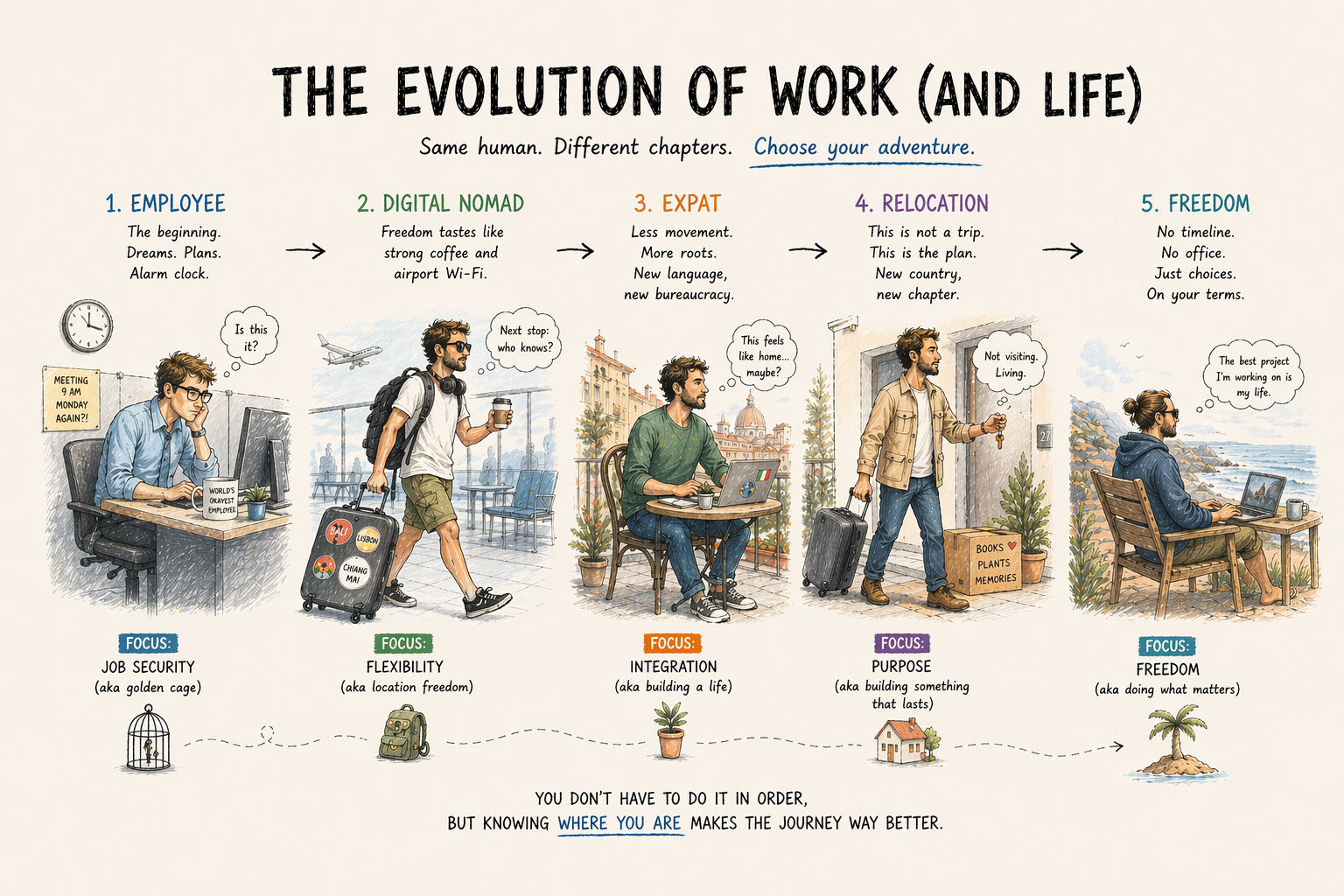
A digital nomad is not simply someone working from a laptop abroad. That’s the Instagram version, and it’s about as accurate as calling anyone with running shoes a marathoner. What defines a nomad is not the laptop, nor the destination, but the structure of their life. Movement is not an accident; it is the model. They design their existence around the ability to leave, to shift, to remain temporarily uncommitted to any single place.
That temporal dimension is everything. It influences how they choose housing, how they relate to local communities, how they organize work, even how they think about identity. A nomad doesn’t just live somewhere; they pass through it with intent - even when they linger.
Now compare that with someone who arrives in a country and, after an initial period of exploration, begins to stabilize. They sign a longer lease, learn how the local healthcare system works, open a bank account, perhaps start dealing with tax residency questions. At some point, whether they admit it or not, they stop optimizing for movement and start optimizing for continuity.
That person is no longer a digital nomad. They have crossed into expat territory, even if their income still comes from abroad and their original intention was “just to try it out.” The transition is often subtle, almost reluctant, but it changes everything. The expectations they place on a place - and the expectations that place should reasonably have of them - are no longer the same.
And then there is relocation, which strips away the ambiguity entirely. Relocation is not exploratory. It is a decision. It implies a before and an after, a shift from one system to another, usually accompanied by a degree of commitment that goes well beyond lifestyle experimentation. It might still be driven by cost, lifestyle, or opportunity, but the mindset is no longer “let’s see” - it’s “this is happening.”
Remote work, in all of this, is the least interesting category, despite being the one most frequently used. It is not an identity, nor a lifestyle. It is simply the condition that makes all the others possible. It tells you how someone performs their job, but it tells you almost nothing about how they live their life.
And then, inevitably, we arrive in Italy, where smart working has become a kind of semantic wildcard. In theory, it refers to flexible, results-oriented work. In practice, it often means working from somewhere other than the office, usually within the same country, occasionally from a second home, and very rarely with the kind of structural mobility that defines true cross-border living. It has its place - but that place is not this conversation.
(And yes, we occasionally zoom in on the Italian angle - because nearly 30% of our readers are based in Italy, and what happens there is often a preview of how quickly narratives can drift away from reality.)
Why getting this wrong becomes expensive very quickly
It would be easy to dismiss all of this as semantics, the kind of distinction that matters only to people who enjoy categorizing things.
Except it doesn’t stay in the realm of language. It leaks into decisions.
Take housing. A city that believes it is attracting digital nomads will tend to favor short-term accommodation, flexible leases, and high turnover platforms. It builds for transience. But if the people arriving are not actually transient - if they are, in effect, becoming long-term residents - then the system begins to distort. Prices rise, availability shrinks, and what was framed as a strategy to attract talent slowly turns into something else entirely.
Nomads need flexibility. Expats need stability. Confuse the two, and you break the market.
We’ve seen this pattern already. And it repeats with almost boring consistency.
The insurance question nobody asks - until it’s too late
This is where things stop being theoretical.
Because sooner or later, something goes wrong. A health issue, an accident, a gap in coverage that nobody thought to check because everything seemed to be working just fine.
And suddenly the question becomes very simple: what exactly are you, and who is responsible for you?
A digital nomad, by definition, exists across borders. They move through systems that do not fully recognize them, often without access to public healthcare, and without the safety net that comes from long-term integration. Assuming that a domestic insurance policy will somehow stretch across multiple countries is one of those comforting ideas that tends to collapse under pressure.
An expat, on the other hand, gradually plugs into the host country. They may gain access to national healthcare, they may be required to contribute locally, and their coverage begins to align with where they actually live. But that process is not immediate, and it is rarely seamless.
Then there is the remote employee abroad, who often assumes that their company has everything covered. Sometimes that’s true. Sometimes it’s partially true. And sometimes - quietly - it’s not true at all.
This is where reality hits hardest: coverage is not based on how you see yourself, but on how systems classify you.
And this is exactly why global, portable insurance solutions have moved from niche to necessary. Providers like Nomad Insurance by SafetyWing - supporting this newsletter, thanks guys! - exist because traditional systems are still built for a world where people live and work in the same country.
That world is gone.
If your life is mobile, your protection needs to be mobile too. Not as an afterthought, but as a foundation.
Because in the hierarchy of bad surprises, “I thought I was covered” ranks dangerously high.
Why this matters to us (and why we don’t pretend otherwise)
At Nomag, this isn’t a theoretical debate.
We care about these distinctions because we live inside them. We’ve seen how easily the narrative drifts away from reality, how quickly a flexible lifestyle becomes something more anchored, how often people underestimate the practical implications of their choices.
We’ve chosen to tell this story from the inside. Not the polished version, but the one where plans change, assumptions get tested, and the idea of “working from anywhere” meets the reality of actually doing it.
At the same time, we’ve made another choice.
We don’t try to be everything.
There are areas - tax, legal frameworks, regulatory complexity - where others go deeper, and where it makes sense to let those voices lead. Not because we lack opinions, but because clarity sometimes comes from knowing where your perspective ends.
What we do instead is connect the dots. We observe, we test, we partner with those building real solutions, and we try to make sense of a landscape that is evolving faster than the language used to describe it.
Because this isn’t just about telling better stories.
It’s about helping people make better decisions.
The part nobody puts in the headline
Yes, cost of living matters. It’s often the trigger.
But it’s rarely the full story.
What follows is a process of adaptation, of redefinition, of moving - sometimes consciously, sometimes by inertia - from one category to another. From nomad to expat. From temporary to permanent.
And that journey cannot be understood if we insist on calling everything by the same name.
Final thought (before we all book another one-way ticket)
Call yourself whatever you like.
But understand what you’re actually doing.
Because the systems you rely on - housing, healthcare, insurance, work, community - are not built on vibes. They are built on assumptions.
And if those assumptions are wrong, the consequences don’t arrive loudly.
They arrive all at once.