

Dear Forbes, Digital Nomadism Is Not a Stock Photo With Wi-Fi
And maybe, just maybe, next time ask a digital nomad to write about it, not 'Corporate America'

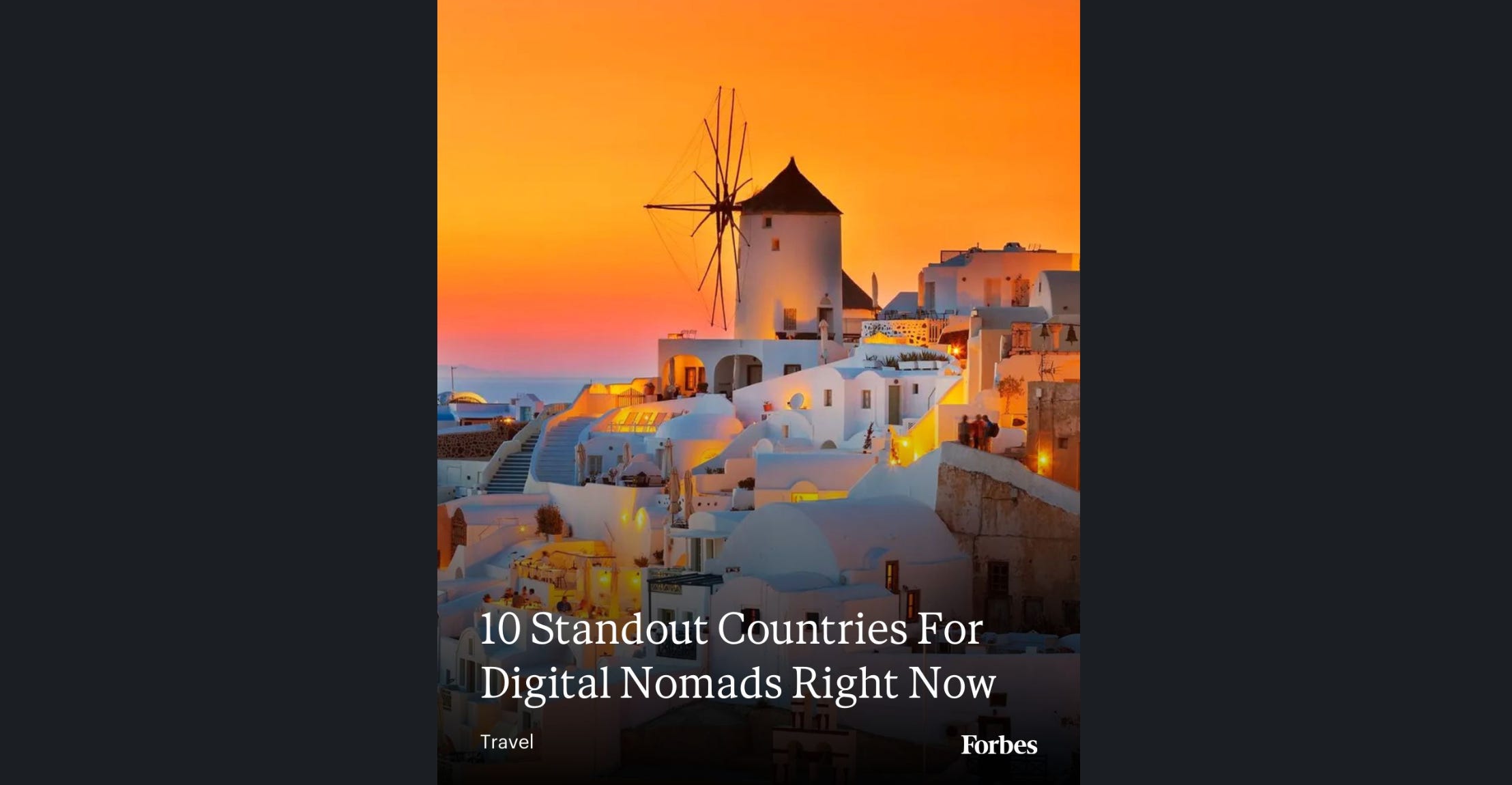
There is something oddly fascinating about the way mainstream media keeps trying to explain digital nomadism as if it were a slightly more sophisticated version of a holiday brochure (which is why is treated as a ‘travel feature’). Every few months, another big publication discovers that remote work exists, opens three rankings, sprinkles in a few phrases about “quality of life,” “safety,” and “Mediterranean lifestyle,” and suddenly we are presented with The Future of Work. This time it was Forbes, with an article titled 10 Standout Countries For Digital Nomads Right Now.
Now, to be fair, not everything in the piece is wrong. In fact, some of the countries mentioned absolutely deserve attention. Thailand is evolving quickly and far more intelligently than many European destinations are willing to admit. Estonia continues to understand digital infrastructure better than half the continent. Slovenia is genuinely underrated. Austria probably deserves more visibility than it gets. Even Switzerland, often dismissed as “too expensive,” becomes far more interesting once you stop imagining only Zurich bankers and start looking at cross-border ecosystems, secondary regions and places where quality of life intersects with actual livability rather than performative luxury. Dear Forbes, ever heard of the Mendrisiotto? We have. Wink wink.
The issue is not the list itself. The issue is the lens.
Because the article reads less like something written by people who have actually spent years navigating remote work across countries and more like the polished synthesis of reports, rankings and corporate “future of work” narratives packaged into lifestyle journalism. And that suspicion becomes stronger when you realize that a huge part of the statistical backbone comes from MBO Partners, a workforce consultancy whose business revolves around independent work, contractor ecosystems, compliance and distributed labor structures.
Again, there is nothing scandalous about that. Industry reports can be useful. But perhaps - just perhaps - readers should be reminded that this is not some neutral observatory of anthropologists studying digital nomads in the wild from a remote Alpine laboratory. This is a company with a direct commercial interest in the continued expansion and normalization of remote and location-independent work models.
And you can feel that framing throughout the article.
The modern “digital nomad,” as described in many of these reports, has quietly become an enormous umbrella category that now includes almost anybody who occasionally answers emails outside their home country. Remote employees spending two months abroad, freelancers, founders, hybrid workers, semi-mobile consultants, Americans escaping Miami rent for a season, corporate employees on temporary work-from-anywhere schemes - everybody ends up inside the same narrative container. The result is that digital nomadism increasingly gets presented not as a specific lifestyle with logistical, legal and psychological complexities, but as a kind of aspirational global mobility aesthetic.
That distinction matters because actual digital nomadism is not simply “living somewhere nice while keeping your American salary.” It is often a constant negotiation between visas, taxation, healthcare access, unstable rental markets, banking limitations, cultural integration, loneliness, bureaucracy and the simple question of whether a place can still function as a place once it becomes globally marketed as a lifestyle product.
And this is where Forbes falls into the same trap many publications keep falling into: confusing visibility with sustainability.
Portugal is the perfect example. Yes, it remains one of the strongest remote work ecosystems in Europe. Yes, Madeira was smart in positioning itself early. Yes, Lisbon and Porto built international visibility faster than most governments could even understand what was happening. But pretending Portugal is still some untouched paradise for nomads in 2026 requires a very selective memory. Housing pressure is real. Local frustration is real. Economic distortion is real. Entire neighborhoods have transformed at extraordinary speed because global purchasing power arrived faster than local systems could adapt.
Thailand, meanwhile, is treated almost casually in the Forbes article, when in reality the country is implementing one of the most strategically significant evolutions in the entire nomad ecosystem. The new Destination Thailand Visa (and its restrictions) is not just another gimmick designed for Instagram freelancers. It is a signal that some governments have finally understood that remote workers do not fit neatly into traditional immigration categories anymore.
Japan is another interesting case because it reveals the gap between fantasy and practicality. On paper, the country’s opening toward remote professionals sounds revolutionary. In practice, the framework remains selective, restrictive and geared toward relatively high-income profiles. Which is fine - but that nuance matters.
And then there is Italy, which international media still insists on misunderstanding in the most spectacularly repetitive ways possible. Italy is either portrayed as a romantic fantasy where everybody drinks wine in medieval villages while replying to Slack messages under olive trees, or as a bureaucratic disaster incapable of adapting to modern mobility. Usually both narratives appear within the same article, often written by someone who spent six days in Tuscany and now considers themselves an expert on Southern European demographic transformation.
Meanwhile, the genuinely interesting story is happening elsewhere. Smaller territories, secondary regions and cross-border ecosystems are slowly realizing that attracting globally mobile professionals is not about becoming the next Bali with focaccia. It is about building places where people can realistically stay, contribute, integrate and live without immediately becoming part of a speculative real-estate spiral.
That is why Switzerland deserves more nuance than “beautiful but expensive.” That is why smaller Italian territories may ultimately have more long-term potential than oversaturated hotspots. That is why the future of digital nomadism probably belongs less to postcard destinations and more to places capable of balancing infrastructure, healthcare, housing, accessibility and actual daily life.
And maybe that is the biggest problem with articles like this. They still describe digital nomadism primarily as consumption. As lifestyle. As scenery. As mobility theater.
But for many people, this is no longer tourism with a laptop.
It is migration.
It is economic geography.
It is demographic policy.
It is regional development.
It is urban pressure.
It is the restructuring of work itself.
Which is exactly why the conversation deserves something slightly more sophisticated than a few rankings, a consultancy report and a sunset photo used as visual shorthand for “freedom.”